

How My Children Made Me Finish My Dissertation
Lewis E. Thayne *98 recounts his journey from ‘ABD’ to Ph.D.
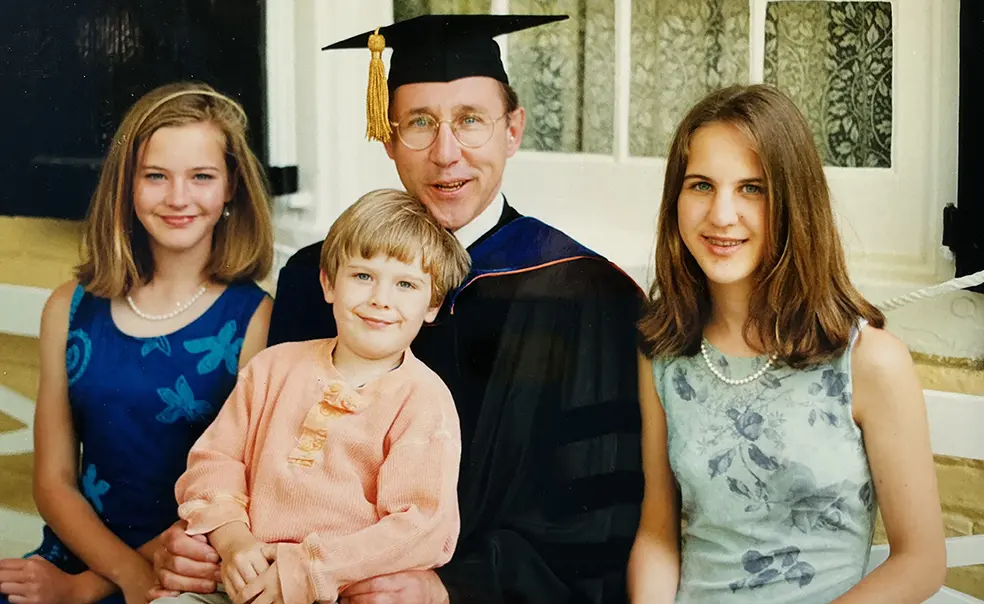

Lewis E. Thayne *98 is a retired college president. He and his wife, Dorothy, live in Lancaster, Pennsylvania.
I left Princeton in 1981 having finished an M.A., passed my written exams, and completed a dissertation prospectus on “Satire and the Descent to the Underworld.” My unofficial status was “all but dissertation,” known familiarly as ABD, letters that many graduate students in that era expected to place on their tombstones.
To get a sense of the ABD existence, consider that I carried with me annotated texts, research notes, and random, handwritten dissertation paragraphs as Dorry and I married, had three children, and moved from house to house. Dissertation materials went with my family on vacations, on visits with friends and grandparents, even to soccer games and tournaments.
“Dad’s dissertation” was a theme of my children’s youth — as in overhearing my school-age daughters say: “Annie, maybe we could go swimming first thing in the morning!” “No, Julia, remember? Dad has to work on his dissertation.” Groans of disappointment, slumping shoulders, and cynical acceptance followed.
I had no excuses. Dorry was unswerving in her support, even encouraging me in New York City to buy — with money we didn’t have — a primitive word processor. Eventually, thankfully, Microsoft developed Word. In 1993, I took an administrative job at Mount Holyoke College, where I found colleagues and faculty who supported my efforts to complete the dissertation. I now had the support of my wife, the technological innovations, and the supportive professional environment — but I still had to do the work.
One night at the dinner table, my daughters stood at my shoulders and announced in tones dripping with sarcasm, “Dad, you always tell us to finish everything we start. But you haven’t finished your dissertation.” Not finishing was now not a choice. Whether Princeton would accept it became irrelevant. I determined that I was going to do this for myself and for my family.
I started getting up early, as Dorry suggested years before. I worked in a more straightforward manner. Every day, movement forward. I adopted an exemplar, Erich Auerbach, who wrote his critical masterpiece, Mimesis, in Istanbul while fleeing the Nazis and with a limited library. His example was this: Do something great within the limits of your time, place, and abilities.
It took me three years.
In 1997, I called Princeton, the prodigal son. I had written four chapters and now dared to hope they might be accepted. The departmental assistant answered the phone, “Department of Comparative Literature. How may I help you?” Time and space disappeared. I recognized the voice immediately. “Carol?” I asked, less a question than a prayer. There was silence. Then, “Lewis?” I am telling you that a burst of golden light splashed from the phone and into the room. If I had been in the office, Carol Szymanski and I would have embraced in tears of joy after 16 years.
I shared with her what I had been doing and hoping. She listened. After a few questions back and forth, Carol said, “Professor Fagles is no longer chair of the department, but I suggest I talk to him before I speak with Ralph Freedman, who is now our graduate director.”
I felt the presence of guardian figures — of Carol, of Bob Fagles and Ralph Freedman, and then others. As requested, I sent the chapters. I visited campus and spoke with Fagles and Freedman, beloved teachers and mentors. Then Carol called to schedule interviews with prospective committee members — Fagles, Alban Forcione ’60 *68, Bob Hollander ’55, Earl Miner, and Eileen Reeves. Professor Fagles met with me in the fall of 1997. “Lewis, I made comments on your dissertation,” he said, “but it will be up to Earl Miner to determine whether it can be approved. I assure you that the department will support you if Earl signs on.”
Professor Miner was my next meeting in McCosh 1. Like an archbishop, he sat behind his desk in a hard-shell body cast as the result of a bicycle accident. I gave a brief, sincere answer to his question about what I was doing with my life at this point, to which he listened. He then looked me squarely in the face: “Well, Lewis. I have read your dissertation carefully. After so much time — and seemingly out of a clear, blue sky — you have written a dissertation that has very few problems … and no major problems.” He paused to see if I would say something. I could not think, let alone speak. “There is work still to be done,” he said, “but I will recommend that we support your candidacy and proceed to forming a committee.” Even now as I write this, I can experience the dizzying, overwhelming sense of gratitude and completion I felt in that moment.
Dorry and our children were with me for Commencement in June 1998, 17 years after leaving ABD. At the Hooding Ceremony in Alexander Hall, John Wilson, dean of the Graduate School, advised us, “The hood is a symbol of your hard work, of our faith in your future contributions to your respective disciplines and to humanity. It is the insignia of a great university. Wear it lightly but know its value.”
The Latest
See all


Related News
These Young Alumni Balance Tech Careers and Musical Ambitions
‘...I realized that I probably wanted to live a life where I had the opportunity to pursue what I felt like was my purpose,’ says Naaji Hylton ’22

AI and the End of the World
As warnings about artificial intelligence grow louder, four Princeton experts debate how worried we should be
No responses yet