

How One Lonely Man Made Thousands of New Friends
Paul Harris 1890 founded the Rotary Club, transforming a simple idea into a worldwide movement devoted to service
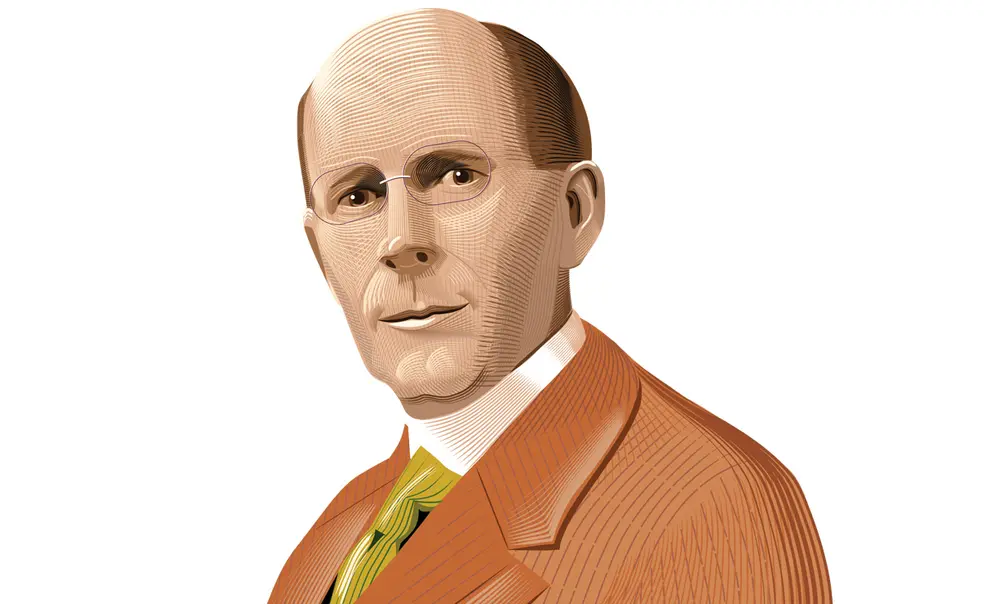

The year was 1900, and Paul Harris 1890 was desolately lonely. He had moved to Chicago four years earlier to start a law firm, but he had never gotten the hang of living in a city. The pleasant anonymity that city writers talk about, the ever-changing landscape of faces, the air of mystery that comes with being surrounded by great but unknown undertakings: None of this mattered to the boy from Vermont. Instead he found himself — especially on weekends when the office was empty — brooding, with the intensity that once made people designate nostalgia as a medical illness, over the friendly sights of his youth.
“Strolls through city parks were far from satisfying,” he wrote in his memoir, My Road to Rotary. “There was too much artificiality, and among the thousands of strollers there was not one familiar face.”
One day, after dining at the home of a professional colleague, Harris took a walk with his host and watched him chat familiarly with the men working at the neighborhood shops — which finally made him feel again like he was in a village.
“The thought came to me,” he wrote, “why not in big Chicago have a fellowship composed of just one man from each of many occupations, without restrictions as to their politics or religion, with broad tolerance of each other’s opinions? In such a fellowship could there not be mutual helpfulness?”
So he made it happen. In 1905, he started up exactly such an outfit with a few law clients; because they met at different workplaces on a rotating basis, he called it the Rotary Club. Today, the organization has more than 1.2 million members and clubs in just about every country.
What’s Princetonian about Rotary? Harris attended the College of New Jersey for only a single year, leaving after his grandfather died. But the College counted such students among its alumni, and seeds planted in paradise will naturally take strong roots. Princetonians’ and Rotarians’ common affinities include, for instance: an emphasis on leadership and social responsibility; a belief in open discourse among people of different backgrounds and cultures; the Presbyterian conviction that divinity can be found in committee meetings (though Harris didn’t belong to any particular denomination); and commitment to the democratic internationalism that was popular in America at the time, of which Harris advocated for an unusually strong version.
“Rotary is blazing the trail over which the present and future generations will follow,” he said at a 1937 Rotary International convention. “I predict that the day will dawn when the coming and going of human beings will be as free as the movements of migratory birds. Eventually passports, visas, customs duties, and all other impediments to free intercourse among the children of the Earth will be abandoned as obsolete.”
But above all, Princetonians and Rotarians share a commitment to service. From early on, Rotary clubs started raising funds, labor, and political pressure for service projects like building parks and schools. In 1911, Rotary approved the motto, “He profits most who serves best.” Which, as far as ethics for businessmen go, is pretty good, and probably true. Harris started his venture because he wanted friends. By the time of his death at the age of 78, he had 300,000 of them. More, he profited, as someone involved in humanity, from the humanitarian work that Rotary carried out, in ever more ambitious waves, over the years: feeding the hungry during the Depression, helping refugees in wartime, and, after his death, helping to conquer polio by vaccinating millions of children. He believed that one can do well by doing good.
The Latest
See all


Related News


These Young Alumni Balance Tech Careers and Musical Ambitions
‘...I realized that I probably wanted to live a life where I had the opportunity to pursue what I felt like was my purpose,’ says Naaji Hylton ’22

AI and the End of the World
As warnings about artificial intelligence grow louder, four Princeton experts debate how worried we should be

No responses yet