

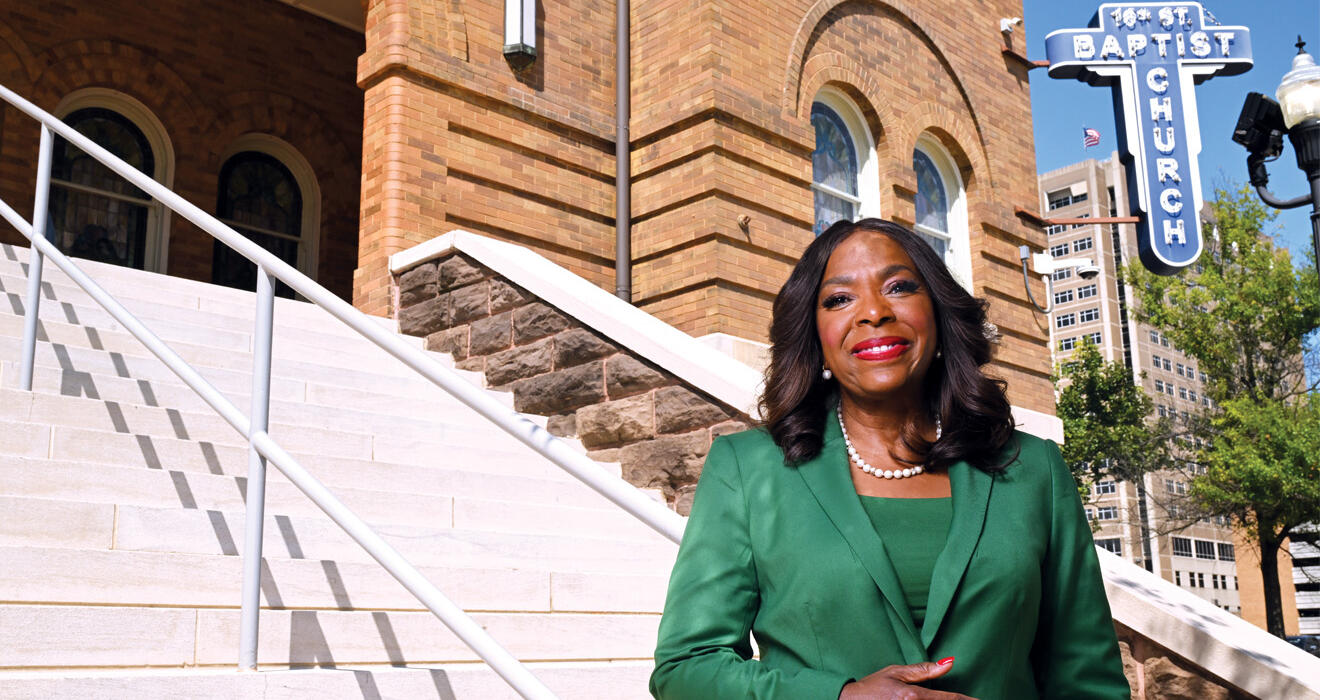
History Is in Terri Sewell ’86’s Hands
The congresswoman brings lessons from Selma, Alabama, to today’s voting-rights fight

Terri Sewell ’86, the congresswoman from Alabama’s 7th District, was grinding out the work of today’s politics: recording short videos for her social media accounts.
Although the calendar said late September, Alabama’s summer hadn’t yet released its sweltering grip as the Democrat angled her cellphone under the trees of Kelly Ingram Park and vented her outrage over President Donald Trump’s latest healthcare cuts.
“The one thing President Trump loves more than starting unnecessary wars is kicking Americans off their healthcare,” Sewell said, starting a one-minute blast.
The video itself was unremarkable. But the place where it was recorded is one of the Civil Rights Movement’s holiest shrines. What happened in the downtown Birmingham park helped create the path for Sewell to be elected to Congress. The voting rights struggles of the 1960s may seem like history, memorialized in the park’s statues, but that battle for Black political power has come roaring back.
In April, the U.S. Supreme Court dramatically constricted Section 2 of the Voting Rights Act, the provision most successfully used to challenge racially discriminatory election maps. The ruling didn’t overturn the law but upended decades of precedent, making it much harder for minority voters to challenge maps that dilute their political power.
That decision could have severe consequences over time, experts say. It could lead to the erosion of minority representation not only in Congress and state legislatures, but in local governments. And in Alabama, like in other Deep South states where changes are already happening, Republicans could choose to erase the majority-Black district stretching from Birmingham to Sewell’s hometown of Selma. For her, the stakes are personal and political. She is leading the congressional effort to restore the Voting Rights Act’s protections, just as generations before her fought to create them.
“If you had told me that I would be carrying a bill to restore the full protections of the Voting Rights Act of 1965, I would have said, ‘No way,’” Sewell says. “But here we are. I guess it goes to show you that progress is elusive and that every generation has to fight to hold on to the progress that we’ve made and to try to advance it lest we lose it.”
Kelly Ingram park is where, during one week in May 1963, Black children and adults faced police dogs and high-pressure water hoses deployed by Birmingham authorities trying to hold the line on racial segregation. Images of the brutal tactics led white leaders in Birmingham to buckle and agree to desegregate restaurants, stores, and other public facilities. A month later, President John F. Kennedy pledged his support for what became the Civil Rights Act of 1964.
Those victories came at a cost. In September 1963, four Klansmen bombed the 16th Street Baptist Church, killing four young girls. The church, on the northwest corner of the park, had been the launching point for the demonstrations.
The spotlight later swung to Selma, where the beating of John Lewis and other protesters on Bloody Sunday in March 1965 contributed to the passage of the Voting Rights Act later that year.
Sewell, born in 1965, is too young to remember any of this. But civil rights history is omnipresent in Selma, where routine errands take drivers under the steel arch of the Edmund Pettus Bridge, site of the Bloody Sunday beatings. Sewell’s childhood church was the starting point of the Bloody Sunday march and hosts annual commemorations.
“The fight for voting rights is in my blood, if you will,” Sewell says. Democrats have tapped her to sponsor a bill to bolster the Voting Rights Act in every Congress since 2015, though none has become law, even when Democrats were narrowly in charge of the Senate earlier this decade.
Sewell has lived the promise of the Civil Rights Movement: She was the first Black valedictorian of Selma High School; the first Selma High graduate to enroll in an Ivy League school; a Harvard Law School graduate; the first Black partner at her prominent Birmingham law firm; and the first Black woman elected to Congress from Alabama, in 2010.
As Sewell climbed, the achievements of the Civil Rights Movement seemed set in concrete across the South. Racial injustice persisted, but Black representation in state legislatures, city councils, and school boards became increasingly common.
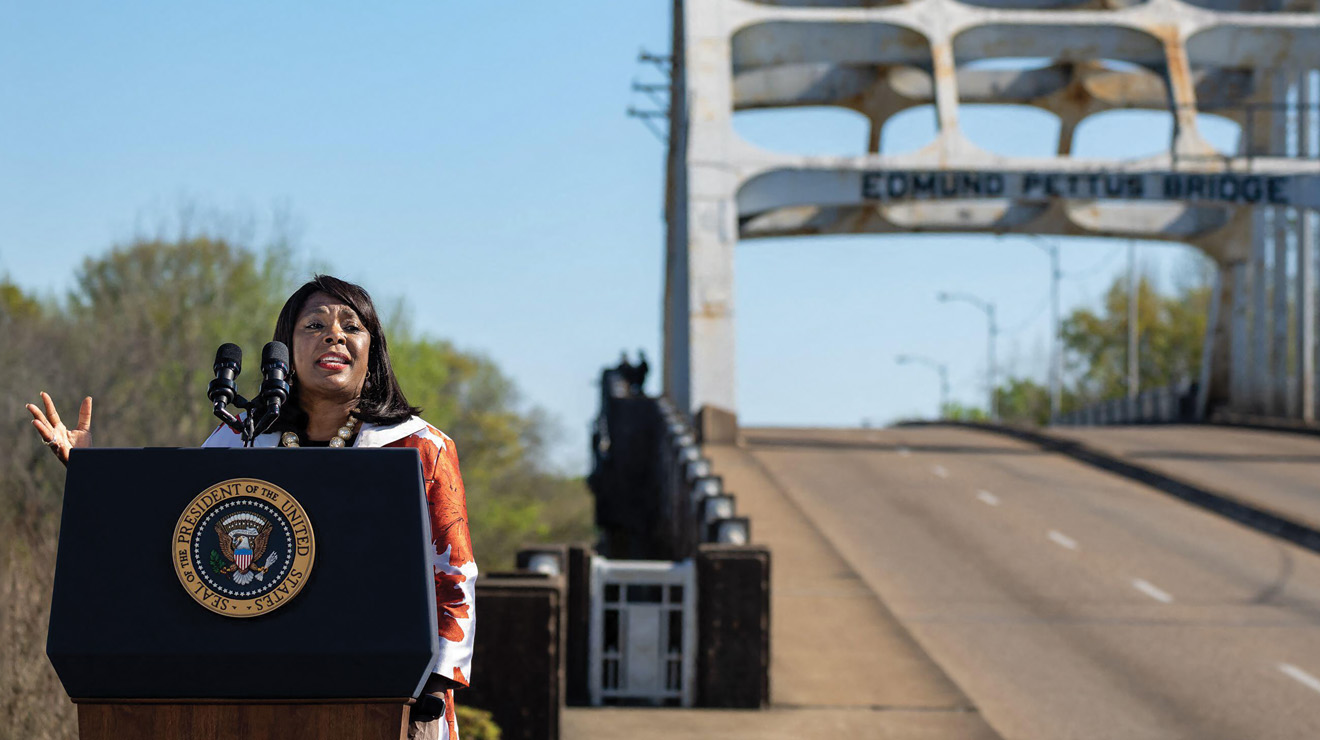
In 2002, historian J. Mills Thornton III ’66 wrote Dividing Lines, a history of how local politics affected the Civil Rights Movement in Birmingham, Montgomery, and Selma. A professor emeritus at the University of Michigan who has retired to his hometown of Montgomery, Thornton likens the April decision to an 1883 Supreme Court ruling that overturned the Civil Rights Act of 1875, setting the stage for southern states to disenfranchise Black voters after the end of Reconstruction.
“This really is the judicial reversal of the achievements of the Voting Rights Act, and I think it’s going to lead us into a similarly dark period,” Thornton says.
The 6-3 opinion written by Justice Samuel Alito ’72 in Louisiana v. Callais, a challenge to the creation of a second Black-majority congressional district in Louisiana, significantly narrowed Section 2, which for decades has been used to challenge voting practices that dilute minority voting power and, in some cases, to require the creation of majority-minority districts.
In places where there were enough Black, Hispanic, or Native American voters and where lawyers could prove white voters routinely voted against minority candidates, lawsuits could often force the drawing of new districts that gave minority voters a chance to elect their preferred candidates. In Alabama, for example, Sewell’s majority-Black district was created after a lawsuit following the 1990 census.
Over time, litigation brought Black representatives not only to Congress but to city councils, county commissions, and school boards, says Kareem Crayton, a vice president of the Brennan Center for Justice, a voting rights and social justice think tank based at New York University School of Law. That representation spurred local governments to pave roads, extend water lines, and pick up garbage in minority neighborhoods.
“The lion’s share of the impact of Section 2 has been at the local level,” Crayton says.
The court’s ruling also reflected a long-running argument from opponents of race-conscious redistricting: that majority-minority districts improperly use race to shape electoral boundaries, and that the government should be colorblind rather than counter the discriminatory effects of other redistricting practices. Those arguments have gained ground in a Supreme Court that in 2023 struck down race-conscious affirmative action in college admissions.
“There’s not been an economic development in our state that I wasn’t at the table convincing folks that Alabama had changed. Was I wrong in saying that Alabama had changed?”
Terri Sewell ’86
Alito said any Section 2 challenge must preserve a state’s other objectives in drawing a map, including partisan gerrymandering, writing that “litigants cannot circumvent that rule by dressing their political-gerrymandering claims in racial garb.”
Michael Dimino Sr., a professor at Widener University Commonwealth Law School in Pennsylvania, says he sees the court overruling an incorrect interpretation of the law that had been in effect for 40 years. He says that as long as Black people can register and vote, join a political party, and nominate candidates, the Voting Rights Act shouldn’t require the states to draw districts that guarantee victory to their candidates.
He also says that he believes most gerrymandering is done for partisan purposes, and that if such line-drawing is going to be legal in Democratic-controlled states, it should also be legal in Republican-controlled states, even if those states have large minority populations.
“It allows Republican-controlled states in the South to do what Democratically controlled states elsewhere have been able to do forever,” Dimino says.
Related coverage
Local Politicians Are Thinking Twice About Serving
A Princeton study finds widespread hostility toward local officials in what one mayor calls “the age of rage”
But Justice Elena Kagan ’81, writing for the dissenting three-member bloc that included Justice Sonia Sotomayor ’76, said the court was wrong to give partisan considerations such weight.
“Today, though, the majority straight-facedly holds that the Voting Rights Act must be brought low to make the world safe for partisan gerrymanders,” Kagan wrote. “For how else, the majority reasons, can we preserve the authority of States to engage in this practice than by stripping minority citizens of their rights to an equal political process?”
Black voters in the South overwhelmingly support Democrats, while white voters overwhelmingly support Republicans. For example, in 2020, a survey of Alabama voters by The Associated Press found that 78% of white voters supported Trump, a Republican, and 91% of Black voters supported President Joe Biden, a Democrat. Because of that split, Crayton and other voting-rights advocates warn that the decision could make it easier for Republican-controlled legislatures to eliminate Black-majority districts in pursuit of partisan gains.
“We’re going back to a day when you have no representation in Congress for African Americans except in super-Democratic states,” Sewell warns.
Fair Fight Action and the Black Voters Matter Fund estimated in 2025 that as many as 19 seats with Voting Rights Act protections for Black or Hispanic voters could be wiped away in the South and Midwest in the 2026 election.
Even before the decision, North Carolina lawmakers redrew a rural district, making it less Black and less Democratic, in a move that could boost Republicans to an 11-3 edge in the state’s congressional delegation. On the very afternoon of the Supreme Court decision, Florida lawmakers voted for a map that sought a 24-4 Republican advantage, with Gov. Ron DeSantis arguing Florida was obligated to wipe out a previously drawn Black-majority district because it was a racial gerrymander.
Weeks later, Tennessee’s Republican lawmakers split a Black-majority Memphis congressional district into three, with the stated goal of creating a 9-0 Republican U.S. House delegation for the state.
In June, the Supreme Court allowed an Alabama congressional map that it had struck down in 2023 to take effect despite a lower-court finding after the Louisiana decision that the map showed intentional discrimination. The state-backed map made it unlikely that Rep. Shomari Figures, Alabama’s second Black member of Congress who was elected in 2024 following a
Section 2 lawsuit that created his district, would be able to hold his seat in November.
And there may be more redistricting on the way before 2028. Republicans in Mississippi and South Carolina have discussed eliminating their states’ only majority-Black congressional districts, and lawmakers in Georgia could reduce the number of Black Democrats in Georgia’s congressional delegation from the current five. While the new Alabama map makes Sewell’s district a little less Black, a more radical redraw could create an Alabama congressional delegation that’s 7-0 Republican.
“My job in this office was to put the legislature in the best possible legal position to draw a congressional map that favors Republicans 7-0,” Alabama Attorney General Steve Marshall said in a May 11 video, adding that “we have fought for years against courts forcing Alabama to sort its citizens by race, and we were right to fight.”
“There’s no reason why the state can’t go back and totally change my district, too,” Sewell says. “If you had told me
that would happen, I wouldn’t have believed it. It suggests to me everything’s on the table when people are considering political power.”
Sewell was the sole member of Alabama’s congressional delegation to vote for the infrastructure law passed under President Biden and is still aggressively lobbying Alabama officials to make sure more of that money gets used in her district. She helped bring federal money to install modern septic systems in impoverished areas where waste had been dumped without treatment for decades. She was a key force behind a law passed earlier this year that requires Medicare to pay for a blood test that can screen for cancer. The law was named after her mother, who died from pancreatic cancer in 2021. She says she has also worked with Republicans on initiatives such as relocating the U.S. Space Command to Huntsville and recruiting a new factory to her district.
“There’s not been an economic development in our state that I wasn’t at the table convincing folks that Alabama had changed,” Sewell says of the state’s racial climate. “Was I wrong in saying that Alabama had changed?”
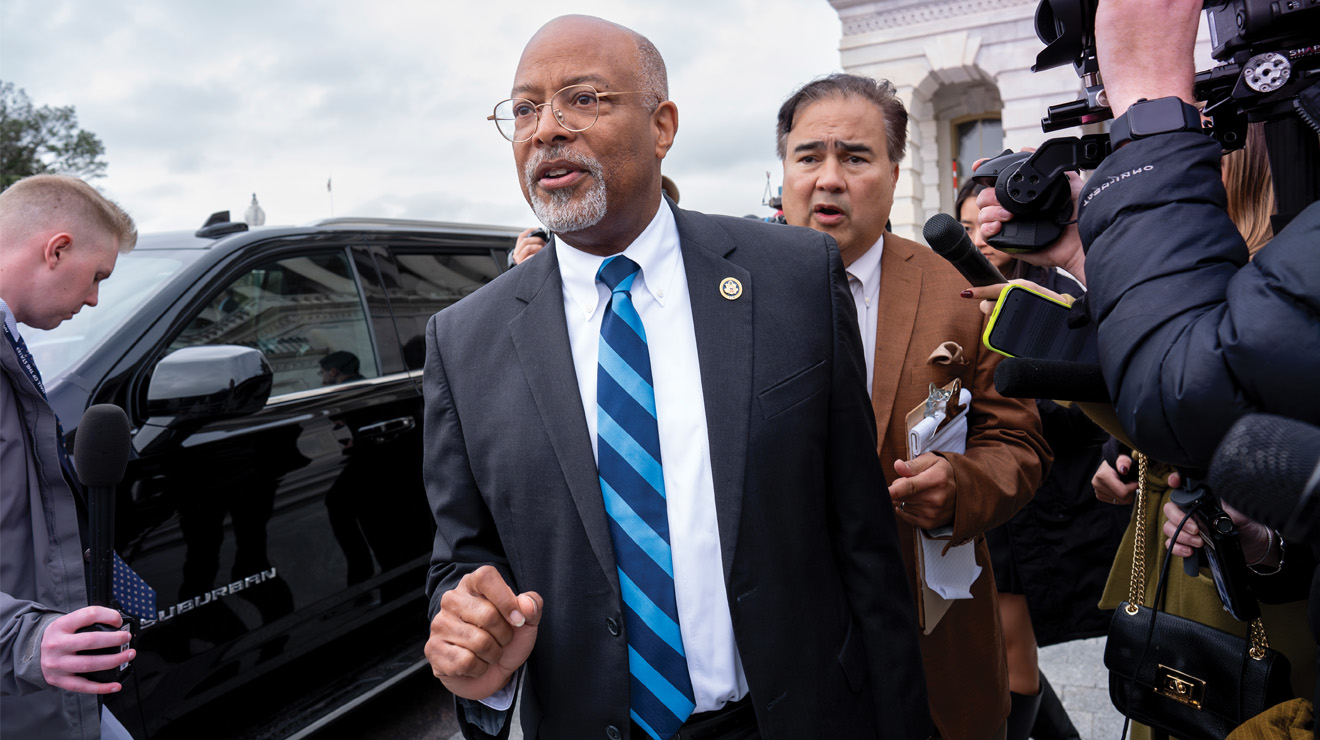
The outlook is substantially brighter for the other Black Princetonian in Congress. Glenn Ivey ’83 represents a majority-Black district, but he serves in the heavily Democratic state of Maryland.
Maryland’s 4th District covers much of Prince George’s County in suburban Washington, D.C., as well as a slice of neighboring Montgomery County. It was first drawn as a Black-majority district following the 1990 census and is the most Democratic seat in Maryland.
“So it started off as a [Voting Rights Act] district,” Ivey says. “It’s kind of grown beyond that.” The congressman adds that in heavily Democratic areas, Black candidates can win in districts that don’t have a heavily Black voting presence. But in the Deep South, Ivey says that’s not the case.
Ivey says the most important impact of the Voting Rights Act for Maryland voters may be in determining who’s in the majority in the House. Secure in his own seat, he spent part of the runup to this November’s election in his hometown of Rocky Mount, North Carolina, trying to help Rep. Don Davis retain the congressional seat that Republicans redrew to make more favorable to their party.
Ivey says the Supreme Court’s decision could also energize Black voters, particularly in the South. Turnout was high for Democrats in primary elections in Alabama, South Carolina, and Louisiana following the decision. If that enthusiasm carries into this month’s election, Davis, or even more imperiled Democrats like Shomari Figures or some Florida Democrats, could benefit.
“Shomari could win that seat,” Ivey says. “Don Davis in North Carolina could win again anyway.”
But Maryland illustrates another consequence of the redistricting fight. The question there is whether Democrats should redraw that state’s congressional map to shift from a 7-1 Democratic advantage to 8-0. Ivey, who once worked for former U.S. Attorney General Eric Holder and supported Holder’s efforts to limit gerrymandering, now supports such a move, saying, “You have to really fight fire with fire.” He argues that Trump and Republicans are trying to concentrate power in Washington and that Democrats need a message that resonates across the country.
“I think you have to meet that national effort with a national response, and that’s what this is,” Ivey says.
Sewell says the ongoing push to maximize partisan advantage through redistricting is a “race to the bottom.”
The question for Sewell is how to respond. Some experts have called for big changes in how officials are elected, such as creating voting districts that elect multiple representatives or moving toward forms of proportional representation. For now, Sewell is focused on restoring protections under the Voting Rights Act. If Democrats control both the House and the Senate in January, there’s likely to be a renewed push for senators to change filibuster rules requiring 60 votes for most legislation, potentially clearing a path for voting-rights legislation.
Sewell says that the next version of her bill will seek an outright ban on partisan gerrymandering, as well as restoration of requirements that jurisdictions with a history of discrimination get federal “preclearance” before making changes to voting districts or voting procedures, a requirement of the Voting Rights Act that the Supreme Court struck down in a 2013 Alabama case.
“I look forward to Democrats taking back the House and me reintroducing that bill with the tweaks that have to be made to make the Callais case go away,” Sewell says. “Because it won’t be the law of the land. The law of the land will be a congressional bill.”
But Trump is unlikely to sign any such law while he remains in office.
“I don’t think there’s a legal or a legislative response that’s going to be coming in the short run,” Ivey says.
Over the longer term, it’s unclear, given that Alito’s opinion ruled that the previous interpretation of the law violated the 15th Amendment, whether a revised Voting Rights Act could survive another Supreme Court challenge as an unconstitutional race-conscious remedy.
But the court hasn’t banned Congress from passing laws to enforce the 15th Amendment, and a law that also bans partisan gerrymandering, Crayton says, would force the court to revisit its current decision, which “essentially privileges partisanship” by clearing the way for more gerrymandering.
“What the justices choose to do in response to that move, we’ll have to see,” Crayton says. “But it’s an important question that is absolutely worth finding out the answer to.”
Sewell, drawing on the determination she learned in Selma, is not giving up. She says she’s confident Congress can restore and modernize the Voting Rights Act in a way that withstands judicial scrutiny and protects fair representation.
“It is up to our generation,” she says. “It’s up to us to push back on it.”
Jeff Amy ’95 is a writer in Atlanta who has covered politics in Alabama, Mississippi, and Georgia.
Related News
Dung Beetles Do ‘the Job That Is Necessary’
Princeton researcher Finote Gijsman *25 studies crucial links between the insects and elephants in a new paper

No responses yet