
New Sounds at Old Nassau
How Rudresh Mahanthappa reshaped Princeton’s jazz program amid an Ivy League surge

For reasons better explained by a meticulous American studies thesis, the Ivy League has not historically been a hotspot for jazz music. Part of this is logistical: None of the Ivies offers enough courses to earn a conservatory-style bachelor of music degree. (Yale does haves a loophole involving graduate school.) Another aspect is cultural. Jazz is traditionally a late-night, city-centric art form, more often learned on the bandstand than in the liberal arts classroom.
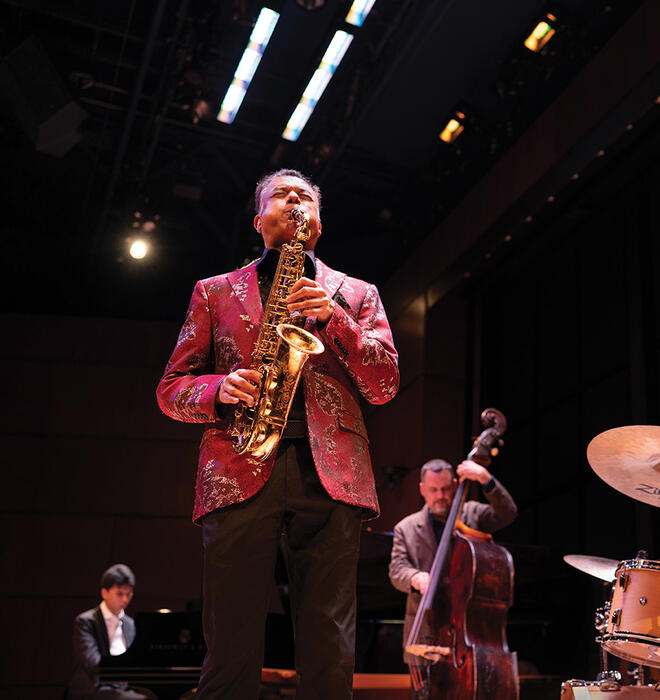
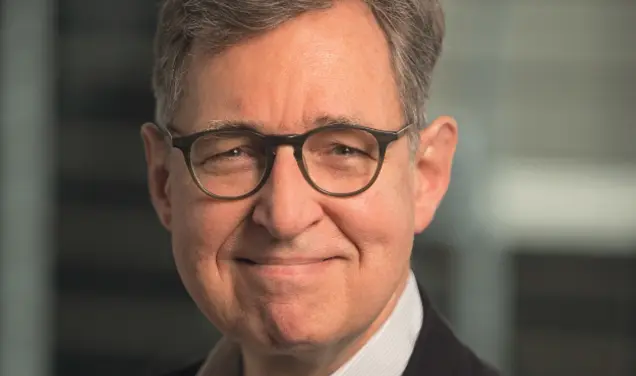
More recently, this paradigm has begun to shift. This spring marks 10 years since Princeton announced that its jazz program would be led by saxophonist Rudresh Mahanthappa, not just a known quantity in the jazz world but one of the genre’s major contemporary players. A touring maestro coming off multiple first-place finishes in the prestigious DownBeat Critics Poll, Mahanthappa had been quietly exploring job listings around his New Jersey home in 2016, looking for stability as he settled into fatherhood.
“I have a family full of academics,” says Mahanthappa. “But my hesitation [with teaching] didn’t have to do with that. There’s this phenomenon where people enter academia and disappear.”
Large research institutions should exhort new hires to continued excellence in their fields. In jazz, this means improvising before live audiences. Princeton assured Mahanthappa that he would be able to maintain a strong touring schedule. “They encourage us to do what we do,” he says. But even as the saxophonist continued his rounds of international jazz festivals and clubs, he began to oversee a radical transformation back in New Jersey.
Mahanthappa grew up in Boulder, Colorado, and later studied at the Berklee College of Music and DePaul University, breaking out in New York City both as a solo artist and as a sideman for the pianist Vijay Iyer. He took over the Princeton program from longtime head Anthony Branker ’80, an accomplished composer who held the reins for 27 years. Mahanthappa, a seasoned musician but a newcomer to academia, found that he had to earn the trust of both existing staff and upperclassmen after getting the job. This was no easy task. But you don’t win fistfuls of awards without a bit of pluck.
“I went in there and saw a program that seemed like it needed a boost in a couple different ways,” says Mahanthappa. “I wanted to make sure everyone teaching was out there playing. I wanted people in the program that students could get excited about, that they could go see play in a club in New York or Philadelphia. I didn’t feel like that was necessarily the case.”
In a program without much footing in the national jazz ecosystem, this was an extraordinary first step. Mahanthappa knew that if he wanted to keep touring, he’d need to quickly onboard new teachers or be buried by the procedural workload. His first significant hire was Grammy-nominated jazz composer Darcy James Argue, a Guggenheim fellow (like Mahanthappa) who took over the school’s large ensemble. Bassist Matthew Parrish, who’s toured with jazz stalwarts such as Stefon Harris and Orrin Evans, followed soon after. In the coming years, trumpeter Ted Chubb, guitarist Miles Okazaki, and pianists Elio Villafranca and Sumi Tonooka — all of them active, dynamic performers — were added to the roster.
These notable moves also contributed to an ongoing jazz arms race among Ivy League schools. Harvard instigated things in the winter of 2014 by bringing on Mahanthappa’s old bandmate Iyer, a Ph.D. and fellow DownBeat champion, as the Franklin D. and Florence Rosenblatt Professor of the Arts. As Harvard professor Ingrid Monson told The New Yorker in 2016, “It’s always been my dream that we have a prominent jazz artist on the faculty.”
Other Ivy League schools either felt similarly or were pressured to react. “Seldom, if ever,” wrote DownBeat in 2016, “have so many poll-topping bandleaders stepped offstage and into the classroom in such a short time.” Harvard followed the Iyer hire with an even more impressive one, that of bassist Esperanza Spalding, in 2017. (She left in 2022, citing ideological differences.) Yale hired Grammy-nominated saxophonist Wayne Escoffery a few months after Mahanthappa got the nod. Across the country, Stanford has lately outdone all of its East Coast counterparts by adding venerable composers and instrumentalists Joshua Redman and Ambrose Akinmusire to its faculty.
Saxophonist Matthew Clayton, a lecturer in jazz history at Princeton, spent three decades hopping around the Ivy League — Yale, then Harvard, then Penn — before winding up at Princeton in 2018. “Part of the surge of jazz interest in Ivy League schools,” he says, “is in line with how the music has become more institutionalized over the last 40 years.”
He cited his own career as a case study. After receiving acceptances to Columbia, Yale, and Harvard in 1998, Clayton called Juilliard, who offered a joint music program with Columbia, to express his interest in auditioning on the saxophone. Juilliard balked. “They said, ‘If you play sax, you can’t come here. We only have the clarinet and flute.’”
Three years later, trumpeter Wynton Marsalis founded the jazz studies program at Juilliard, signaling a sea change at the highest levels of American education. But Clayton was already in New Haven. “Jazz has been embraced by elite institutions now,” he says. “Ivy League schools have definitely caught wind of that.”
It goes without saying that Ivy League musicians, by dint of their acceptance letters, are terrific students. But the pathway to professional jazz playing, which often involves at least one prolonged stint in New York City, is rooted not just in raw intelligence but in accumulated practice, thousands upon thousands of hours with an instrument in (or under) your hand. This type of drive, more of an obsession, doesn’t always line up with classic GPA-style metrics.
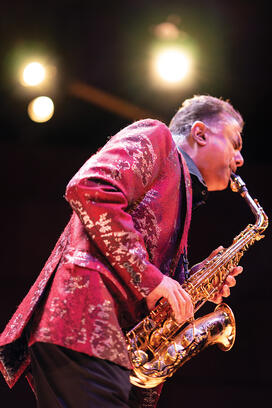
Musical applicants can submit an “arts supplement,” 10 to 15 minutes of recorded music, when they apply to Princeton. Mahanthappa and his staff rank these incoming samples each year and make recommendations. “But we don’t quite know how much weight that carries,” Mahanthappa says. “I imagine it’s not quite the same as being the next power forward for the basketball team.”
As he packed his bags for the Princeton gig — metaphorically; he didn’t actually have to move — Mahanthappa was candid about who would and would not be attending the program. “It’s an interesting situation because the University doesn’t offer a jazz studies degree,” he told DownBeat at the time of his hire. “I’m not going to kid myself that my students are going to practice 10 hours a day. These are people who are going to be running the world someday. I mean, it’s Princeton, right?”
Asked about that quote today, Mahanthappa says that his opinion hasn’t changed. “I still think these folks are going to be running the world,” he said. “But these skills that they take from improvising, and from playing music in a group, I’d like to think that these are applicable in whatever it is that they pursue.”
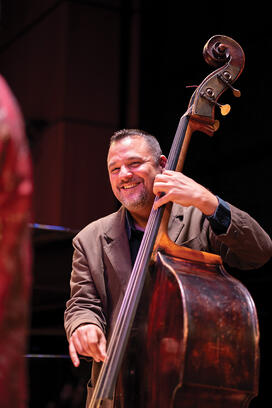
On the brass tacks level of playing an instrument, Mahanthappa will push his pupils as far as they’re willing to be pushed. He’s been surprised by how musically invested some of his students are, even while they’re studying other majors. “There are students where I’m a little bit concerned,” Mahanthappa says, chuckling. “Like, ‘you do major in something else, right? You’re spending an awful lot of time here’ [in the jazz department].”
It wouldn’t be Princeton without go-getters. And there are a few students who do vie for professional music careers after college. One of them is saxophonist Alex Laurenzi ’20. Before Princeton, Laurenzi completed a precollege program at the Manhattan School of Music, one of the country’s major jazz institutions, and realized, “I didn’t want to only study music. I was playing a lot and knew that I’d always be playing in some capacity. But I was also interested in politics and history.”
Laurenzi contacted the Princeton music department as a high school senior and was told that it was on the brink of changing the program’s direction. “They alluded to the fact that they were looking at DownBeat winners, so I figured Rudresh was in the mix,” Laurenzi says. “And right from my first few weeks on campus, the vibes were really strong.” In addition to the new director, Princeton had been building the Lewis Center for the Arts complex, which opened during Laurenzi’s sophomore year. “The big band had been playing in an old building before and the combo in a small, windowless room,” he says. “A year later, you have this whole beautiful new space to play in.”
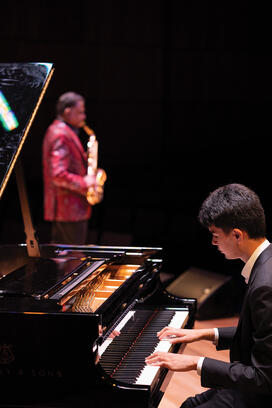
Mahanthappa had been corralling other resources for the department as well, bringing in influential national players as guest lecturers. Laurenzi, who eventually majored in African American studies, didn’t find many hopeful pros in his freshman-year class. But a few years later, he says, “we had three or four people show up who were really talented, who were serious about playing after college. People were seeing the momentum of our program, seeing that you could almost get a conservatory thing here. It was a perfect storm.”
Graduating at the height of the pandemic, Laurenzi taught virtual lessons while he waited for live music to return. “I was scrappy and sustained through that first year. Then the city reopened and I started to gig. I feel like going to Princeton allowed me to choose whether I wanted to be a musician or not,” Laurenzi says. “If I had gone to a conservatory, there wouldn’t have been a choice. But at Princeton, I actually got to make the choice.”
This decision is the major crossroads in any artist’s career. It’s one that Mahanthappa himself grappled with en route to Berklee. “I really relate to these students because they’re doing the opposite of what I considered,” he says. “I was on the fence of going to music school or doing something else. I was a serious number theory guy. I decided I wanted to be a professional musician in high school. But I saw the conflict and knew I had to choose. My dad said, ‘Why don’t you go someplace and double major?’ But I said, ‘Nah. If I’m doing music, I’m doing music.’”
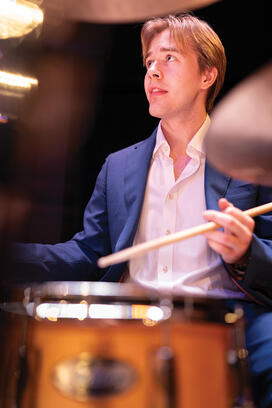
For his strongest set of students, Mahanthappa says, “If I’m afraid they’re going to get bored, I’ll find ways to engage them. I’ll just play with them once a week. And I’ll let them know, my door’s always open. We can play, we can talk about stuff. So they don’t feel like they’re alone trying to figure this stuff out.”
Personal mentorship from a nine-time DownBeat winner is a novel offering in the Ivy League and can attract many gifted prospects to Princeton. But the program has also changed the intellectual trajectories of students who attended the school for nonjazz reasons. Take current senior Allison Jiang ’26, who dipped into the jazz program her junior year. “I really didn’t have knowledge of the genre at all,” she says. “I was drawn to the sound.” Jiang grew up playing classical violin but began singing in high school, branching out into other genres. She auditioned for Princeton’s vocal jazz ensemble as a junior. “To my surprise,” she says, “I was placed in one of the jazz combos [with instruments].” She’s risen quickly through the ranks and now sings with Princeton’s premier big band, the creativelarge ensemble.
“The program has been very supportive,” Jiang says of these last two years. “You get a lot of one-on-one time with these incredible players, artists in the real world.” Her academic studies focus on environmental policy, but Jiang’s experience in jazz has opened her up to the possibility of performing after college. “Everyone’s sort of a conflicted musician and academic,” she says of her fellow students. “I’ve heard this conversation so much. Someone asks, ‘If there’s nothing else in life you’d have to worry about, what would you do?’ And a lot of people say, ‘Become a musician.’”
Why jazz music? The answer is relatively straightforward, even if the manner — learning how to improvise melody over shifting harmonic movement on the fly — is more complex. A liberal arts education is meant to teach students how to think, and the language of jazz provides a rich template for problem-solving as a member of a team. Furthermore, the art form is deeply connected to American history.
While playing jazz is rather involved, decoding the genre’s basic ideas, even as a listener, can unlock mental doorways. Critically acclaimed guitarist Miles Okazaki joined the Princeton faculty in 2021 and teaches a class aimed at explaining jazz to the school’s general public. “I don’t teach it like a music theory course,” he says, “which is how I used to teach at [the University of Michigan’s] conservatory. My classes don’t have any books, or many materials or notes. It’s like a language class, like Portuguese 101.”
Okazaki, who went to Harvard as an undergrad, had an idea of what his new students would be like. “Princeton is a magnet for uniquely talented people,” he says. “And a lot of their skills overlap with music in some way. My job is not necessarily to prepare them for a next step, musically. My job is more to teach them about what this music can teach you about how to think.”
As one of the nation’s leading jazz guitarists, Okazaki says that students in other majors — even those with no musical background — can benefit from his courses. “My take on it is, you’re studying the highest form that human improvisational music has ever reached,” he says. “If students can understand how it was created, it can complement all these other analytical tools that they’re learning in other classes. For me, this is much more valuable than information. Information, you can forget. You can look it up. This stuff, you get it in your bones.”
Like Clayton, Okazaki has marveled at the growth of Ivy League jazz, which during his undergraduate days could be deemed peripheral at best. He credits Mahanthappa’s “high-functioning” intellect and Princeton’s inquisitive student population for the program’s current success.
This momentum can best be seen and heard April 11 at the 2026 Princeton Jazz Festival. In addition to student group performances and a faculty septet that includes Mahanthappa, Clayton, and Okazaki, the creative large ensemble — with Jiang singing — will feature the legendary saxophonist Gary Bartz, a one-time bandmate of Miles Davis.
Bartz played with Davis’ band at Princeton’s Alexander Hall on Nov. 14, 1970. But they certainly didn’t invite any students onstage to perform. This new age of jazz brings many a new possibility, and to hear the faculty tell it, things are just kicking into high gear.
“All the greatest music, regardless of genre, engages your intellect and your heart and soul simultaneously,” says Mahanthappa, reflecting on his first decade of teaching. “It hits you in the heart and totally engages your brain. I’m trying to figure out as many ways to emphasize that, in as many different paths as possible.”
Eric Olson is a Seattle-based writer whose work appears in The New York Times, The Washington Post, and Slate.
Related News
McCarter Theatre’s First South Asian Musical Took Me Back to Forbes Basement
A Beat of Our Own is about a college dance team not unlike Princeton South Asian Theatrics

No responses yet