

David W. Miller Wrote a Guide for Making Ethical Decisions


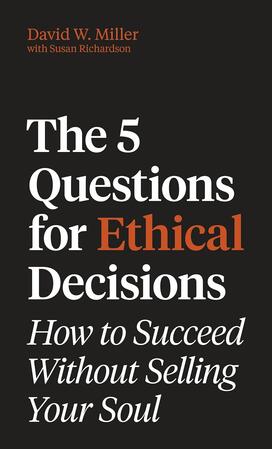
The book: In The 5 Questions for Ethical Decisions (Princeton University Press), Miller sets out to help people discover their “true north.” Using five key principles, the book guides readers to help them understand the meaning of ethics, establish their why, design an ethical framework that can be clearly articulated, and learn how to apply it when making tough decisions. Based on his two decades of experience teaching professional responsibility and ethics, Miller offers practical tips to help readers build their “ethical fitness” and avoid costly mistakes that don’t align with their morals.
The author: David W. Miller is the director of the Faith & Work Initiative at Princeton, a senior professional specialist in ethics, and a lecturer. He also works as an adviser to corporate CEOs and senior executives. He joined the Princeton faculty in 2008 and earned his M.Div. and Ph.D. in ethics from Princeton Theological Seminary.
Excerpt:
Life is all about decisions, in which we act out — and often find out — who we are. There are a range of ways to think about how ethics works in our lives. But given how decisions both draw on who we’ve been and shape who we’re becoming, we’ll focus here on decision-making as an elevated moment in the ethical landscape of our lives. How we want to see ourselves as behaving and how we actually behave in the moment, or our “lived ethic,” can all too easily be two different things. As you reflect honestly on your recent decisions, what is your own lived ethic? What is mine? And how can it be wiser and more informed for the sake of your future self and those you care about? What we need are the tools and practices for effectively tackling ethical decisions, particularly when the dilemma is in the ethical gray zone or, worse, disguised and unrecognizable until it is too late.
To create and hone those tools, I’ve drawn on years of teaching a class at Princeton University called “Professional Responsibility and Ethics: Succeeding Without Selling Your Soul.” Credit to the title goes to my students who gave that nickname to the class. It’s a title that, I hope, balances the idea of the tools with that of your own story. But tools are only as useful as they are used, and they don’t work very well if they remain abstract. Since there is no perfect way to wield them, I encourage my class to try without fear of failing. In fact, I tell them they have 36 chances to fail, that is, to try out the questions and frameworks over the semester — that is, the thirty-six hours of class — without penalty. In the same way, you need to get to know how a particular tool — whether a question or a framework — feels in the context of your own life and work.
As in the Princeton course, my book — The 5 Questions for Ethical Decisions: How to Succeed Without Selling Your Soul — focuses on interaction and engagement with other people’s stories and with yours. I differentiate between right doctrine (“views or belief”) and right practice (how you actually live out of your beliefs, and that can change over time). My emphasis is on the latter — how the source(s) of our ethics show up in ethical situations, what we do in real time. This helps you avoid getting lost in the weeds of theory and instead evaluate how you enact and play out particular ideas in your daily life. Look it as your lived ethic and the “ethical field” in which you find yourself for a particular decision. Your lived ethic is the behavior and values you personally bring into an ethical decision. But the fact is you’re never there alone. You are in an ethical field, which can be compared with a playing field in sports. That field comprises the context in which your personal ethics and decision-making is taking place, including external factors, organizational ethics, and the ethics of other people.
Given the variability and subjectivity of what it is to be a normal human who’s trying their best, we need a system external to the demands and even impulses of the moment through which we can process an ethical decision, whether large or small. So, over the past twenty years of teaching, research, and C-suite-level ethics advisory work, I developed five key questions that together create a sound ethical process that is academically robust and grounded yet easy to remember and use in your everyday life. I call them the Five Questions, or the Five Q’s.
The Five Q’s — when they are exercised in your daily life — give you two ways to counter impediments to your ethical decisions and think reflectively about possible outcomes. First, they give you a framework outside yourself that helps illuminate things you hadn’t thought of or might tend to overlook, perspectives that were not naturally your own but that might reveal important insights. Second, the act itself of taking regular time to visit them helps you create space in your life for reflection, space that helps you engage in slower, less reactive, more insightful thinking and step away from triggers of the moment. Both ways help you reset, moving you away from the distortion your biases and other impediments can create — if left unchecked and free to meddle in your perceptions. The Five Q’s help you move from being ethically out of shape to being ethically fit and well.
In short, our human ethical judgment is more important now than ever. You matter, and so do your ethical decisions, whether it’s one you encounter only once, or one that you run into many times over the course of a career or lifetime. Especially in a world where tech, quantum computing, and generative artificial intelligence have more and more ability to replicate human functions, the value we humans offer will lie in the ethical discernment and insightful perspectives we bring to bear to a nuanced decision that algorithms can’t replicate. We need a process for making ethical decisions confidently but not arrogantly, for being informed and not naive, empowered and not paralyzed. Above all, we need tools that not only allow for but engender humility and the wisdom it brings, which may be the most important tool in your kit.
The way that judgment shakes out in our everyday ethical decisions can set up a future to look forward to — or not. Who are you now, and who are you becoming? Or, put another way, what will your future self thank you for doing — or not doing — today?
Adapted from THE 5 QUESTIONS FOR ETHICAL DECISIONS: HOW TO SUCCEED WITHOUT SELLING YOUR SOUL. Copyright © 2026 by David W. Miller with Susan Richardson. Reprinted by permission of Princeton University Press.
Reviews:
“A practical guide for navigating ethical complexity, The 5 Questions for Ethical Decisions empowers leaders and teams with actionable clarity, integrity, and courage. This is essential reading for cultivating principled cultures and confident decision-makers.” — Cari Gallman ’03, executive vice president, general counsel, and chief policy officer at Bristol Myers Squibb
“We often hear the phrase ‘Do the right thing’ and question whether it’s ‘the right thing’ at all, and according to what or to whom. David Miller shares a sharp framework for grounding ‘the right thing’ in truth.” — Tom Horton, former CEO of American Airlines
The Latest
See all


Related News


Janice Lee ’09 Worked to Renovate One of Hollywood’s Best-Kept Secrets
An engineer by training, Lee has been deputy project manager on the renovation of Hollywood Burbank Airport


1 Response
Jay Tyson ’76
4 Months AgoLooking Forward to Reading
Based on the reviews, this looks very good, and very helpful for young people starting out, mid-career people in the throws of decision-making, and retired folks reflecting back on years of experience. I am looking forward to reading it in detail.