
Joseph Nye Jr. ’58 Strengthened America Through Soft Power
Jan. 19, 1937 — May 6, 2025

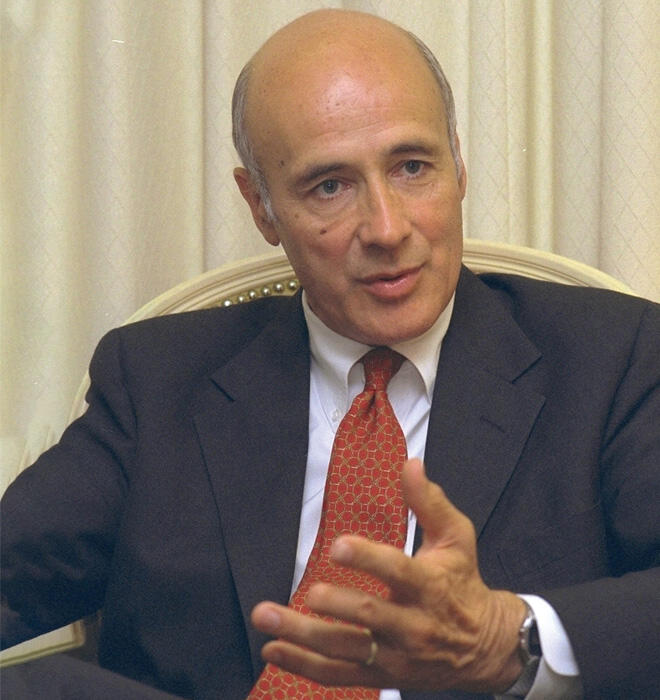
The man who coined the term “soft power” was a Princetonian. When he came up with the idea, he had long since left Princeton — but he also hadn’t left, in the sense that he stayed all his life near the seminar room and used those experiences to inform his guidance to the war room. Often called “the dean of American political science,” Joseph Nye Jr. ’58 advised governments, steered U.S. intelligence, and worked for the White House and the Pentagon, but he was also an academic leader who thought long and hard about what it is, exactly, that universities export to the world — and argued that universities, in their quiet way, can project power just as forcefully as armies.
Nye grew up in New Jersey, the son of a Wall Street trader and a Smith College graduate. At Princeton, he was a big man on campus, serving as vice president of Colonial Club and writing columns for The Daily Princetonian. (In his columns, he practiced the Princeton style of overwriting, as we all do: “Princeton in the fall. Fitzgerald-like leaves of crimson and vermillion take the final plunge of their subastral existence. Bold figures in orange and black march upon fields of green — fighting fiercely for every precious yard.”)
After his graduation — his classmates elected him Class Day speaker — Nye went to Oxford as a Rhodes scholar, choosing to study politics, philosophy, and economics. Next, he went to Harvard for a Ph.D. in political science. His dissertation adviser was Henry Kissinger, which must have been interesting.
Nye stayed at Harvard to join the faculty and rose through a series of powerful directorships and deanships, ultimately becoming dean of the John F. Kennedy School of Government. The U.S. government also tapped him for senior roles in intelligence and national security.
He coined the idea that became a global phenomenon at the end of the Cold War. In a 1990 book titled Bound to Lead, he pointed out that policy wonks usually defined power as control over resources. This definition made power measurable, but it also made that measurement misleading because time and again countries with fewer resources managed to win over countries with more: “Some countries are better than others at converting their resources into effective influence, just as some skilled card players win despite being dealt weak hands.”
Nye argued that, thanks to mutually assured destruction, the power countries derived from the threat of force often proved to be blunted in the age of nuclear weapons — but opposing sides still won or lost contests of power, often for reasons that had nothing to do with weapons. Ordinary East Germans tore down the Berlin Wall, not because the democratic West had control over resources in East Germany, but because the East Germans found its vision for the future attractive.
This is what Nye called soft power: The ability to achieve your goals, not with carrots or sticks, but because people in other countries find your ideas attractive, identify with your culture, and follow your example. The United States had, during the second half of the 20th century, the immense advantage of a popular culture that dominated the globe, as well as a reputation for audacious tolerance and generosity, immigration policies that made other countries lament their “brain drain” to the U.S., and universities that attracted bright students from around the world.
The concept of soft power changed how states all over the world approached diplomacy. Nye often talked about how universities, in particular, supply a formidable form of soft power: “For example,” he wrote in The New York Times in 2000, “at a time when Chinese government propaganda was lambasting us, a former student in this country who was the son of a high Chinese official published a book widely read in Beijing that described the United States positively.”
Nye worried at the end of his life that America’s standing was diminishing, and he warned that soft power, once lost, is difficult to restore.
But he also believed in America’s resilience, and in the “American idea” — which is, at bottom, the power of America as an idea. For him, America’s reputation for optimism, generosity, and plain old decency wasn’t propaganda; it was a gift and a duty, and the nation’s best hope for survival. In his memoir, he recalled a message he shared as Class Day speaker: “I can remember standing in Alexander Hall and telling my classmates that, while we could not alone save the world, we could each do our small bit to improve it.”
Elyse Graham ’07 is an English professor at Stony Brook University.


3 Responses
John Milton Cooper Jr. ’61
8 Months AgoDiplomat Wisner ’61’s Service in Foreign Policy
I was delighted to see Joseph Nye ’58 included and featured in the February “Lives Lived & Lost” issue. Over the years, I knew Joe personally slightly and a lot through his writings and reputation. In all that time, I never heard a harsh word from or about Joe.
May I suggest that a fit companion to him for importance in foreign policy would have been Frank Wisner ’61, who also died in 2025. After learning Arabic at Princeton (in a cohort that also included classmates Andras Hamori and John Waterbury), Frank served with stellar distinction in diplomatic and other government posts, with a record range of ambassadorships that included Zambia, the Philippines, India, and Egypt, where he stayed for an unusually long time because of the close relationship he formed with the country’s leader. Frank also served as assistant secretary of both State and Defense. He was called back after his retirement to conduct the peace talks for the former Yugoslavia, where his fellow diplomats called him “a tough negotiator.” Only a few Princetonians have equaled Frank Wisner for service to the nation and the world.
Aaron Harber ’75
8 Months AgoA Brilliant and Kind Guest
Thank you for including Joseph Nye ’58 in your “Lives Lived & Lost” section.
I was honored to have him as a guest multiple times and not only found him incredibly brilliant but also very amiable and kind.
Despite his long and distinguished academic leadership career at Harvard, I was certain he agreed to join me based on my connection to Princeton and not in any way due to my “other” degree from Harvard’s Kennedy School.
If you’d like to see and hear Joe on the first program we did together long ago, just go to HarberTV.com/episodes/Nye.
My hope is those in power today will somehow gain a greater appreciation of “soft power” and deploy it strategically.
Fletcher M. Burton *88
8 Months AgoMany Types of Power in Good Policy
Yes, let us pay tribute to Joseph Nye Jr. ’58 for coining the term “soft power,” which has enriched the geopolitical vocabulary. But we shouldn’t claim that it “changed how states all over the world approached diplomacy,” as stated in the PAW eulogy (February issue). Soft power may be a general climate in which diplomacy is conducted, but the actual weather is made by specific policy, good or bad.
In my many years in the Foreign Service, I never heard mention of soft power as leverage, a force to be deployed. Secretary of State Hillary Clinton gave currency to the term “smart power” in a nod to Nye. Yet it referred to the formulation of actual policy. The Economist once ran a cover story on the “sharp power” of China trying to influence foreign states. Again, it referred to a deliberate set of actions. Soft power is … well, a bit too squishy.
For success in diplomacy, I would offer the terms “staying power” — a long-term strategic commitment; and “sweet-spot power” — a sustainable domestic construct within an effective international framework. Good policy, not soft power, is the gold coin of diplomacy.