

Kevin Zhang ’16’s Carnivorous Plant Society Holds Its First Show
Zhang is dedicated to debunking misconceptions about these fascinating bug eaters
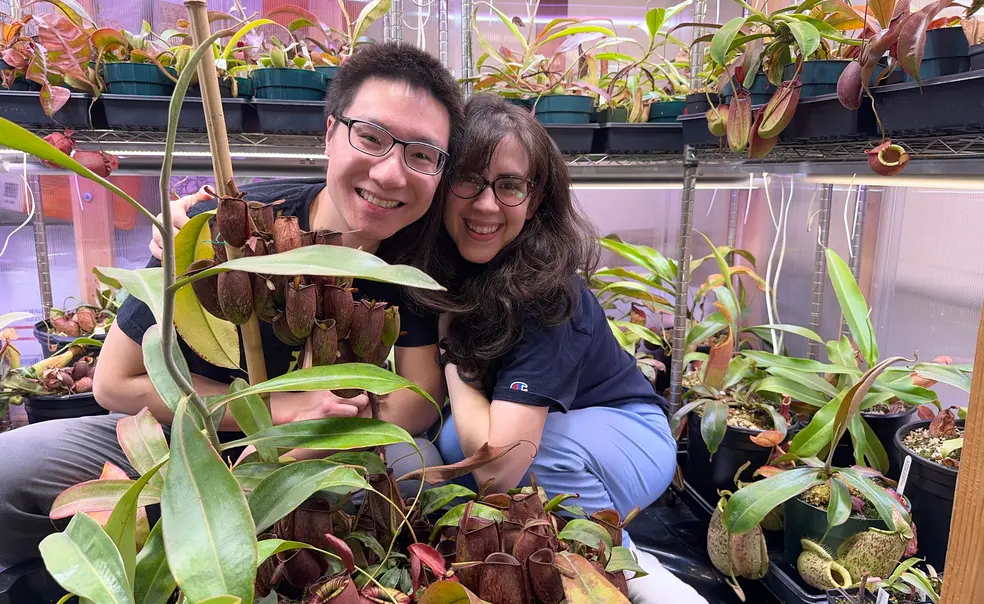

If you didn’t know Kevin Zhang ’16, you’d probably never suspect that the ophthalmology medical resident spends much of his spare time surrounded by predators.
Zhang is immersed in the strange world of the Dionaea muscipula, Sarracenia, and Drosera — also known as the Venus flytrap, American Pitcher plant, and Sundew. A big fan of bug-eating plants, Zhang is president of the nonprofit Mid-Atlantic Carnivorous Plant Society (MACPS), which raises awareness about caring for and protecting carnivorous plants and fosters a sense of community among members.
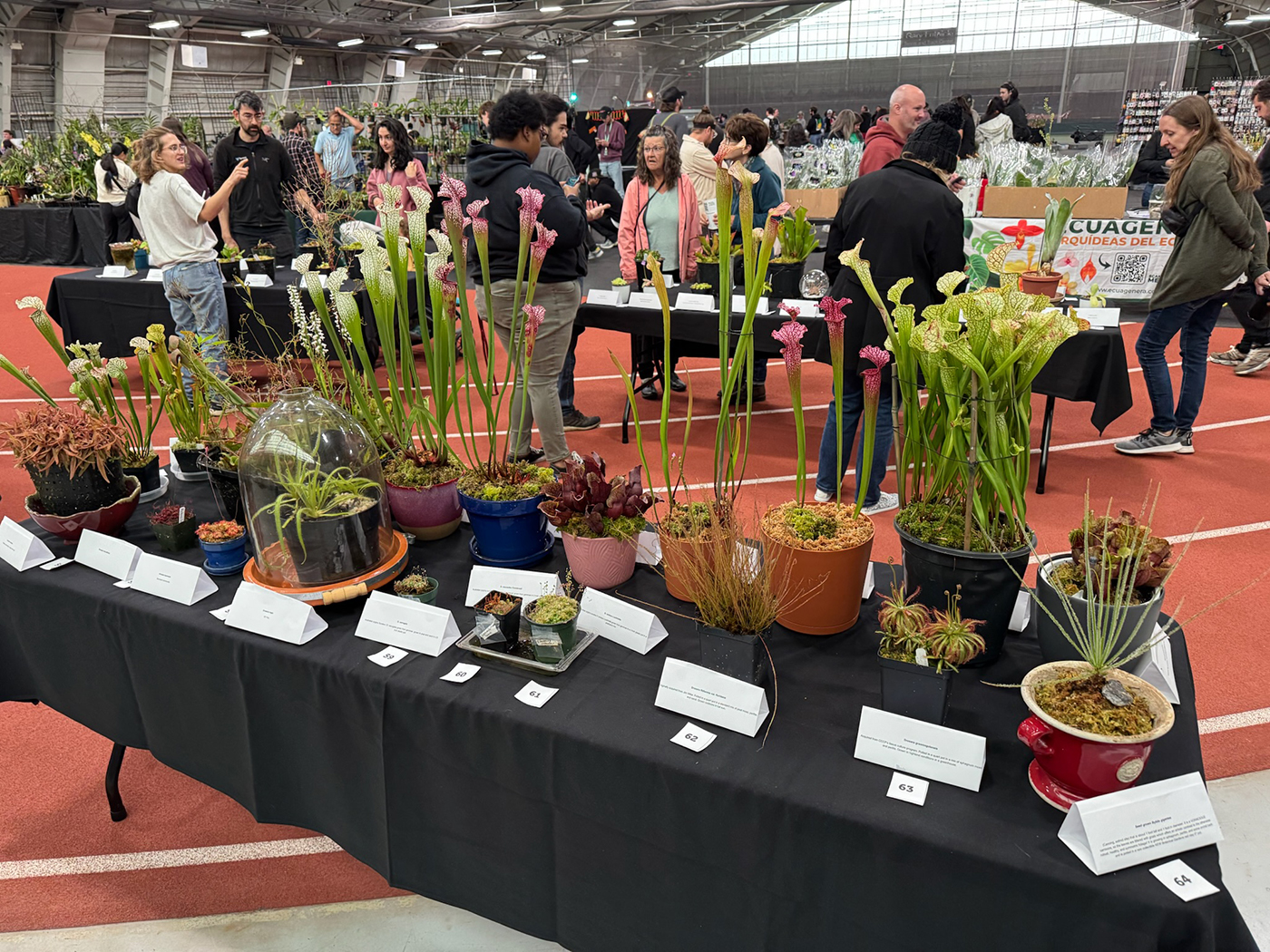
Under Zhang’s leadership, MACPS held its first plant show in October. More than 650 carnivorous plant enthusiasts and newbies mingled at Haverford College among vendors and speakers, and amid a carnivorous plant competition.
“It went fantastically, especially for a first show and given our rather ‘niche’ focus,’” Zhang says.
Calling himself a lifelong gardener, Zhang says his interest in carnivorous plants blossomed in third grade, on a visit to a plant nursery with his father. “[T]ucked away under a bench were these Venus flytraps and they really caught my attention,” he recalls.
Zhang soon had his own Venus flytrap — and watched helplessly as the plant’s leaves turned black. He estimates he killed his first 10 Venus flytraps before discovering that he was giving them the wrong water. “I didn’t realize that you can’t use tap water,” Zhang says. “Carnivorous plants have adapted to low-nutrient and low-mineral soils, so the amount of minerals in tap water is enough to burn their roots.” Instead, these plants need rainwater or distilled water.
Zhang brought his horticultural experience to Princeton, where he served as president of the Princeton University Botany Club and participated in the Princeton Garden Project. After graduating with a degree in molecular biology in 2016, he went on to earn a combined M.D./Ph.D. from the University of Pennsylvania. Zhang established MACPS in 2017 when he realized the region had no carnivorous plant group. Today, MACPS has eight board members, 80 paid members, and more than 1,000 followers on Facebook.
Part of MACPS’s mission is to provide information about carnivorous plants and debunk misconceptions.
These unique plants have specific adaptations to lure, trap, and digest their insect prey to absorb their nitrogen and carbon. Venus flytraps, for example, have hinged leaves that snap shut when an insect comes in contact. Tropical pitcher plants use fragrance and nectar to lure prey into deep cups where bugs become trapped in acidic liquid. Sundews attract meals with sticky hairs topped with droplets of nectar.
A common mistaken belief is that carnivorous plants survive on insects alone, notes Zhang. Their main source of energy actually comes from light through photosynthesis. While the plants do need insects to live, they can go for months or even years without devouring one.
Another misconception is that carnivorous plants only flourish in the jungles of Asia or other remote places. In fact, more than 720 species of carnivorous plants grow all over the world, including in the United States, according to the U.S. Botanic Garden. Venus flytraps grow in the wild only along a part of the coast of North Carolina and South Carolina, Zhang says.
Many carnivorous plants thrive indoors with the right care. Zhang built a greenhouse in the basement of the Cherry Hill, New Jersey, home he shares with his wife, Sarah Santucci ’17, whom he met through the Princeton Botany Club.
Their greenhouse is lined with an estimated 500 pots of plants, including Zhang’s Tropical pitcher plants and Sundews. The collection also includes orchids raised by Santucci. “It sounds like a lot,” Zhang acknowledges, “but it’s organized chaos.”
The Latest
See all


Related News

With Prominent Journalists and Hoagies, the ‘Prince’ Celebrates 150 Years
A gala at the New York Historical raised roughly $400,000 for the independent student newspaper



No responses yet