

Life During Wartime
Philip Stoltzfus ’79 and Lebanese American University try to thrive amid another Middle East crisis

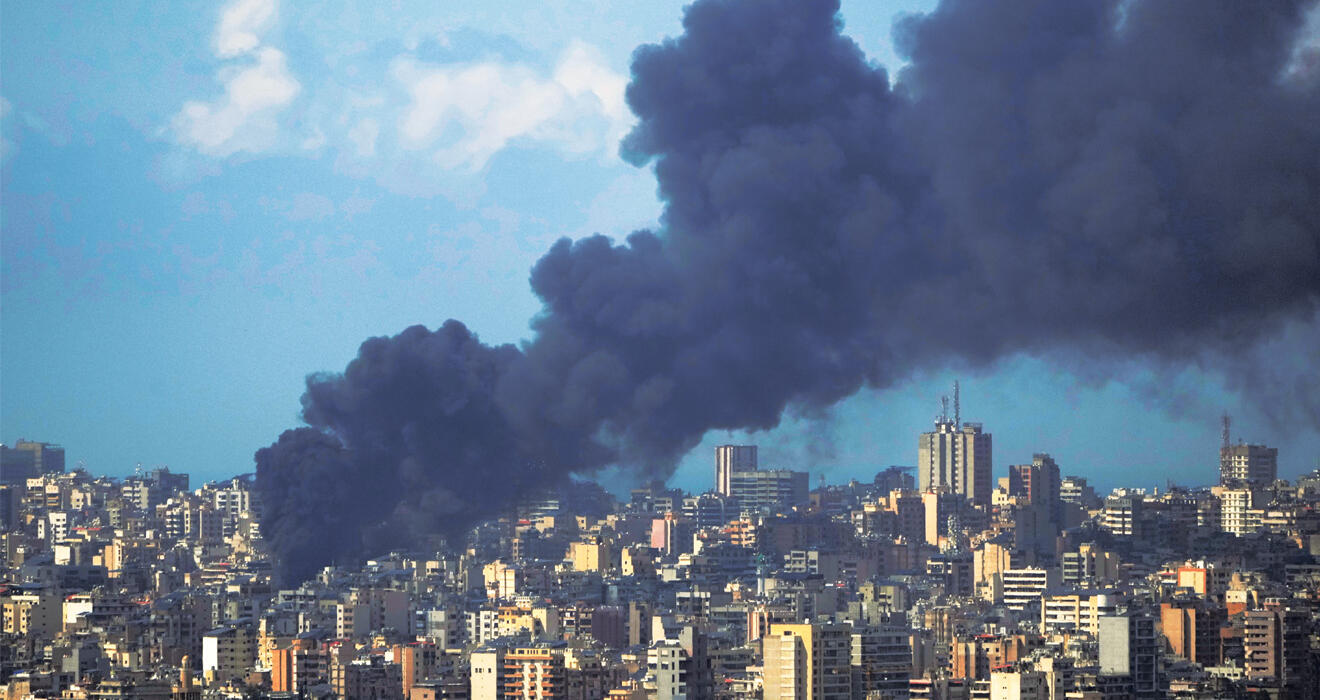
The roar of the sea and the cry of gulls along the Beirut waterfront were punctuated by the familiar sound of explosions. Starting on March 2, Israeli rockets hit the city almost daily, aimed at strongholds manned by Hezbollah, the Lebanese political party and paramilitary group that is one of Iran’s chief allies. Hezbollah had already fired rockets into Israel. Israel retaliated with airstrikes and troops surging across the border. And Lebanon was once again caught in the crossfire of a broader regional war.
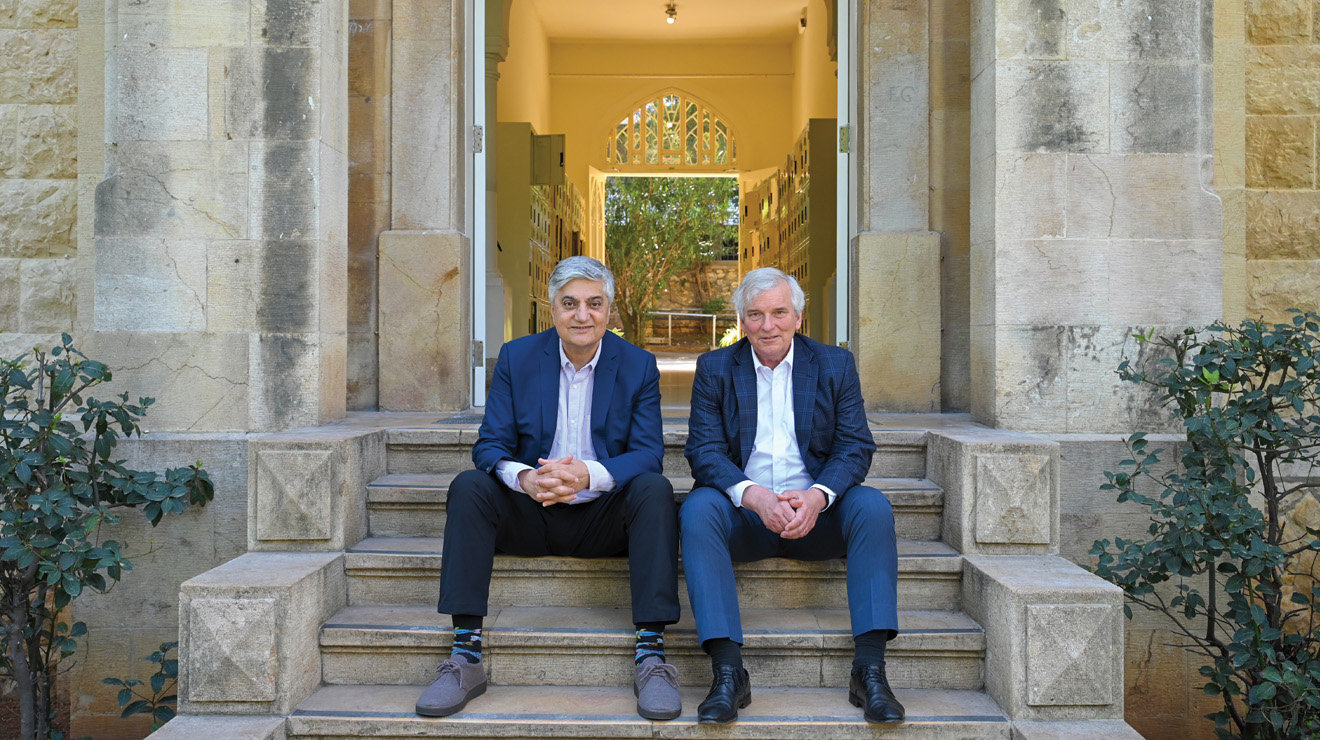
Thousands of miles away in the United States, Philip Stoltzfus ’79, a longtime board member of Beirut’s Lebanese American University (LAU), and its new president, Chaouki Abdallah, tried to figure out what to do.
Although Israeli attacks on Beirut were concentrated on neighborhoods around the airport where Hezbollah is headquartered, a few rockets landed in parts of the central city, less than half a mile from the LAU campus. Students sheltered in their apartments, though many were frantically trying to reach relatives closer to the line of fire. According to multiple news media outlets, by the beginning of April, more than 2,000 people in Lebanon had been killed and hundreds of thousands displaced.
Stoltzfus, who lives in London where he owns a consulting firm, was in the U.S. on business when the fighting began. For more than 22 years, he has helped guide LAU through rough times. He is also the man who recruited Abdallah, a Lebanese engineer who spent nearly four decades in teaching and administrative roles in the U.S., to take the LAU presidency. It was Stoltzfus who filled his imagination with the great things he could accomplish back home. Now 18 months into the job, Abdallah was also in the U.S. as part of a preplanned, monthlong swing abroad, meeting alumni, raising money, and overseeing LAU’s reaccreditation by the New England Commission of Higher Education. As its name suggests, LAU is an American university, chartered by the state of New York.
The two spoke daily with LAU administrators back home, helping faculty, staff, and the families of students who had been displaced. Stoltzfus also worked contacts in the U.S. government to make sure the Israelis had LAU’s coordinates, so they would not target it by accident. Although he stepped down as board chair in 2024, Stoltzfus’ institutional memory again made him indispensable. “Unfortunately, I’ve got a bit of experience at this now,” he says. It was Stoltzfus’ idea, in fact, to dub the ad-hoc emergency team the “situation management group” rather than the “crisis management group.” He is fed up with crises.
Within hours after the first missiles struck Beirut, LAU posted a notice on its website: Classes would be suspended for the following day. Exams were cancelled for the rest of the week. Further instructions would follow as the scale of the threat became clearer.
Since ancient times, the place now known as Lebanon has been a crossroads for education, culture, and trade. Its makeup is unique. Estimates suggest that of its 5.3 million people, roughly two-thirds are Muslim, both Sunni and Shia; about one-third are Christians, divided among a dozen denominations; and around 7% are Druze. Part of the Ottoman Empire before gaining independence, Lebanon has long had the unhappy fate of being a small country pushed around by giants, wracked by civil war, and victimized by its own impotent government. The strong do what they can, Thucydides wrote from across the Mediterranean 2,500 years ago, and the weak suffer what they must.
Against this backdrop, it qualifies as a surprise that LAU has built not one, but two successful campuses, its flagship in Beirut and a smaller campus in Byblos, 35 miles to the north. Between them, the university educates 8,250 undergraduates, 1,215 graduate students, and 300 professional students, nearly 90% of whom are Lebanese citizens. LAU offers 34 undergraduate majors and operates two teaching hospitals and seven professional schools. Its urban campus is lined with palm trees, its architecture a mix of 19th century sandstone and modern glass buildings. Tuition runs between $9,000 and $11,300 per semester.
The Beirut campus is in the wealthy Ras Beirut neighborhood along the Mediterranean, which holds many of the city’s nicest museums, stores, and restaurants. It is the area that once earned Beirut the nickname the “Paris of the Middle East.” Get Stoltzfus going on the topic and he insists that he has never felt at risk there. Indeed, wars excluded, by some measures the violent crime rate in Beirut is lower than in New York or London.
“There are areas in Beirut where you feel like you’re in the south of France,” says Princeton professor Bernard Haykel, who grew up there. “And there are areas where you feel like you’re in Tehran.”
Critically, in a country that has been ravaged by religious strife, LAU is nonsectarian and, as much as possible, non-political. Students are forbidden from political or religious sloganeering, chanting, or cheering. LAU must also abide by American sanctions laws, which prohibit any association with Hezbollah, deemed by the U.S. government to be a terrorist organization.
Stoltzfus insists that the university plays a critical role in Lebanese society, one that is more important now than ever. “Philip is a superb booster,” says Joshua Landis *97, co-director of the Center for Middle East Studies at the University of Oklahoma. “In his heart he loves LAU because it has an extraordinary history and has done incredible things for Lebanon.”
In the months before the current fighting began, Stoltzfus was able to peer into the future and hope that things had finally changed for the better. With its funding source in Iran exhausted and its smuggling route through Syria cut off, Hezbollah might be forced to disarm, enabling the Lebanese military to reestablish control over its entire territory. For the first time in more than half a century, the country might enjoy a sustained period of stability.
But at the beginning of March, as Stoltzfus and Abdallah watched the war unfold on the internet, both men worried that they were seeing their hopes disappear. While back in Beirut, students hunkered down, kept one eye on the sky, and waited for the shelling to stop.
“In [Stoltzfus’] heart he loves LAU because it has an extraordinary history and has done incredible things
for Lebanon.”Joshua Landis *97, co-director of the Center for Middle East Studies at the University of Oklahoma
Landis refers to LAU and its sister university, American University of Beirut (AUB), as “jewels in the Lebanese crown.” Between them, they have produced four Lebanese prime ministers and one Lebanese president. “These two universities established a model of excellence that all subsequent universities in the Middle East sought to emulate,” Landis argues. “They also helped convince Middle Easterners that American education is the best in the world.” Both schools have deep Princeton connections.
AUB, the older of the two, was founded in 1866 by an American missionary, Daniel Bliss, with support from the American Board of Commissioners for Foreign Missions, chaired by William Earl Dodge Sr. Over the generations, Dodges and Blisses intermarried, made a fortune in mining, and sent many of their children to Princeton, though they remained dedicated to educating Lebanese youth. During the past century, four Princetonians have served as president of AUB, sometimes at the cost of their lives. David Dodge ’45 *49, acting president from 1981 to ’82 and full president from 1996 to ’97, was kidnapped by Shiite militants during the Lebanese Civil War (1975-90) and spent a year in captivity. Malcolm Kerr ’53, who succeeded Dodge in 1982, was assassinated two years later by a group allied with Hezbollah.
Six decades younger than AUB, LAU might be regarded as Princeton to AUB’s Harvard, but the better analogy would be to Radcliffe. When AUB began accepting women into its medical programs after World War I, a two-year institution known as the American Junior College for Women (AJCW) was created to prepare them for admission. In 1938, the school hired William Stoltzfus, Phillip Stoltzfus’ grandfather, as its second president. An Ohio Mennonite who had gone to Lebanon as a Red Cross volunteer, Stoltzfus served as president of the AJCW from 1937 until 1958, transforming it into a four-year college and changing its name to Beirut College for Women. That school began admitting men in 1975 and changed its name again, to Lebanese American University, in 1994.
Stoltzfus’ father, William Stoltzfus Jr. ’46, was educated in Lebanon, Syria, and the U.S. before entering Princeton. After graduating, he joined the U.S. Foreign Service and spent his career in embassies across the Middle East. Philip Stoltzfus was born during his father’s posting in Saudi Arabia and grew up in Yemen, Ethiopia, Oman, and Kuwait. (From 1972 to ’74, William Stoltzfus served concurrently as the U.S. ambassador to Bahrain, Qatar, and the UAE.)
At Princeton, Stoltzfus majored in religion. Unsure what he wanted to do with his life, at David Dodge’s suggestion he spent a year teaching high school in Beirut. He then joined a training program with a Chicago bank, which sent him to London in 1984. He has lived there ever since. Stoltzfus founded the investment management firm Thayer Brook Partners in 2005.
After leaving Lebanon during its Civil War, Stoltzfus did not return for more than 20 years. “I just felt that there was this overwhelming hostility to the part of the world I grew up in.” Wanting to support his family’s legacy at LAU, though, he made a small online donation to the school’s annual fund in 2002, at the opening of the American war on terror. Within an hour of hitting the send button, Stoltzfus says, someone in the development office recognized his family name and asked if he would meet in London. Stoltzfus was asked to join LAU’s board of international advisers and became a trustee in 2006. He has served two terms on the board, chairing it from 2016 to 2018 and again from 2020 to 2024, and remains chair of the board’s planning and finance committees.
“The thing that those who have not been involved in conflict areas don’t understand is that people still have to go about their daily lives. One of the most important things is that, where possible, the conflict doesn’t interrupt core things you’re trying to achieve.”
Philip Stoltzfus ’79
By the middle of March, Stoltzfus and Abdallah were still in the United States, monitoring a dangerous but seemingly stable situation back in Beirut.
On March 19, a new notice went up on the LAU website. “We hope you and your loved ones continue to remain safe during these challenging times,” it began. Lecture-based classes would continue online, but labs and clinical classes could again meet in person where possible.
Bad as it is, the current fighting is not the worst LAU has experienced. At the outbreak of the Lebanese Civil War, enrollment plummeted from 1,100 in the spring of 1975 to just 150 by the spring of 1976. During the 1982 Israeli invasion, the university was forced to cancel its entire summer session. In 1987, four LAU faculty members were kidnapped from campus; one remained in captivity for four years.
Nor is this Stoltzfus’ first crisis since joining the board. In 2006, Israel again bombed Lebanese targets after Hezbollah attacked Israeli soldiers on the border. Stoltzfus, who was visiting Beirut with his aging father, got out on the last flight before the airport was shelled.
In 2019, the Lebanese financial sector collapsed. Inflation surged, eventually peaking at over 200%, as faculty and staff struggled to survive on a currency that was essentially worthless. The crisis threatened to drag LAU down as it did many other Lebanese institutions, but Stoltzfus and the trustees dug deeply into the endowment to cover operating costs. They converted tuition into dollars while greatly expanding financial aid to retain students. Simultaneously, they converted faculty salaries into dollars to reduce attrition. Stoltzfus says LAU’s finances are again stable and that enrollment exceeds prepanic levels.
In 2023, Stoltzfus chaired the search committee charged with finding LAU’s next president. He was intrigued by Abdallah, who had been president of the University of New Mexico before moving to Georgia Tech as executive vice president for research. At a time when few academics would consider a job in Beirut, Stoltzfus set out to land him.
Abdallah, who was raised in the northern part of the country, followed the path of many young Lebanese students by getting his higher education, including a Ph.D., in the United States. When Stoltzfus approached him, he agreed to meet, but only as a courtesy. While Abdallah thought he might return to Lebanon someday, he had a good, safe job in the U.S. and little desire to leave it.
Refusing to take no for an answer, Stoltzfus encouraged other trustees and prominent LAU alumni to apply pressure. He also appealed to Abdallah’s national pride. “With all due respect for what you’re doing at Georgia Tech,” he said, “these Lebanese universities matter in a way that no other universities do. This is your opportunity to serve.” With encouragement from his American-born wife, Abdallah finally accepted the challenge.
“I decided that maybe there was one more mission in me,” he says.
In the weeks before Abdallah was scheduled to take over, Stoltzfus took an active role in managing the university. They proved to be unexpectedly difficult weeks. In late July 2024, Israeli troops massed on the border after Hezbollah launched attacks in support of Hamas’ assault on Israel on Oct. 7, 2023. Although he and Abdallah had a handshake agreement, Stoltzfus says he was aware that Abdallah had not yet signed the official acceptance papers and worried that he might reconsider.
“I’ve got to get him to sign before the Israelis come into the country,” he recalls thinking. “Because who the hell is going to leave his family and come to Lebanon in the middle of a war?”
Abdallah did sign, but just before he arrived, Israel launched a massive attack on Hezbollah targets across Lebanon. Although the LAU campus was not hit, nearly half the students and 40% of the faculty were displaced. One student was killed when he returned to his home in another part of the city to retrieve clothes and was caught in a crossfire trying to get back.
Stoltzfus labored to hold things together. LAU shut down for a week while the situation management group revised the academic calendar and sought accommodations for those who had lost their homes. Although faculty could be housed temporarily on campus, students’ families could not be. Dormitory space is limited and the Lebanese concept of family is expansive, often including aunts, uncles, and cousins. Sometimes, too, prudence is the better part of empathy; without carefully vetting who it took in, LAU might inadvertently put a target on its own back. Instead, the university provided emergency stipends and helped families find housing in safer areas. It is doing the same now.
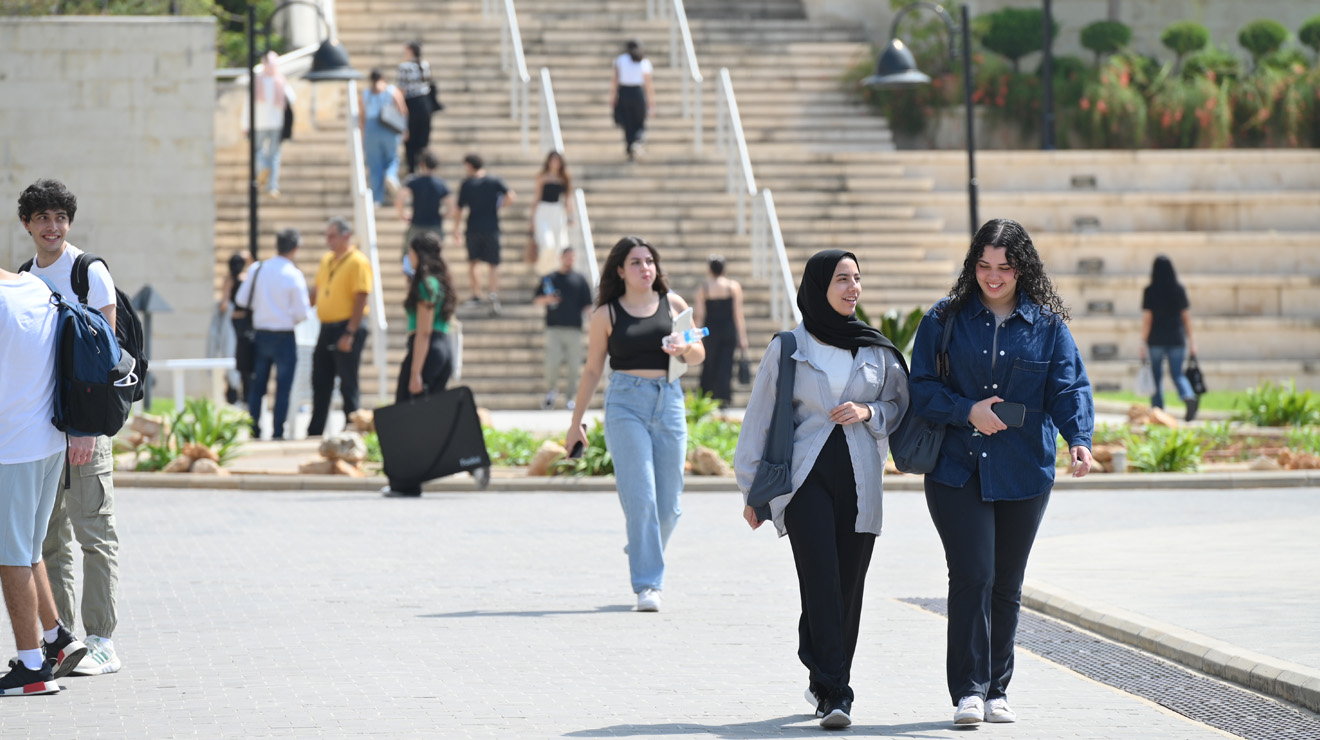
While classes continued online, in mid-March six students from LAU’s Beirut and Byblos campuses traveled with a faculty member to the Harvard World Model U.N. conference in Lima, Peru. Getting out of the country was harrowing. An Israeli rocket blew up the road to the airport on their way there and another struck next door as they were awaiting their flight.
In the Model U.N. exercise, LAU’s students represented Mexico, serving on a committee addressing non-self-governing territories. Though they had been training for the competition for months, their attention was distracted.
“It was so hard to leave our families, the people that we know and love in Lebanon,” says Juneid Shayya, a junior double-majoring in business and information technology management. “Each minute there, though we were fighting to win [the competition], our hearts were here.” Another LAU student, Roy Abi Raad, was trying to keep tabs on his father, who serves in the Lebanese army.
Despite these challenges, both Raad and Shayya won awards for their performances. They expressed pride in themselves and gratitude to the university that was willing to send them to an academic conference amid rocket attacks. “The thing that initially attracted me to [LAU] is the culture, how professors interact with students,” Shayya says. “It is like a family.”
On March 20, after 10 days in Peru, the LAU students left theoretical politics behind and returned to face real world politics at home. “We got used to being normal,” Raad says, “and then going back to Lebanon, there were mixed feelings.” Both are finishing the semester online.
By the third week of March, LAU was still holding a few labs and clinics in person. But after Iran threatened to attack U.S.-affiliated educational institutions across the Middle East in retaliation for American attacks on two Iranian universities, it announced that both the Beirut and Byblos campuses would return to fully online instruction. That policy continued into mid-April.
“Obviously, it’s not an ideal situation for learning,” admits Abdallah, who flew back to Beirut on April 6. “Beyond the physical danger, the students are not in the best mental state.” To deal with that, the university health department is offering extra counseling sessions. Its website also posts links to two webinars, “In Response to Recent Unrest” and “Surviving and Thriving in War Time.”
For generations, Lebanon’s chief export has been educated young people, who take their talents abroad in search of better lives. “Unfortunately, that has been the case for forever,” says John Waterbury ’61, a former president of AUB. Raad, the Model U.N. student, says he hopes to pursue a master’s degree in political science after he graduates this spring but acknowledges that he will have to leave Lebanon to do it.
Stoltzfus wants to end that exodus while also hoping to see LAU become a global university. In 2013, LAU opened a small branch campus in Manhattan, near the United Nations, which has now been authorized to award degrees. It offers a mix of in-person and online programs in business, computer science, and applied artificial intelligence. Stoltzfus hopes that LAU will open another branch campus in Europe by 2028. Not only does globalization spread the LAU brand, it promises an influx of much-needed foreign cash.
In a way that many might find hard to comprehend, LAU muddles along. “The thing that those who have not been involved in conflict areas don’t understand,” Stoltzfus says, “is that people still have to go about their daily lives. One of the most important things is that, where possible, the conflict doesn’t interrupt core things you’re trying to achieve.” What other choice do they have?
America has thousands of colleges and universities. “If one or two of those institutions disappeared, it would be sad for the alumni, sad for the faculty,” Stoltzfus observes, “but life would go on.” Lebanon, though, is different. “LAU and AUB, these are trusted institutions in a country that has lost all faith in its institutions.”
Because of the war, Lebanese parliamentary elections, which had been scheduled for May 10 of this year, have been postponed until 2028. What the world will look like then is anyone’s guess. “I’m not a good prognosticator on the future of the Middle East,” Stoltzfus says, “and I’m looking forward to meeting someone who is.”
His hopes for LAU are undiminished, though his hopes for Lebanon have been tempered. Those he explains in simple, practical terms.
“I think it is critically important that Lebanon have a monopoly on the vectors of state power, including military power, throughout the country,” he says. “It would be good if the boundaries of the state were respected by its neighbors. It would be really good if everyone adhered to the Geneva Convention in terms of how they address civilian populations.”
As tall an order as that might seem, Stoltzfus is willing to start small. “If we can just keep from getting into wars,” he says, “this whole country can go absolutely vertical. Because of these universities, the depth of talent here is so great.”
According to the 2025 Times Higher Education global rankings, LAU placed in the No. 251-300 tier, making it the fifth-highest-ranking university in the Arab world. Stoltzfus takes great pride that an institution that began as a little women’s college in a poor and unstable country is now considered among the world’s leading universities.
In that, he also sees a metaphor. “As individuals,” he says, “you look around and the world now just sucks, right? You think, I’m powerless against these big beasts that are destroying things. But that is not, in fact, correct. As an individual, you have enormous agency. I think destructive things tend to burn themselves out over time. Good things tend to be more sustainable.”
Mark F. Bernstein ’83 is PAW’s senior writer.
Related News


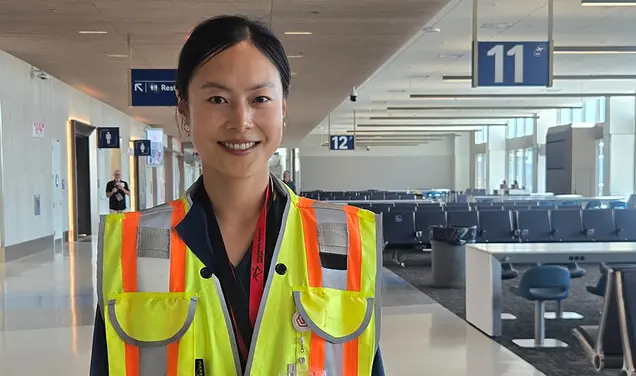
Janice Lee ’09 Worked to Renovate One of Hollywood’s Best-Kept Secrets
An engineer by training, Lee has been deputy project manager on the renovation of Hollywood Burbank Airport

1 Response
Sara Sill ’73
3 Months AgoReverse Chronological Order
I am curious as to why the author presents certain details of the war in a reverse chronological order.
The article opens with the firing of Israeli rockets into Lebanon. Only thereafter does the author note that Lebanon’s Hezbollah fired rockets into Israel first. Similarly, the author cites various Israeli actions in 1982, 2006, and 2024, explaining only later that they were in response to preceding Hezbollah’s aggression.
The heart of the article, the LAU students’ plight in the midst of a war, would be just as poignant had the author stated the actions of the various parties involved in the war in the order in which they actually happened, e.g., Hezbollah did this, so Israel did that.
It’s a nuance pervasive in the media today. Offering the reader one fact before another suggests some judgement on the relative significance of the facts. In this case, citing the response before the triggering event subtly minimizes Hezbollah’s provocation. It needlessly colors the real story, which is about how the students were impacted.