

A Hub for What’s Next
New paths for research take shape at the Environmental Studies and School of Engineering and Applied Science complex

Bioengineering professor Cliff Brangwynne visited the Environmental Studies and School of Engineering and Applied Science complex (ES and SEAS) at nearly every step of its construction, often in a hard hat, as director of the Omenn-Darling Bioengineering Institute, one of the new site’s residents. But it wasn’t until early in the fall semester that he was able to bring his lab group into the spaces where they’d soon be working.
“Seeing it through their eyes for the first time, blank slate … was kind of amazing,” he says. “They were just like, ‘Whoa!’” The new building provides facilities for microscopy, biofabrication, and cell engineering that will be “game-changing,” Brangwynne says, as researchers pursue technologies that interface with living cells.
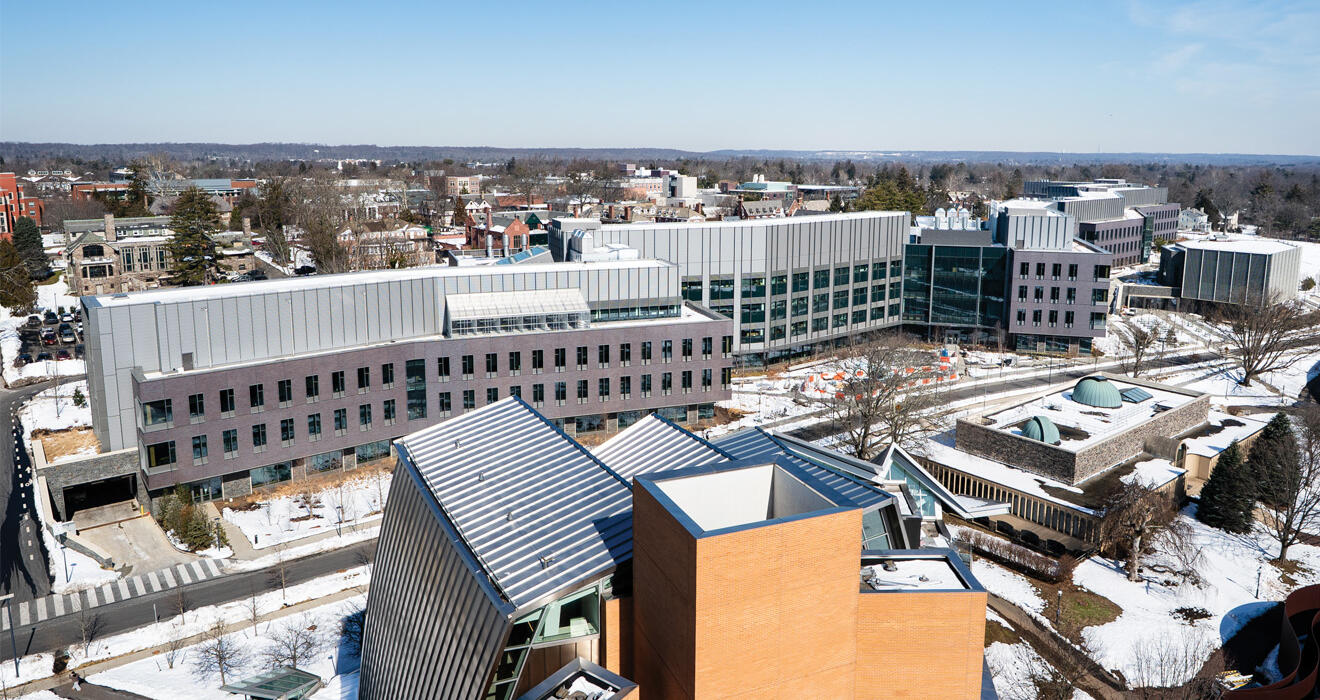
The ES and SEAS complex is the largest construction project in Princeton’s history and one of the last pieces of the 2017 campus plan. Offices and labs began filling up after Commencement in 2025 — a year defined by angst about federal funding for scientific research, particularly in areas such as climate change — and the move-in process has continued through the early months of this year. With 666,000 square feet, the four buildings have more interior space than the University’s last three major science construction projects combined (Frick Chemistry, Peretsman Scully Hall/Princeton Neuroscience Institute, and the Andlinger Center for Energy and the Environment). The University declined to share the cost of its construction.
The complex includes new homes for three University departments — chemical and biological engineering, ecology and evolutionary biology, and geosciences — as well as the High Meadows Environmental Institute (HMEI). But for Brangwynne and the Omenn-Darling Institute, it’s a first home. Jointly appointed faculty who previously sat with six different departments are coming together in one building, with room to add more labs and researchers as the institute continues to take shape.
“For us, it really is formative,” Brangwynne says. “It’s a physical manifestation of the community we’re building.”
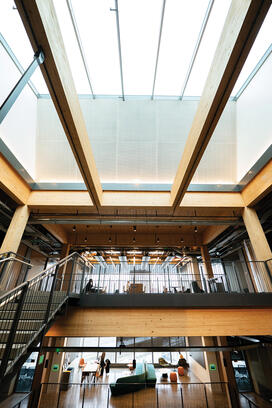
When faculty and administrators talk about ES and SEAS, “community” ranks high among the keywords, along with “interaction,” “crossroads,” and “hub.” While the departments and institutes may be somewhat compartmentalized in different buildings or hallways, the complex was created with mingling in mind. Briger Hall boasts a range of naturally lit common areas, some large enough for departmental poster presentations and others best suited for small group chats over coffee. The Commons, centrally located, features a new interdisciplinary library and a visualization laboratory for presentations. Outside the buildings, courtyards and gathering spaces are situated among newly planted trees and grasses.
Stretching about 1,900 feet from end to end, the complex traces a continuous public pathway that enables a “shirtsleeve connection” (no jacket needed to go from place to place), as Ron McCoy *80, the University architect, said at a recent meeting of the Council of the Princeton University Community. It’s also a short walk from the E-Quad, the Lewis Science Library, and a half-dozen other science buildings alongside Washington Road.
“We love it that we’re closer to physics, we’re closer to the Lewis-Sigler Institute for Integrative Genomics, we’re closer to neuroscience, we’re closer to molecular biology,” Brangwynne says. “Biological systems are the most complex systems that we know of. … No one’s kidding themselves that a single discipline is going to house all the knowledge in order to understand that complexity and harness it.”
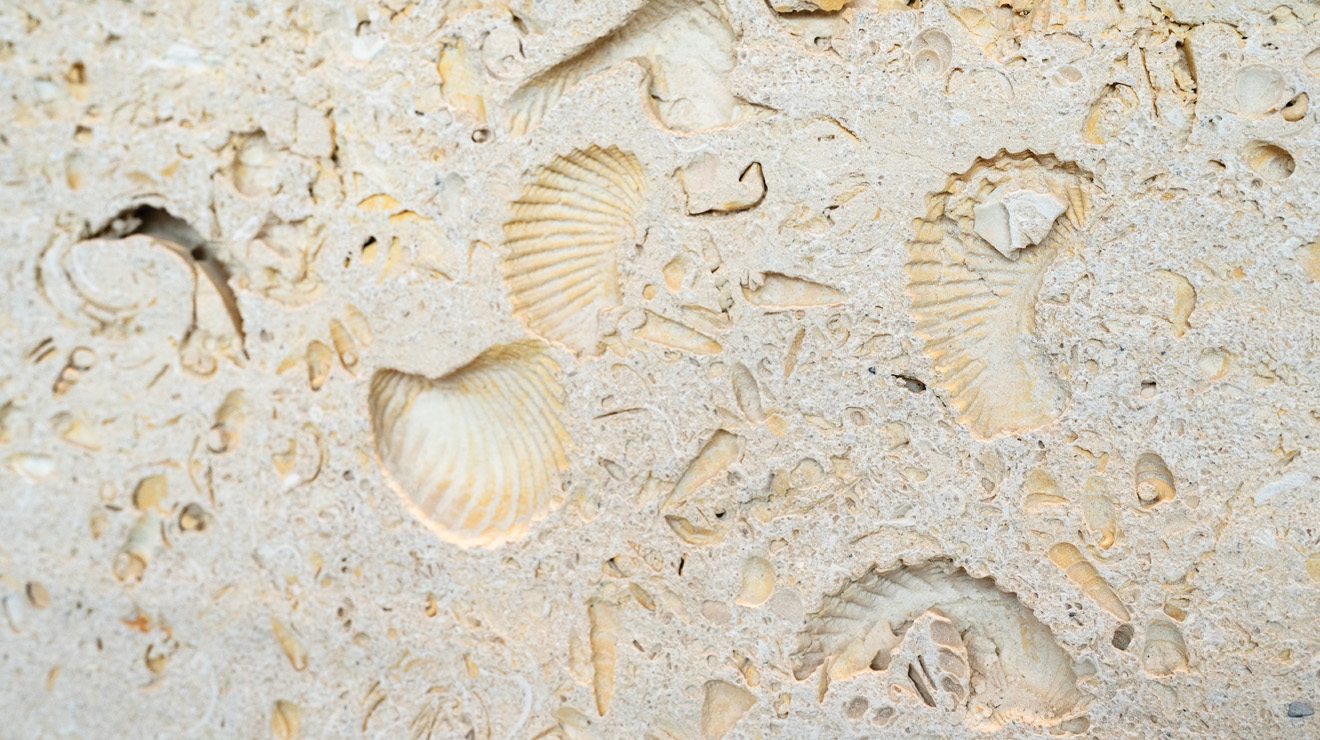
Briger (rhymes with bigger), the largest of the four buildings, houses environmental studies and boasts some of the most visually striking spaces in the new complex: walls lined with fossil-filled limestone panels, exposed wooden beams, and soaring stone staircases. It’s also the new home for Guyot’s famed resident dinosaur, Al the Allosaurus, freshly refurbished and positioned near the entryway by Roper Lane.
Gerald Carter, an associate professor of ecology and evolutionary biology who studies the social behavior of vampire bats, says that in just a few months, he’s noticed changes in how faculty in his department interact in the new space. “We all walk the same path to our offices, which makes a huge difference because you run into people,” he says. When Carter steps out of his office, he can usually tell which colleagues are in their offices because they have glass walls and doors — clear at the top and bottom but frosted in the middle for “just the right amount” of transparency, he says. “Obviously a lot of thought went into it.”
Mary Caswell (Cassie) Stoddard, a professor of ecology and evolutionary biology, calls Briger “modern but inviting,” designed for both style and function. Stoddard, who researches bird coloration, was able to work with the architects to arrange the specific functions of her lab, including a microscopy room, a hyperspectral imaging facility, a wet lab for experimental work, and areas for collaboration. “Having all of these spaces integrated in a flexible, state-of-the-art lab has been a huge benefit for my research group,” she wrote in an email to PAW.
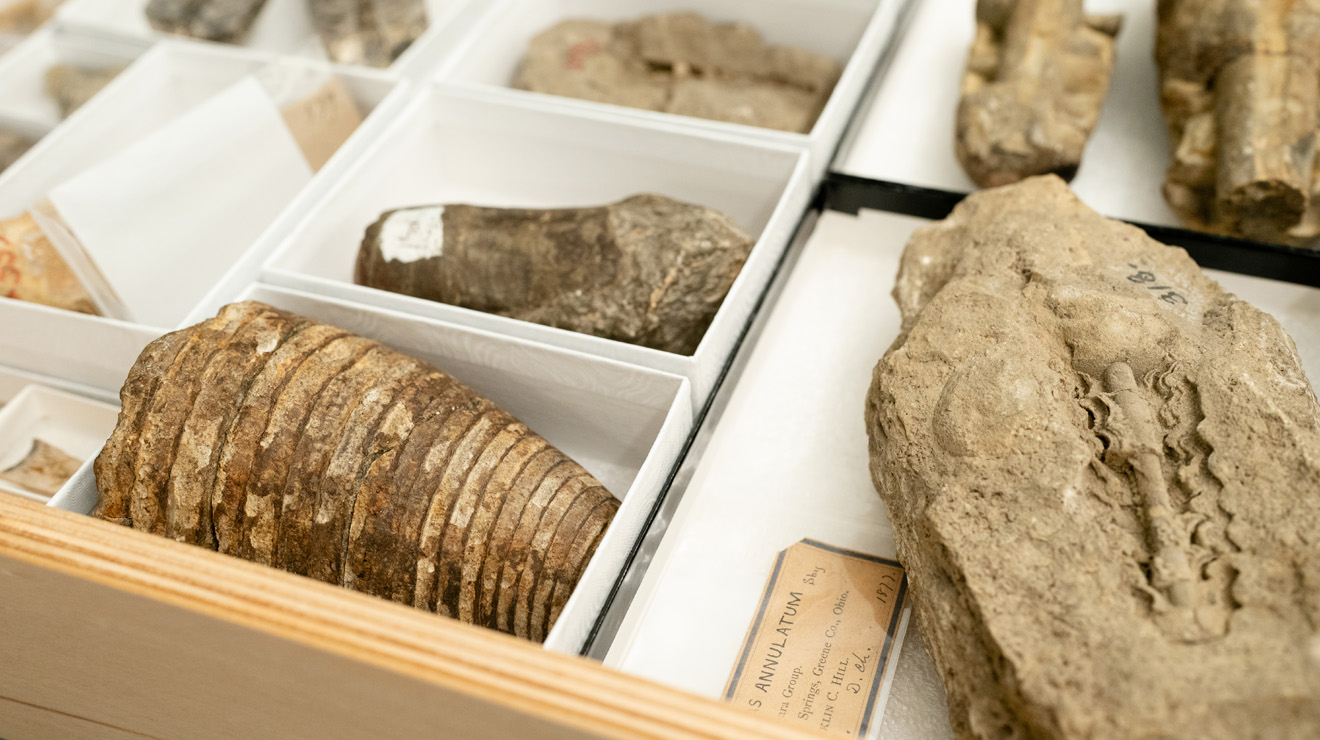
Stoddard is looking forward to seeing the Princeton Bird Collection, with its 6,000 avian taxidermy specimens, on display at Briger. There’s also a dynamic globe on the ground floor that can be programmed to present different global environmental data and niches to show fossils and minerals. Princeton’s mineral collection includes acquistions from the early 1800s, and its fossils were once so prized that they were displayed in a museum space at Nassau Hall.
For geosciences, the research facilities at Briger “literally go down from the deepest level to the tallest level,” says professor Frederik Simons, who asked project team members if they could dig custom holes on the basement level so that he could collect seismic measurements near the bedrock. (They obliged.) On the rooftop, the department has sensors that gather environmental data and GPS readings. Both will be used as teaching spaces, Simons says.
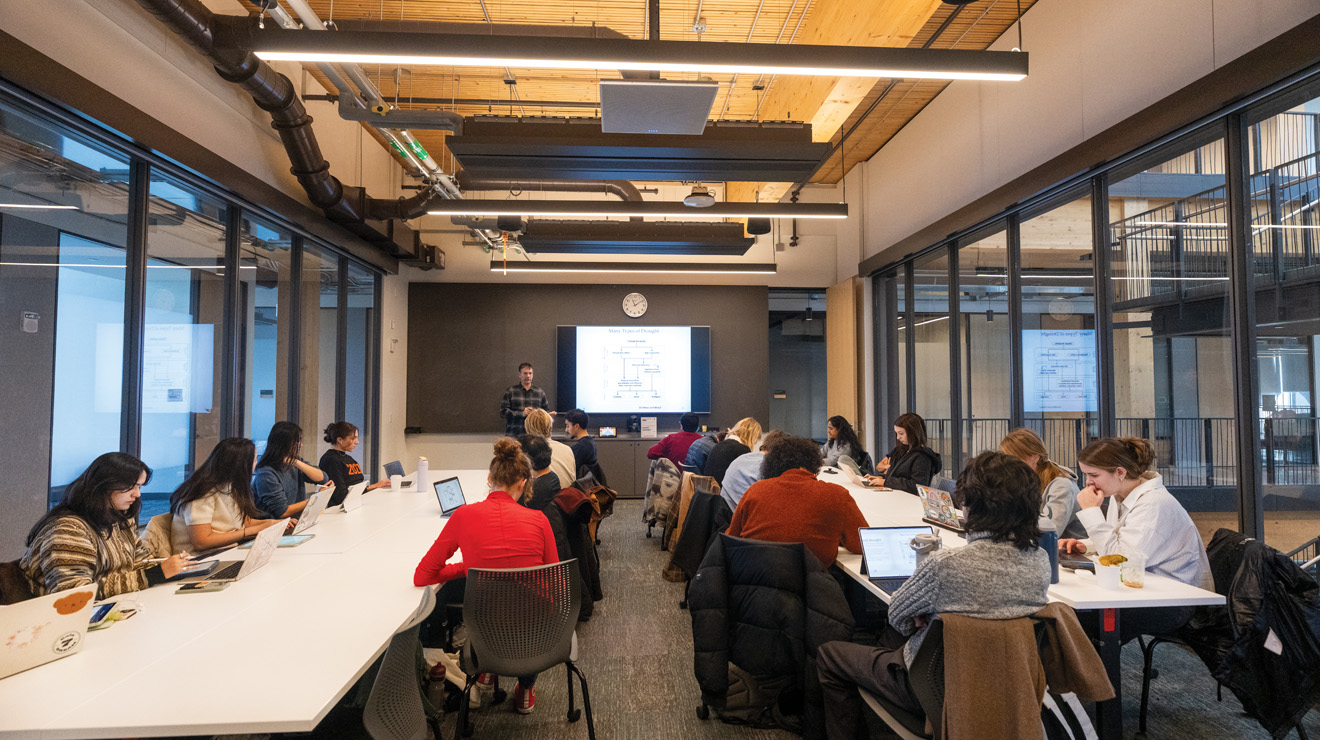
While much of the long-term focus is on the research that faculty, graduate students, and postdocs will produce at ES and SEAS, the complex has had an immediate impact on Princeton’s undergraduates. HMEI now has its own classroom for courses in the Program in Environmental Studies, its own teaching lab, and access to a broader range of shared spaces, which executive director Katharine Hackett ’79 says has increased interaction among affiliated faculty and students.
Several students who have taken classes and labs at Briger told PAW that they’ve enjoyed its comfortable classrooms, quiet study spaces, and communal events, including HMEI guest lectures and the afternoon “cookie time” hosted by geosciences. Ally Robertson ’26, an architecture major and environmental studies minor, says details like bird-safe glass and natural wood and stone surfaces “operate in the background,” but the overall effect “aligns with the environmental purpose of the building.”
If you’re trying to visualize what used to occupy the space where the new science complex stands, think football tailgates. The western side of the site used to be parking lots behind the Prospect Avenue eating clubs, including some popular pregame haunts for Tiger fans headed to Princeton Stadium (and Palmer Stadium before that).
As early as the mid-1960s, the area was discussed as a site for possible future development, and it was formally labeled as such in Princeton’s 2008 campus plan. The 2017 campus plan finally set that development in motion.
In preparation for the new construction, the University razed the Computer Center, once home to coveted mainframes, and the Ferris Thompson Apartments, built for junior faculty in the late 1940s. It also bought land to complete the site, paying Ivy Club $7.29 million for a roughly half-acre parking area, according to a 2020 agreement shared with PAW by the Office of Communications, and resolved a somewhat contentious planning board process by agreeing to preserve 91 Prospect Ave., the former Court Club, by moving it to a lot on the other side of the street.
On the western half of the site, Briger hosts two venerable science departments that were in Guyot Hall for more than a century, geosciences and ecology and evolutionary biology, as well as HMEI, founded in 1994 as the Princeton Environmental Institute, which has affiliates in 30 academic disciplines across the University. At the northeastern end, bordering Prospect Avenue, is Sarofim Pavilion, home to chemical and biological engineering, which traces its history at Princeton back to the 1920s. The Omenn-Darling Bioengineering Institute links those two buildings, and the Commons is just south of a pathway between Briger and Omenn-Darling.
Originally targeted for a fall 2025 opening, ES and SEAS began to move departments into Briger in late May. The process has seen delays and disruptions, with eight labs at Briger still waiting for their spaces to be ready as of early March, but the rest of the complex is now fully occupied, according to University spokesperson Ahmad Rizvi, who told PAW the move is expected to be complete by mid-2026. Leaders of the five departments and institutes taking residence in the new buildings say they believe the finished complex will be worth the wait.
“We have experienced challenges related to the fact that we moved into the building so soon after it was inhabitable, and some of the lab spaces designed four-plus years ago did not operate as we had expected,” professor Jonathan Levine, chair of the ecology and evolutionary biology department, explained in an email to PAW in the fall, adding that the University and its contractors were working through the required fixes.
Professor Thomas Duffy, chair of the geosciences department, says it wasn’t easy to say goodbye to a beloved historic building like Guyot, which will be repurposed as Eric and Wendy Schmidt Hall for the computer science department. “It’s maybe a little disruptive at first, and you don’t want to give up what you’ve known for a long time,” Duffy says. “But once you get over that hump, the new environment and the better lab spaces and the better layout — it’s all very positive. So we’re happy with it, again, despite some bumps in the road.”
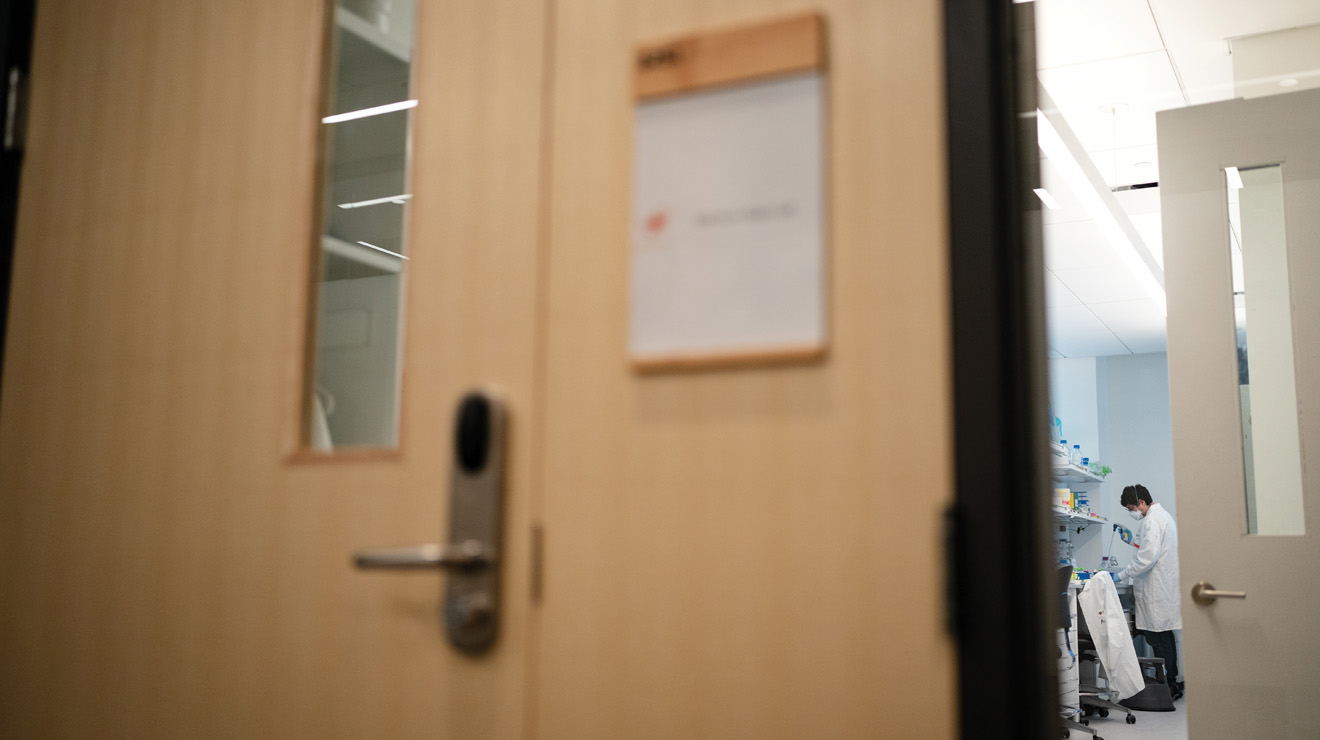
What new advances will researchers develop at ES and SEAS? Brangwynne, the bioengineering institute director, says it’s too soon to possibly know — and that’s the exciting part. The founders of Princeton’s science and engineering departments could not have foreseen today’s technologies, and while today’s faculty can speak about what’s on the research agenda, not even they know where it will lead. In bioengineering, Brangwynne says, applications in human health often come to mind first, but faculty jointly appointed in areas like civil and environmental engineering are exploring different paths such as “living electronics,” using electrochemical properties of cells to create remote sensors that can detect pollutants in waterways.
In the chemical and biological engineering department, core areas such as catalysis, materials science, and systems engineering could have wide-ranging applications in renewable energy, battery technology, pharmaceuticals, and chemical production. Christos Maravelias, the department chair, has a joint appointment with the Andlinger Center for Energy and the Environment and is also an associated faculty member in HMEI. Many in Princeton’s engineering departments have these formal connections to other institutes and centers, he says, and informal ties are abundant.
“I would say the size of the University also helps,” says Maravelias, who previously taught at the University of Wisconsin. “It’s easier to have these collisions, and people learn what others do.”
The ecology and evolutionary biology department has been building on its strengths, such as theoretical ecology, the use of mathematics to study nature’s dynamics, which “was essentially founded at Princeton in the 1970s and ’80s,” according to Levine, the department chair. Faculty are applying these theoretical perspectives to study the spread of human disease, the genetics of insect behavior, and life on the savannas of Africa, Levine says. The work also relates to other areas of inquiry — such as the global loss of biodiversity — that have been top of mind for ecologists and HMEI’s Grand Challenges research funding.
Modern geosciences departments cover both the “fluid earth” — the atmosphere and the oceans — and the solid earth, as well as how these systems interact, how they are changing, and what their histories can tell us about today, as Duffy, the department chair, explains. He is particularly excited about a shared facility for isotope geochemistry. Isotopes help geoscientists reconstruct the past, giving insights on everything from the diets of prehistoric organisms to shifts in atmospheric conditions that date back more than a million years. “A good fraction of our faculty use isotopic measurements in one form or another,” Duffy says, and having the tools together — along with the technical staff to maintain them and train students to use them — will be a boon for future research.
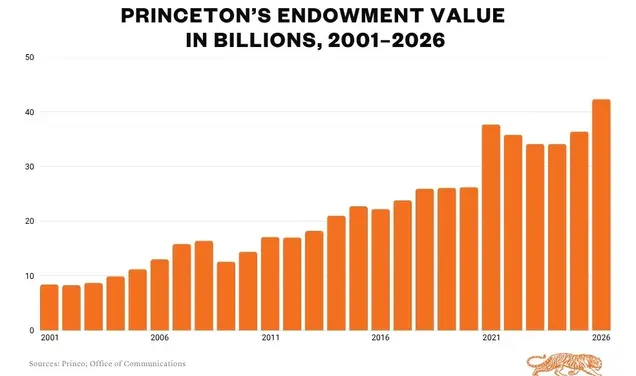
With the opening of ES and SEAS and other construction projects on the horizon, such as Schmidt Hall and an institute for quantum science, the University has made a massive investment in science and engineering. The outlook for federal research funding, however, has been clouded by cutbacks.
The Trump administration’s budget requests for 2026 included massive cuts to the National Science Foundation (down $5.1 billion, or 57%, from the 2024 fiscal year), space science and earth research at NASA (down $3.4 billion), and the National Oceanic and Atmospheric Administration (down $1.8 billion, or 28%, from the 2024 fiscal year), which reduced line items for climate research, weather and air chemistry research, and ocean and coastal research to zero. In January, a bill that preserved most of the research funding was passed with bipartisan support in the House and Senate and signed by President Donald Trump a week later. How the funds will be directed remains to be seen.
Simons, whose work focuses on geophysics, says that funding for the “unfettered, curiosity driven” research that many Princeton labs pursue has become significantly harder to find, often for reasons that have little to do with the science itself.
“All we can do, I think, is through our work show that science is a stronger force than political winds,” he says.
Moving into new spaces amid that uncertainty has been particularly meaningful for HMEI, according to Hackett, the executive director, who says the move acted as a “counterbalance” to the threats against climate science’s future.
“I think the faculty and students who are doing environmental work feel really supported by the University — that this work is important and it will continue,” she says. “I’m not in any way dismissing what we went through, particularly in the spring [of 2025]. … But this, on the other side, was incredibly uplifting.”
Brett Tomlinson is PAW’s managing editor.
Related News
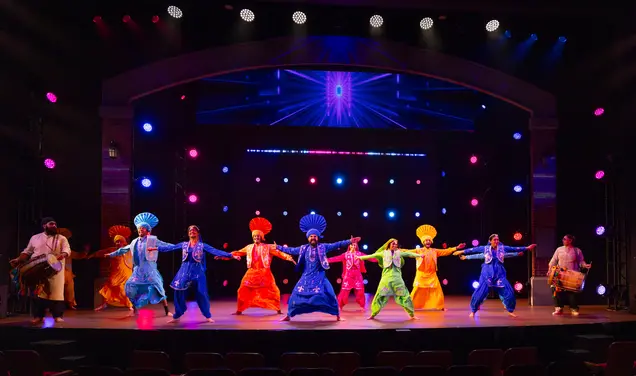
McCarter Theatre’s First South Asian Musical Took Me Back to Forbes Basement
A Beat of Our Own is about a college dance team not unlike Princeton South Asian Theatrics


1 Response
Pat Patterson ’74
5 Months AgoLooking for More on Design and Construction
Regarding Brett Tomlinson’s article on Princeton’s latest great construction project, am I missing something? An extensive, 6-page article on this fantastic addition to the campus and University facilities and no mention of the architects and engineers who designed it. And maybe a recognition of the contractors and builders who realized it would be appropriate.
Editor’s note: The ES and SEAS project was designed by the architecture firm ennead, with Richard Olcott serving as the lead design partner. Engineering firms on the project team included LERA, Affiliated Engineers, Inc., and Nitsch Engineering. Additional details about the construction team can be found on the Princeton University Facilities site.