

Christopher Beha ’02 Penned a Book About Leaving and Returning to Faith
Beha says he hopes Why I Am Not an Atheist invites readers to think
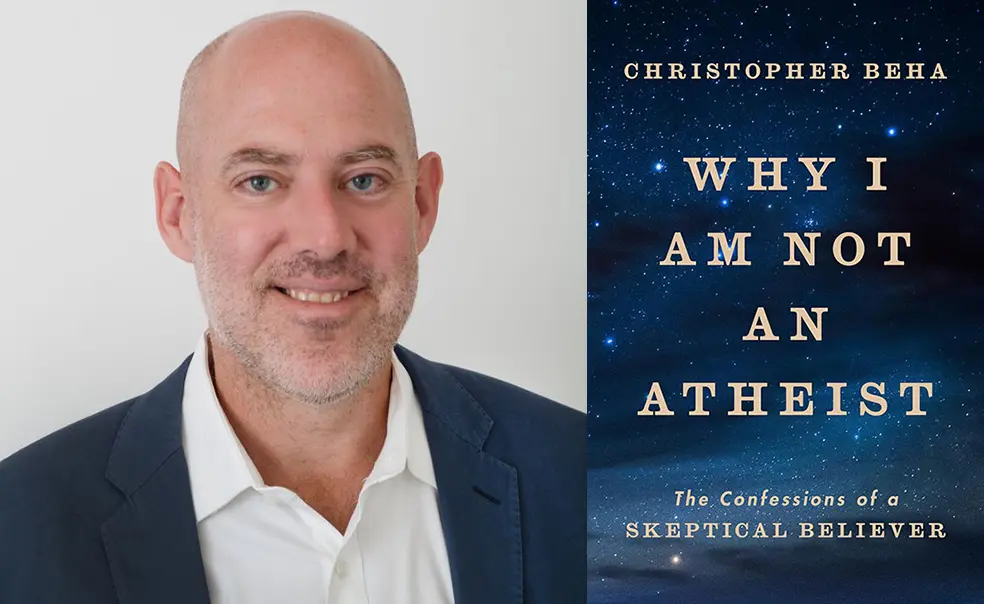

Christopher Beha ’02 was raised to be a good Catholic. He attended Catholic elementary and high school, observed Mass every Sunday, and arrived on Princeton’s campus with his faith intact. Then his world shifted. During his time at Princeton, his twin brother was struck by a car on Prospect Avenue and nearly died. His senior year brought another blow: a diagnosis of Hodgkin’s lymphoma. “These events taught me about loss, human suffering, and mortality, and pushed me away from the faith in which I’d been raised,” he recalls. “It sent me down the road of a long period of spiritual and intellectual searching.”
That searching is the subject of his new book, Why I Am Not an Atheist: The Confessions of a Skeptical Believer, published in February. Named one of The New Yorker’s Best Books of 2026, it follows Beha as he recounts his journey out of and back into faith, while working through some of the oldest questions humans face: Does God exist? What does a meaningful life look like? And how do we actually go about living one?
To find answers, Beha immersed himself in the major secular worldviews, including scientific materialism (the view that the physical world is our only reality) and romantic idealism (that emotion and imagination matter more than practicality). “Reading these thinkers led me to the conclusion that, for me, none of the major atheist worldviews I was presented with were convincing,” Beha says. His conclusion, instead, was that faith — specifically, faith in a created order in which every human life carries meaning — offered the most holistic view.
As he moved back toward belief, Beha also arrived at a broader realization: that no worldview, religious or secular, can be fully proven. “We must all inevitably have some beliefs,” Beha explains, “in the sense that we must all take in certain things when deciding how to live our lives that cannot be arrived at simply through a rational evaluation of the evidence of our senses.”
Beha drew on his former literary pursuits throughout this project. A novelist with three previous books to his name, he spent 16 years at Harper’s Magazine, the last five as editor. He is someone who thinks on the page, and Why I Am Not an Atheist reflects that: It is part personal memoir, part intellectual history, and part philosophical inquiry. His goal was never to persuade readers to believe what he believes; instead, he sought to become part of a conversation and invites readers to think alongside him.
“I would love if both religious and nonreligious readers come out of it with a sense of the importance of having some skepticism, in the sense that the beliefs we hold are beliefs, and no one has a monopoly on the reality of our existential situation,” he says.
“We ought to be talking openly about these things with each other and listening to each other, instead of being defensive about our beliefs or offensive in trying to move others off their beliefs. As a novelist and memoirist, I want the reading of the book to be an experience in the way reading a novel is an experience, rather than a rhetorical exercise where you come out in agreement or disagreement with it.”
The Latest
See all


Related News

McCarter Theatre’s First South Asian Musical Took Me Back to Forbes Basement
A Beat of Our Own is about a college dance team not unlike Princeton South Asian Theatrics


No responses yet