

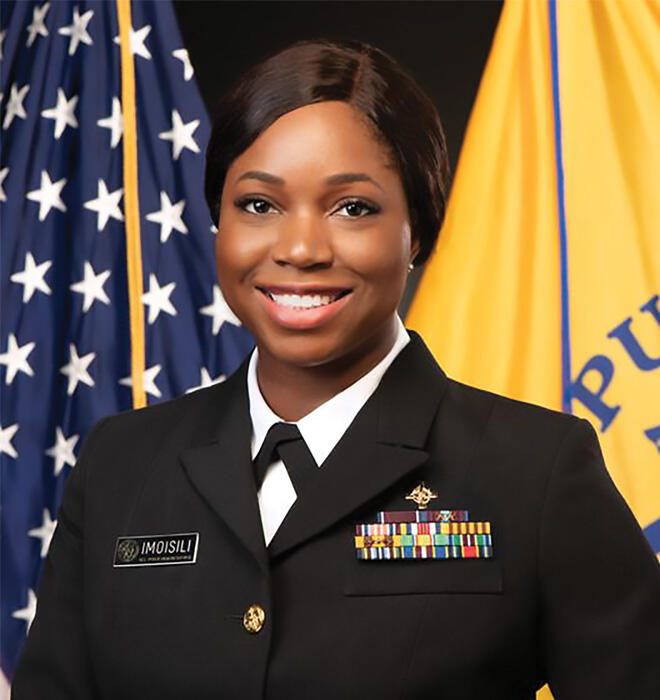
Omoye Imoisili ’08 Found Her Calling in Public Health
Oct. 5, 1987 — Nov. 17, 2025

Before getting degrees from Princeton, Columbia, Johns Hopkins, and Yale; before becoming a physician and official with the Centers for Disease Control and Prevention; and before earning the rank of commander in the U.S. Public Health Service, Omoye Imoisili ’08 was the eldest of her Nigerian immigrant parents’ four children, and she noticed that her mother seemed stretched quite thin caring for her brood.
And so Imoisili, at 8 years old, huddled up with her next oldest sibling, Mabo, 6, about how they could do more to help lighten their mother’s load, including picking up after themselves and being a little less loud.
That intuitive spirit of service to others shaped and animated the rest of Imoisili’s life, right up until she died of colon cancer at 38.
Imoisili, whose friends called her Oye (pronounced Oy-ay) and whose first name translates to “beloved child,” is remembered by a wide range of admirers as a brilliant mind, a caring clinician, and a generous mentor.
Elizabeth Gould, a Princeton professor of neuroscience, served as Imoisili’s senior thesis adviser, and noted that her death is not just a tragedy for those who knew and loved her but “a huge loss to humanity.”
Imoisili’s interest in medicine and public health took root early as she watched her father, Dr. Menfo Imoisili, work as a pediatrician with a subspecialization in infectious disease. Imoisili and her siblings would visit their dad during his long hospital shifts and see how he earned the trust of patients and their families.
As a high school junior growing up in Ellicott City, Maryland, Imoisili joined the Physician Scientist Training Program (PSTP), a national initiative to create a pipeline for underrepresented students through early exposure to scientific research and clinical environments.
Imoisili matriculated at Princeton at the precocious age of 16, but her youth did not prevent other students from looking up to her. “She had an unusual ability to reach out to others while staying focused on her own research,” Gould says.
After graduating in 2008, Imoisili went on to earn her medical degree from Columbia and a master of public health from Johns Hopkins. She completed her medical residency at Yale.
From there, Imoisili decided to put her prestigious training toward the cause of public health, making institutions such as the CDC and U.S. Public Health Service a natural fit.
“Their missions aligned perfectly with how she saw her calling, combining evidence-driven science with interpersonal compassion to help protect and improve the health of entire communities,” her sister Zoddy says in an email.
As Imoisili ascended in her own career, she put a particular emphasis on mentoring, especially aspiring minority female physicians. One of them was Dr. Ntiense Inyang, who first met Imoisili through the PSTP network. Inyang recalls being so taken with this smart, poised, accomplished woman that she soon asked if Imoisili would be her mentor and surrogate older sister.
Imoisili “changed the trajectory of my career and my life,” says Inyang, helping her navigate medical school and leading her to follow in Imoisili’s footsteps. She now serves as a CDC epidemic intelligence service officer.

Inyang and Imoisili went out for Korean barbecue in September 2024 and Imoisili seemed like her typical radiant, upbeat self. She’d never in her life been seriously ill or spent the night in a hospital as a patient.
But just one month later, Imoisili received a cancer diagnosis.
Over the next year, even as her body succumbed to cancer — and as she transitioned from doctor to patient — Imoisili sought to reframe her circumstance as another opportunity for learning.
“She would tell us how interesting, and eye-opening, it was to experience the medical system from the patient side,” says her brother, Mabo, now an internist in Washington, D.C. “She often emphasized how important it is for medical professionals to stay present with patients and their families because so many people that they encounter each day are living through the hardest moments of their lives.”
When a remarkable young person so dedicated to helping others dies, it is understandable to view it as a cruel and senseless outcome, and feelings of sadness and anger are equally understandable.
But the rebuttal to that despair, as Imoisili saw it, is faith. Imoisili’s Christian faith, her sister, Sowa says, “shaped how she loved, served, and carried herself.”
“Even to the end, even though she knew things were probably not getting any better,” Inyang says, “she still trusted that things were going to be OK.”
P.G. Sittenfeld ’07 is a freelance writer based in Cincinnati. His recent work has been published in The Washington Post, Esquire, Slate, and Outside.



1 Response
Joanna Wendel '09
8 Months AgoRemembering Oye’s Kindness
Oye was my pre-frosh host. I will never forget her kindness and hospitality. May her memory be a blessing to her family.