

Opening Exercises 2026: ‘What You Learn Along the Way’
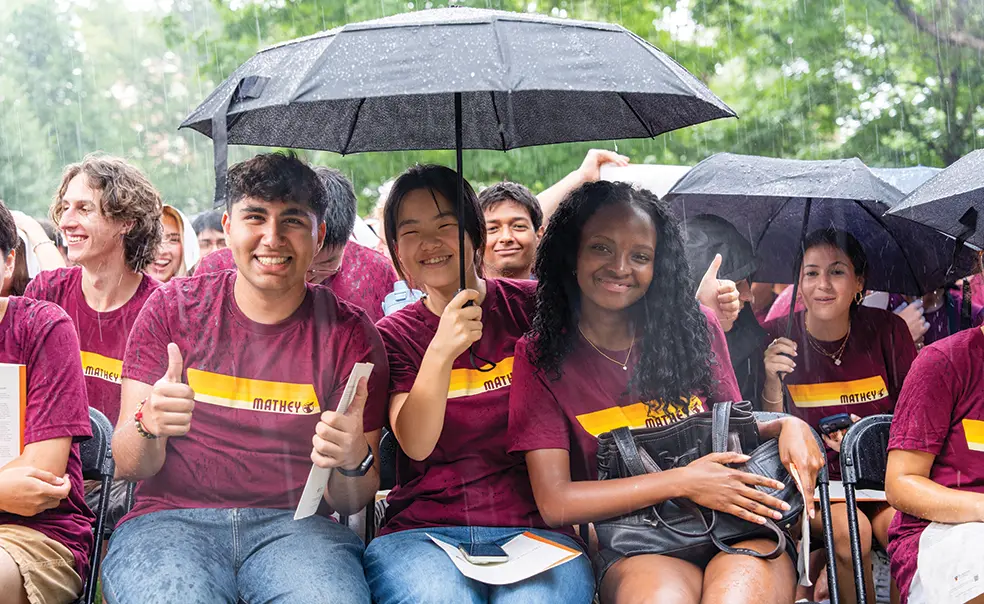

For Opening Exercises on August 30, we gathered on the front lawn of Nassau Hall to welcome new transfer students and members of the GREAT Class of 2030. The students were in great cheer and laughed with me through a brief downpour, after which blue skies returned for the Pre-rade. These are my remarks, as prepared, from that memorable day. — C.L.E.
Please let me begin by saying once again what a pleasure it is to welcome you to Princeton!
Today we perform a ritual nearly as old as Princeton itself: the University president gives a speech to freshly arrived students. It is easy to imagine John Witherspoon doing something similar after James Madison and his classmates moved into their Nassau Hall rooms in 1769.
Someone might ask why we still bother with such an old-fashioned routine.
I could instead post remarks online, and AI could summarize them for you. You could read the summary and do something else with the time you saved.
You could take a walk and explore this beautiful campus.
Or a robot could take the walk for you. You could deploy a drone to record video and summarize key observations.
I hope that suggestion sounds absurd. Skipping the walk deprives you of exercise. It strips away noises, smells, and impressions that might stimulate your senses and your emotions.
The drone would overlook details that might capture your attention because of who you are, because, for example, they remind you of home or because they are unlike anything you have seen before.
You would miss the serendipitous encounters that might launch a new friendship or excite a new interest.
You lose a lot if you replace a walk with a drone’s report.
But you also lose a lot if you replace a lecture, or a book, with a few bullet points.
Lectures, essays, and books travel an intellectual path.
They are invitations to think along with the author.
As you know from the work that earned you a place at Princeton, scholarly exercise strengthens the mind. Conceptual details stimulate insight. Serendipitous connections among ideas launch discoveries and open new horizons.
Genuinely understanding an argument or an idea is not merely a matter of repeating a conclusion; it requires your intelligence, your presence, your active participation in the train of thought.
A good book or a good lecture is a journey, and if you take that journey you grow because of what you learn along the way.
The easy availability of AI tools may tempt us to skip the journey that makes learning possible, but the capacity, and temptation, to replace learning with summary is nothing new.
Let me tell you a story from the distant past—from a time before AI or even cell phones, a time, in other words, when
I was almost as young as you are now.
In the early 1990s, I taught a first-year class to entering students at New York University’s School of Law. I devoted the first two weeks to a short, rarely studied case called Siegel v. Spear.
I would ask students questions about the case, and then I would follow up with more questions that exposed unjustified assumptions in their answers and surprising mysteries in the text. I wanted the students to learn how much they could discover by reading every word carefully.
In my third year of teaching, something miraculous happened. I asked the questions that had stumped everyone in the past, and students answered immediately and correctly.
I was so impressed! I thought that I had the smartest class ever.
Because the class moved so rapidly through my usual questions, I had time for others that I had never asked before. When I posed them, I got terrible answers. My class of legal prodigies suddenly seemed clueless.
Perhaps you have guessed what happened. Students in previous years took scrupulous notes and assembled them into study guides that they passed down to their successors. In my third year, some of the aspiring lawyers in my class no longer had to think to answer my questions. They simply read the answer from their notes—until I asked a new question.
As I pointed out to my students, they learned nothing by reciting answers collected by their predecessors. Even in those technologically primitive times, computers were already far better than human beings at information retrieval.
The key to becoming a leader in your field is not memorizing answers to old questions. It was, and is, developing the skills required to answer questions that nobody has asked before.
It depends on finding and leveraging the human advantage, the ways of knowing that allow us not simply to consume the products of information technology but to evaluate, critique, harness, and build upon them.
So how can we know which knowledge or skills will be most useful in a world where technology changes with dazzling and dizzying speed?
The honest answer is that we do not know. But that is not new. It has been true for centuries, if not millennia, because one thing we do know, and have long known, is that the world will change in unexpected ways.
At Princeton, we want your education to equip you not only to succeed at your first jobs, but also to become leaders many years from now in a world far different from the one we now inhabit.
Liberal arts universities like Princeton are based on the idea that you should learn both deeply and broadly, so that you will acquire not just knowledge but, more fundamentally, multiple ways of knowing that will enable you to discover, attack, and conquer questions that nobody has yet answered or even asked.
Perhaps I can illustrate the point with another story, from a time when I was even younger than you are now.
When I was in high school, my parents were always worried that I would not be able to find a job. (Does that sound familiar to any of you? Some things never change.)
To avert this crisis, they insisted that I sign up for a typing class in high school so that I would have at least one practical skill.
And when I came to Princeton, they told me to take computer science, which was an ahead-of-its-time requirement in the early 1980s.
My parents were absolutely right about typing. I have benefited from my typing skills every day of my professional life.
Computer programming, not so much. I used it in my senior thesis. But I have not written a line of code in more than forty years.
I am glad that I took computer science. It was part of my liberal arts education and has helped me think about the technological transformation of modern society.
From a purely practical perspective, however, I got much more value from the course on modern literary theory that I took in the Department of Comparative Literature.
That statement would have shocked my parents. But I have no doubt that it is true. As a lawyer, a scholar, and a university president, I have needed to think creatively about how words constitute meaning, community, and institutions. And for those purposes, studying structuralist poetics was far more useful than constructing recursive subroutines.
Human advantage often comes from learning things without knowing why or how they will be useful.
Let me finish with one more story, from the Opening Exercises program that took place almost exactly forty-five years ago, in 1981, when I was beginning my junior year. In his address to entering students, President William G. Bowen recited C.P. Cavafy’s poem “Ithaka,” which was inspired, appropriately enough for this Homeric summer, by The Odyssey. I want to share with you a couple of stanzas:
As you set out for Ithaka
hope your road is a long one,
full of adventure, full of discovery. […]
Keep Ithaka always in your mind.
Arriving there is what you’re destined for.
But don’t hurry the journey at all.
Better if it lasts for years,
so you’re old by the time you reach the island,
wealthy with all you’ve gained on the way,
not expecting Ithaka to make you rich.1
As you enter Princeton, I hope that you will not hurry the journey at all. Give yourself permission to savor the experiences and the ideas that make this campus magical.
Linger and reflect, because it matters profoundly what you gain along the way.
It is not the degree you will earn, nor your post-graduation career prospects, it is not the endpoint, it is not Ithaka, but rather the marvelous, challenging, bewildering, sometimes uncomfortable and sometimes awesome journey that will be Princeton’s most precious gift to you.
I look forward to our travels together. Welcome to Princeton!
1 Cavafy, C.P. “Ithaka.” C.P. Cavafy: Collected Poems, 1896-1932 (Princeton University Press, 1975), 34.






No responses yet