

With Prominent Journalists and Hoagies, the ‘Prince’ Celebrates 150 Years
A gala at the New York Historical raised roughly $400,000 for the independent student newspaper
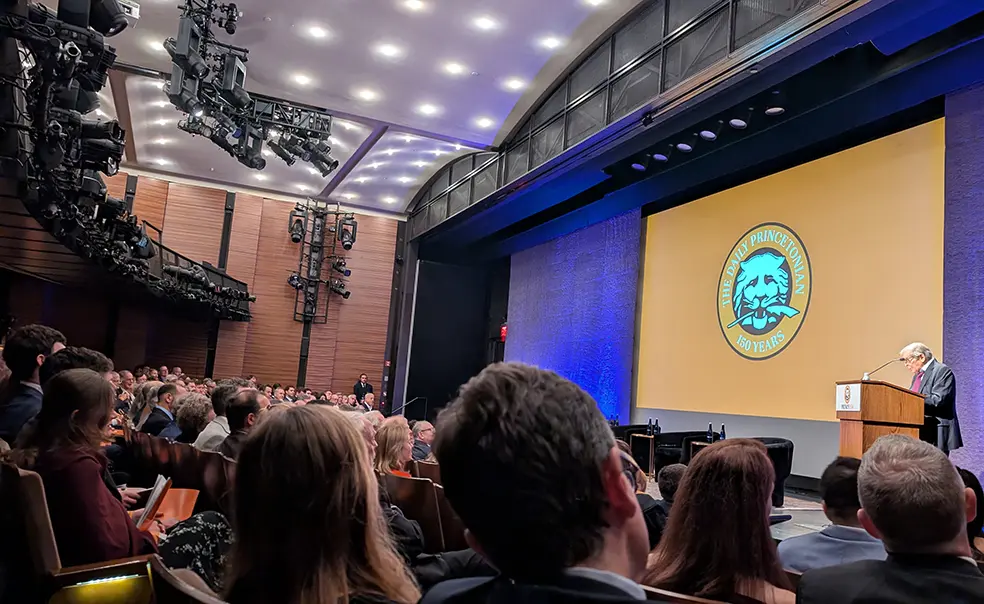

More than half a century has passed since journalist and author Robert Caro ’57, best known for his Pulitzer-Prize winning book The Power Broker, graduated from Princeton, but he can still recall his long shifts in the newsroom of The Daily Princetonian. Despite his attempts to wrap up the paper before the eating clubs stopped serving food at 7 p.m., he would sometimes fail and end up at a burger joint in town.
Addressing about 250 guests at a gala fundraiser for the Prince on Oct. 16, Caro said, “it hardly feels like the same world,” a sentiment echoed by other alumni throughout the evening as they reflected on the student newspaper’s long history. Still, Caro emphasized the importance of good journalism, especially in a time when “the most powerful man in the country tells lies.”
Caro gave keynote remarks during the event held at the New York Historical to mark the Prince’s 150thanniversary; it raised roughly $400,000. Also in attendance were University President Christopher Eisgruber ’83, who gave remarks on the value of an engaged student press; former U.S. Sen. Bill Bradley ’65; members of the classes of 1956, 1957, and 1958; and current undergraduates on the Prince staff.
A new short film was shown: Always On Deadline, by Azza Cohen ’16 and Kathleen Borschow, featuring Prince alumni including former U.S. Ambassador Crystal Nix-Hines ’85, the paper’s first Black editor-in-chief.
The program continued with an alumni panel moderated by ABC News political director Rick Klein ’98, which opened with a discussion about The Cornell Daily Sun’s reporting on a former student’s rape allegations against seven members of a campus fraternity, one of the biggest stories to come from student journalism in recent years.
Marie-Rose Sheinerman ’23, a former Prince editor-in-chief and current assistant editor at The Atlantic, praised the dedication of student journalists who followed the story for two years before its publication and pushed back on criticism that student newspapers are limited in their reporting because of their four-year staff turnover.
Stephen Engelberg ’79, ProPublica’s editor-in-chief, pointed out that no division of the Sun lost a government contact or faced financial repercussions after breaking the story, underscoring the need for independent journalism.
The panelists also discussed AI’s proliferation in journalism, a challenge for news organizations already struggling to adapt their traditional business models to the digital era.
The conversation took a briefly combative turn when Barton Gellman ’82, an investigative journalist and visiting lecturer at the Princeton School of Public and International Affairs, noted that AI disruption is being carried out by companies represented on the panel, referring to former Prince business manager Morgan Kennedy ’07’s affiliation with Google as its senior policy counsel. Kennedy took the jab in good humor and defended the organization by promoting its more collaborative News AI pilot licensing program, which offers compensation to participating news outlets for AI-generated overviews of their work.
Regardless of AI’s growing capacities, Sheinerman argued that journalism will always remain “one of the most human jobs” that relies on human connections, and that AI will never be able to sit in meetings at Nassau Hall to get the inside scoop.
The evening resumed its celebratory tone over dinner as alumni reconnected over memories of 48 University Place.
“Nearly every close friend I have from Princeton was on the Prince,” said Brian Rokus ’99, a senior producer at C-SPAN who served as a managing editor for the paper. “Seeing so many of them in the same room was incredibly special.”
Jon Ort ’21, a former Prince editor-in-chief, said the organization changed his life trajectory.
“The Ph.D. I’m doing today began with an op-ed I wrote my first semester,” he said. The piece reviewed the legacy of Harvey Firestone, who owned rubber plantations in Liberia, and Ort is now researching Liberia’s colonial history at the University of Chicago.
As guests began to leave, current Prince assistant business manager Angela Han ’28 breathed a sigh of relief that the evening had gone to plan but was sad to see the celebration, which had been in the works under several student boards, come to an end. She and other Prince staffers rented two vans to drive into the city and set up a table near the museum’s entrance to sell copies of the Prince anniversary book Princeton in Our Words.
With around 425 copies sold so far, current Prince business manager Alistair Wright ’27 said he is happy with the results.
At an afterparty at Dive 75, students distributed sandwiches from Hoagie Haven that they had hauled by van all the way from Old Nassau.




No responses yet