

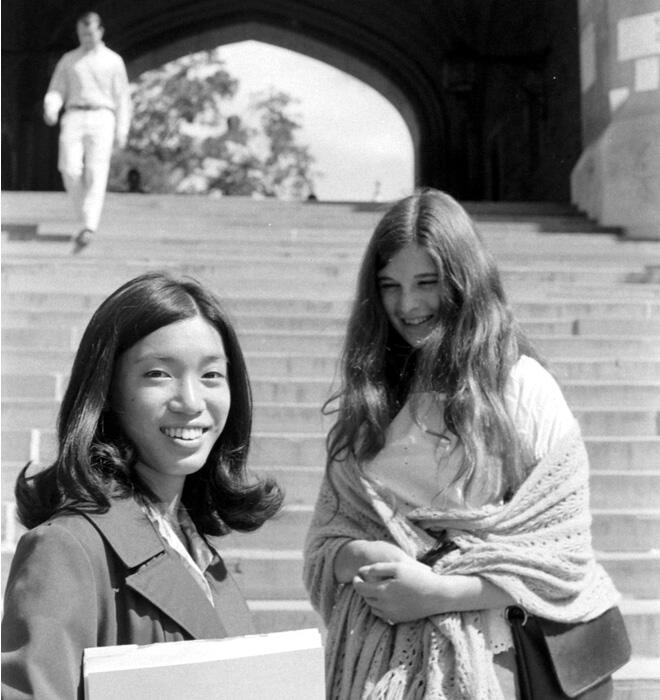
Rande Brown ’71 Taught Buddhism, Karma, and Consciousness
Dec. 16, 1949 — Oct. 13, 2025

Achieving enlightenment was the guiding force behind much of Rande Brown ’71’s life. The daughter of a Jewish lawyer and a homemaker, Brown was the oldest of four children and grew up in Westfield, New Jersey. She was smart and developed interests in Japanese culture and Buddhist philosophy at an early age.
Those passions bloomed throughout her teenage years as she learned more and traveled to Kyoto, Japan, with her grandmother. By that point, Brown was certain she had experienced Japan in a previous life and dedicated the rest of this life to understanding consciousness, both for herself and for others.
Brown first attended American University but transferred to Princeton in 1969 as an East Asian studies major, joining one of the first classes of women to graduate from the University. She explained to PAW in 2006 why she chose Princeton: “I was trying to legitimize my quest for enlightenment to my family,” she said. “It would have been totally weird if I’d dropped out and gone right to a monastery in Japan.”
She said she enjoyed her time at Princeton and formed close bonds with her roommate Tina Sung ’71, Arthur Thornhill ’74, and professor Karen Brazell, who became a mentor to Brown. “I had never experienced anybody like Rande,” says Sung, noting her boundless energy.
After Princeton, Brown spent the next decade in Japan studying Zen Buddhism and working for the Institute of Religion and Psychology, where she helped research the relationship between the mind and the body. She completed her first translation — the book Science and the Evolution of Consciousness — and would go on to become a prominent translator, publishing several other works. Most notably, she also co-authored Geisha, A Life with Mineko Iwasaki in 2002. While in Japan, she was also briefly married.
These threads continued to shape her life when she returned to the U.S. In the 1980s, she founded East West Communications to promote a cultural exchange between the U.S. and Japan and worked with many artists, including Philip Glass, Laurie Anderson, and Cindy Sherman, to host events in Japan. She also helped found the magazine Tricycle: The Buddhist Review, volunteered in the pastoral care department of Beth Israel Medical Center, and went back to school in 2009 to study social work and psychoanalysis.
“I had always been interested in ways that Buddhist practice can be used to alleviate suffering in the real world,” Brown wrote, explaining her choice to become a therapist.
“Her spiritual life was important to her,” Brown’s sister, Sharon Gamsby, says. Brown continued to write and educate about Buddhism, karma, consciousness, and related topics up until she died from complications from esophageal cancer.
Her connection to Princeton over the years was limited, but she attended lunches, starting with her 35th reunion, hosted by Sung. Though frail from her illness, she was in attendance in May, and classmates recall her vibrancy.
Brown’s final book, Live, Die, Repeat: One Woman’s Wild Ride on the Cycle of Life and Death, is scheduled to be published in the summer. It explores what she learned throughout several lifetimes about reincarnation, karma, and finding peace with death.
“Her years of meditation really were so evident in the way that she died,” says Gamsby, who spent Brown’s final month with her in the hospital. “I really feel she’s free.”
Carlett Spike is PAW’s associate editor.




No responses yet