


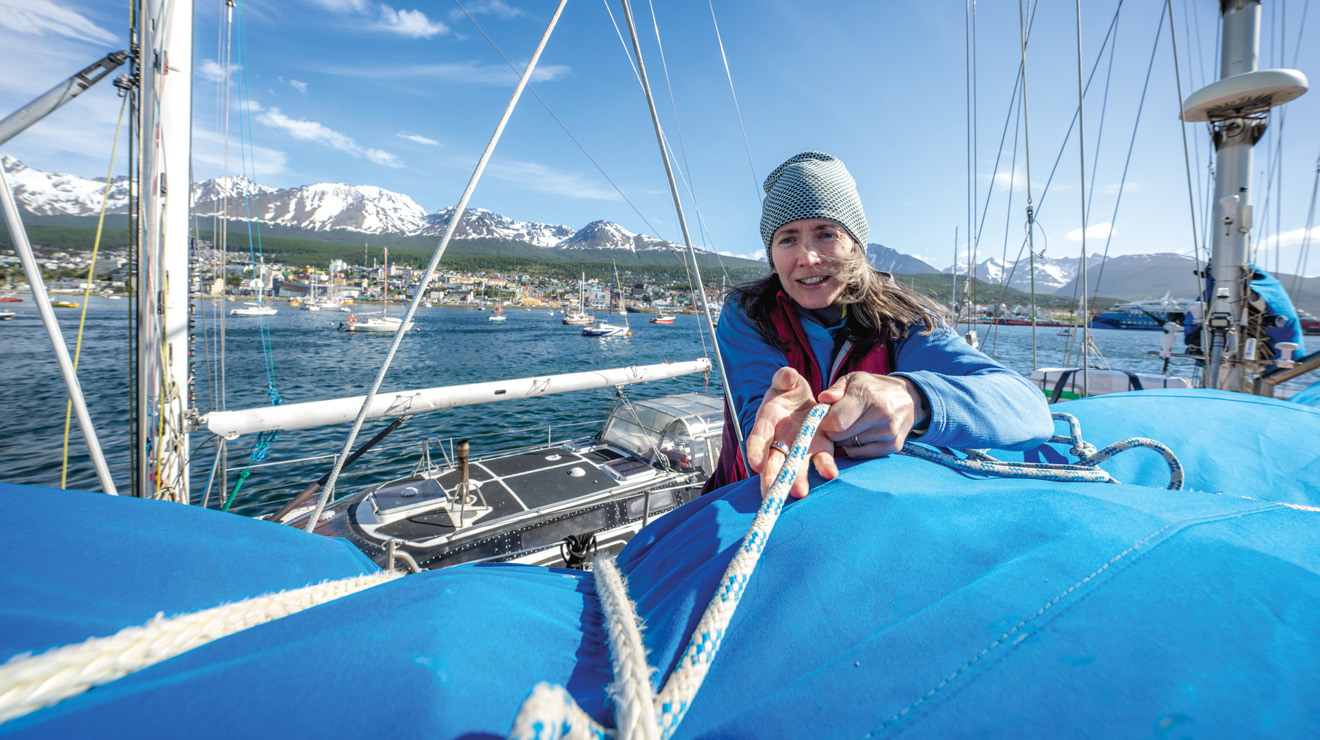
On a sunny Wednesday in November in the southernmost city in the world, Laura K.O. Smith ’05 dons a bright blue parka before jumping in the car for the morning’s adventure.
The plan is to find the geocache, a GPS-trackable container she has hidden on a mountain near her home in Ushuaia, Argentina, where she has lived with her husband, Federico “Fede” Guerrero, since they bought their house in 2018. Designed and built by a French boat captain named Jean Paul Bassaget, their wood-paneled home overlooks a mountain range of southern beeches that frame snowcapped mountains in the far distance — the kind of view Smith wanted geocachers to enjoy when she first hid her treasure several years before.
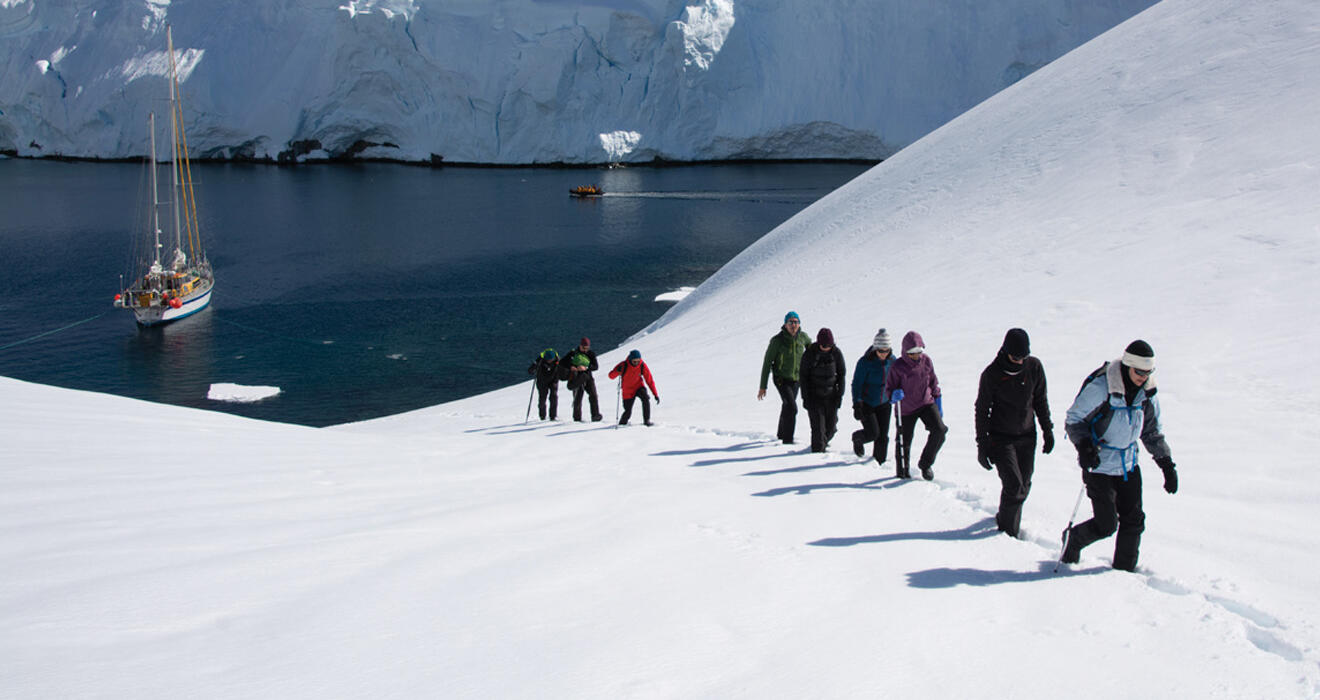
Such views are typical in Ushuaia, a frequent destination for travelers seeking sparkling lagoons and the breathtaking beauty of nature left mostly untouched. But Smith’s reach extends far beyond the mainland. Since 2016, she and Guerrero have brought seasonal groups of eight to 12 adventurers to nearby Antarctica, where participants spend weeks watching whales, observing penguins, and making nightly gin and tonics with rinsed 10,000-year-old glacier ice.
“It’s pretty amazing to me,” Smith says of what she and Guerrero have achieved with 60 South, their travel company, which until 2025 was known as Quixote Expeditions. “It’s just the two of us. We have charter flights going in and out. We’ve changed the game a little bit.”
In addition to rebranding to 60 South, the couple added a third boat, Meredian, to their preexisting fleet. Typically, a journey to Antarctica involves either a large cruise ship with hundreds of passengers — tickets for which cost anywhere between $6,000 and $11,000 for a two-week trip — or private boats that charge hundreds of thousands of dollars to charter. In contrast, the business model of 60 South aims to circumvent both issues of size and cost while maximizing time spent on Antarctica proper. To get on board one of 60 South’s journeys to Antarctica costs between $14,500 and $29,900 depending on the boat and the type of cabin one selects.
A former Outdoor Action leader, Smith has a knack for logistics. In emails she is brief and to the point, her queries missing question marks. In person she is both eloquent and loquacious — on a TED fellow application, she listed one of her hobbies as “talking” — and her laughter, loud and unapologetic, punctuates her speech as she tells story after story. Walking under a dense canopy of trees dripping with the previous day’s frost, she weaves tales of her time at Princeton with current events and news of her family. She occasionally stops to check the geocaching app, which shows where she stands relative to the geocache with a straight line and an approximate distance.
“Here, you lead the way,” she says, handing me her phone. Her bearded border collie mix, Hai-Ma, bounds straight into the trees ahead.
Five months before Smith and Guerrero embarked on their first voyage to Antarctica, they were married in Smith’s parents’ backyard in Maryland, not far from the Washington, D.C. suburb in Northern Virginia where Smith grew up. Her father, Robert Smith, had worked for the State Department on the “law of the sea,” a body of international laws governing the rights and duties of states with regard to the world’s oceans.
“We would have nautical charts on our table on a Saturday as he was calculating how far offshore a country owns,” Smith recalls of her father, who would often ask her geography questions before bed. “By the age of 6 or 7 I could tell you about how exclusive economic zones were 200 nautical miles offshore.”
Smith learned to sail in an Optimist boat on Deep Creek Lake, where her family spent its summers. A historian at heart, she was fascinated by the American Revolution and grew to love the 1990 historical novel The True Confessions of Charlotte Doyle, an account of a 13-year-old English girl who boards a tall ship in Liverpool en route to Rhode Island. As the journey progresses, she struggles with a violent captain who threatens and undermines her for her age and gender, but Charlotte nevertheless resists; after the voyage is over, the once-cloistered girl ends up pursuing a sailor’s life — and redefines who gets to live their life at sea.
Awed by the world in Charlotte’s story, Smith set up her childhood desk to resemble that of an 18th-century captain (think quill pens, fake coins, an old chest). As a high schooler she volunteered on the Maryland Dove, a reproduction of the 17th-century English cargo ship that brought the first Maryland settlers to America, and as a rising college sophomore helped run a summer camp in a tall ship stationed in Martha’s Vineyard.
“I think in all of my dorm rooms I had a poster of Captain Cook’s first vessel,” she says of her time at Princeton.
Smith started at Princeton intending to be a mechanical engineer. But after signing up for a freshman geology seminar featuring disciplinary heavyweights W. Jason Morgan *64, who developed the theory of plate tectonics, and Kenneth Deffeyes *56 *59, whose research furthered theories on “peak oil,” her interests gradually inched toward the geological sciences. She found a home in the geology department alongside Richard Lease ’05, with whom she studied abroad in New Zealand, climbed Mount Rainier, and did geologic fieldwork in Tibet as part of Lease’s doctoral project at the University of California, Santa Barbara.
“Her sense of adventure and willingness to try new things is what stands out,” says Lease, who went on to become a research geologist in Alaska. Recalling memories of caving with glow worms in New Zealand and preparing to climb the most glaciated peak in the United States, he admits that though “Outdoor Action at Princeton is one crowd, the people who continue with that throughout their lives is another.”
Though Lease and Smith both ended up living and working in remote and dramatic locations, Smith — like many Princeton seniors — returned to Princeton after her semester in New Zealand with a familiar dilemma. “I come back senior fall, and everyone’s like, ‘Oh, I’m on my way to an interview with Goldman Sachs’ or ‘Oh, I’m typing up my Rhodes scholarship application.’ And I have no idea what I want to do next.”
Ever the adventurer, Smith knew that she wanted a challenge. She applied for a Princeton in Asia placement just as a fellow geology student sent her an email about a job. A recruiter for Schlumberger, the world’s largest offshore drilling company, would be coming to campus the following day; the application was due by midnight. “Of course, I wasn’t going to work for an oil company because I’m, like, Outdoor Action” — Smith trills off, indicating all the other reasons why it didn’t make sense for her to apply — “but I was like, you know, it’d be really good practice, and it is geology related.”
Smith got the job. Though she initially rejected it for an opportunity to teach in Vietnam, she eventually returned to a Schlumberger position based out of Norway in the fall of 2006. She subsequently spent 10 years working along the coasts of countries including India, Angola, Democratic Republic of Congo, and Norway in a career move that she recognizes as “not your normal route to Antarctica.”
“It’s not the first thing I bring up, but when it does come up, I’ll be like, ‘Full disclosure, I used to work in the oil industry,’” she says. Despite the tensions that might arise between natural resource extraction and the ecological focus of journeys led by 60 South, Schlumberger, Smith says, “prepared me to deal with logistics. It prepared me to deal with risk. It prepared me to figure out my accounting. Maybe I would’ve been doing something else in those 10 years, but it definitely gave me a lot of skills to be able to do what we’re doing now.”
At 30, Smith became the youngest “party chief” — or crew leader on a survey vessel, in Schlumberger parlance — that the company had ever had; she was the first woman to hold the position in 15 years. By then she had also met her husband, Guererro, the Argentine first mate of a Schlumberger survey vessel who was building a boat from scratch in Buenos Aires when the two met in 2009.
Building Quijote was a labor of love for a born sailor, Guerrero’s mother attests over dinner in the couple’s Ushuaia home. Since Guerrero was a child, he would make small model boats and try to get them to float. Quijote was his first life-sized undertaking. In January 2013, the couple took the hand-built boat to Antarctica along with two friends, bringing enough food for an entire year’s journey. On that maiden voyage they saw leopard seals and penguins, visited friends they’d met on previous adventures, and made pit stops at the many research stations that dot the continent, even finding, in one nondescript location, a wedding gift a friend had hidden for them.
“We found it! The cache, the lost cache,” Guerrero exclaims in a video of their adventure, as Smith unearths the geocache. Inside is a penguin keychain and a long letter addressed to the recent bride. Not long after their trip to Antarctica, Guerrero left Schlumberger to pursue his dream of chartering his own boats; in 2017, Smith followed suit.
The first advertisements Smith bought for 60 South’s first passenger trip were in PAW. Lorraine ’75 and Randy Barba ’75 — who met on Princeton’s sailing team — were intrigued. “We were going to the ends of the Earth here. We wanted to make sure that [Smith] had it in hand,” recalls Lorraine of the Barbas’ initial deliberations. “One [FaceTime] conference with her, and we were like: Sign us up. We’re ready to go.”
The Barbas had traveled to Antarctica several years before on a Russian ship. As longtime boaters, they were familiar with what to expect, and yet their trip with Smith and Guerrero, which they undertook in February 2015 with their niece, Kate Barba, still surprised them.
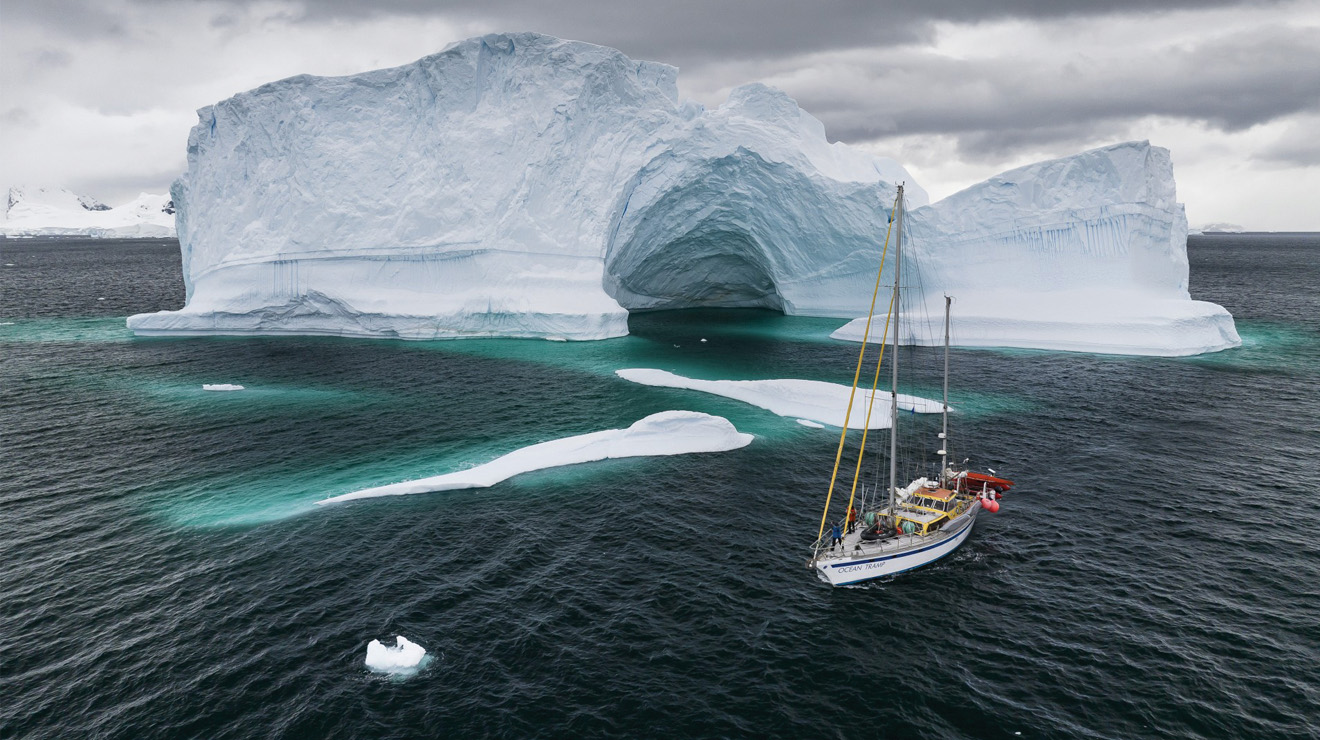
For one, they hadn’t known (or rather, couldn’t tell) that they were the first guests to go onboard the Ocean Tramp — a sailboat Smith and Guerrero purchased in 2013 — where they ate homecooked meals of soups, stews, bread, and Smith’s “amazing” pumpkin muffins. For another, “it was very personalized,” Lorraine says. “The woman has phenomenal energy, so anything you were up for doing, Laura was up for doing.”
Starting in Puerto Williams in Chile, the group sailed around the Chilean fjords before traveling eastward along the Beagle Channel and ending in Ushuaia. Along the way they rode in dinghies, walked across permafrost glaciers, and, after anchoring for the day, hopped on a Zodiac boat for a nightly ritual of “searching for ice” that Randy could plunk into his drink.
“It’s a very difficult place to sail because you get these massive wind gusts that occur,” says Randy. “If you’re not ready for it, you’re doomed. So you had to be very careful about anchoring the boat, and Fede was a master at it.”
The trip gave Smith and Guerrero the confidence they needed to start expanding their business. A year after the Barbas’ expedition, the couple launched their first commercial trip aboard the Ocean Tramp. In 2018, they bought a second boat, the Hans Hanssen. Their added fleet allowed them to shuttle camera crews filming nature documentaries for the likes of the BBC, and their boats have served as research vessels for scientists and biodiversity experts who offer lay passengers important context on Antarctica’s wildlife and terrain. “We’ve brought a scientist since our very first trip,” Smith explains. “Me being a geologist and all that, it was important to me that people interact with the environment through that lens as well.”
Contemporary demand for Antarctic travel is impressive considering how, less than two centuries ago, the continent was virtually a hole in the map. It was only in 1911 that the Norwegian explorer Roald Amundsen became the first person to set foot on the South Pole. Just over a hundred years later, a record 104,076 people visited Antarctica in the 2022–23 season, according to the International Association of Antarctica Tour Operators (IAATO).
IAATO, an organization that Smith joined in 2015, issues guidance on best practices in Antarctica, from drone usage to the distance people should keep from wildlife. This guidance, in turn, is informed by internationally agreed-upon provisions that determine how humans engage with one of the most remote places on Earth.
The multilateral respect for Antarctica’s sovereignty lends the continent — and with it, the communities that uphold it — a singular quality. Signed by 58 countries, the 1959 Antarctic Treaty stipulates peace on the continent and cooperation between the countries that use Antarctica for research. After the Exxon Valdez oil tanker spilled 11 million gallons of oil in Alaska’s Prince William Sound in 1989, the treaty committee produced the 1991 Madrid Protocol to focus specifically on environmental protection in Antarctica, designating the continent as “a natural reserve, devoted to peace and science.”
Now Antarctica faces more than just threats from natural resource mining. Smith, who attended the Antarctic Treaty meeting in India in 2024 as part of an IAATO expert delegation, acknowledges that climate change “impacts Antarctica more than the rest of us.”
“The melting is huge,” she says. “Before, you could bring in invasive plants, and they wouldn’t survive. But now with things being just a little warmer, they might.”
In the second half of the 20th century alone, the mean annual summer temperature of the Antarctic Peninsula rose by over 5 degrees Fahrenheit. Rapid warming has collapsed smaller ice shelves, caused sea levels to rise, and threatened the livelihood of certain Antarctic species like the feisty Adélie penguin, whose food chain has been irrevocably altered.
“It’s not an easy calculation of who’s better and who’s worse,” says Smith, when asked whether traveling as part of a smaller expedition has a lesser environmental footprint than embarking on a large cruise. “The reality is, usually things that are good for the environment” — she lists as examples energy-efficient lithium batteries and purchasing nonperishables in bulk— “are good for business in terms of saving costs on fuel. So once you look for solutions, usually they’re good for everybody.”
On paper, the life of an Antarctic adventurer suggests daily treks and outdoor adventures. In reality, it requires a lot of numbers and computer time, though in Smith’s case even the drudgery has something of a high-wire quality to it. On top of Smith’s responsibilities with 60 South, she also heads committees with IAATO, participates in the Polar Citizen Science Collective (PCSC), and is a member of the prestigious Explorers Club. In what she describes as a “cool tie back” to her origins, she attends treaty meetings with State Department representatives who work in the same office with which her dad was involved. “You can be as involved or uninvolved as you choose,” Smith tells me. “And of course I’m a Type A Princeton student so I’m very involved because I can’t help myself.”
Fittingly, Smith’s demeanor is almost always one of exuberance and energy; in her daily get-up of padded vests and hiking pants, she appears ready to leap into an adventure at a moment’s notice. But a life of constant motion is not without its own juggling acts, required of her not only as a businessowner and partner, but also a daughter, sister, and mother of a 4-year-old, Livia, who has inspired Smith to reconsider how she spends her time. Though a tough decision, Smith — wanting to be as present in motherhood as possible — stepped down as chair of the board of trustees for the PCSC not long ago. And Livia has had no ordinary childhood: At 1 month old she was on a ski lift, and at a year, on Isla de los Estados on an Explorers Club trip. Among her toys is a plushie of Norwegian explorer Roald Amundsen, and among her clothing a T-shirt (a gift from Lorraine Barba) emblazoned with the face of Arnold Guyot — a Swiss American geographer after whom Guyot Hall, former home of Princeton’s geosciences department, was named. “I hope she’s interested in what we’re doing,” Smith says, then laughs: “That girl is switched on. She’s gonna be on our sales team by the age of 10 or something.”
She also recognizes that her daughter might go on to do something entirely different — “and I’m cool with that.” Smith knows, from firsthand experience, the many ways in which life’s paths can diverge before reaching unexpected destinations. “I never feel like I had a path,” she explains. “So it’s just been interesting where the path has led, and I really feel like all the bits and pieces have added up.”
On the way to find Smith’s geocache, we walk 45 minutes or so along a Hacheros trail, named after the prisoners who cut wood from the mountains when Ushuaia was an Argentine penal colony. Occasionally Smith provides a subtle hint or indicates where it might be wise to turn back. “Usually there’s something distinctive about where a geocache is hidden,” she offers. I click the hint on the geocaching app: “Number tree,” it reads.
The cache is nestled under a rock leaning against a tree stamped with the number ‘2082’ in red ink. Finding the treasure at last, there is a feeling of exhilaration that only builds as one walks a little ways out of the forest and into a nearby clearing, where up ahead is the snowcapped Martial Glacier shining in the sun. Save for the sound of boots crunching on ice, it is quiet. The frost is melting, revealing the earth underfoot. Looking out at the view, it becomes clear that when Smith hid the geocache for strangers to find, she was hoping they’d stray a little further to glimpse what else lay ahead.
Jimin Kang ’21 visited Smith in Ushuaia in November 2024.
Related News

Janice Lee ’09 Worked to Renovate One of Hollywood’s Best-Kept Secrets
An engineer by training, Lee has been deputy project manager on the renovation of Hollywood Burbank Airport

No responses yet