
Terence Tao *96 Is Fighting AI Companies For the Future of Mathematics

On Sept. 8, the tech company OpenAI announced that its artificial intelligence programs had solved one of the enduring problems of theoretical mathematics, known as the Navier-Stokes existence and smoothness problem. Navier-Stokes was considered so difficult that in 2000 the Clay Mathematics Institute offered a $1 million prize to anyone who could crack it. For more than a quarter-century, it had stumped some of the world’s top mathematicians, but according to OpenAI, the company threw 10,000 AI bots at the problem and solved it in just 88 hours.
AI bots have been blasting their way through much of theoretical mathematics this year, solving riddles long considered unsolvable. Barely a month after solving Navier-Stokes, OpenAI released AI-generated solutions to more than 350 additional mathematical problems across the discipline.
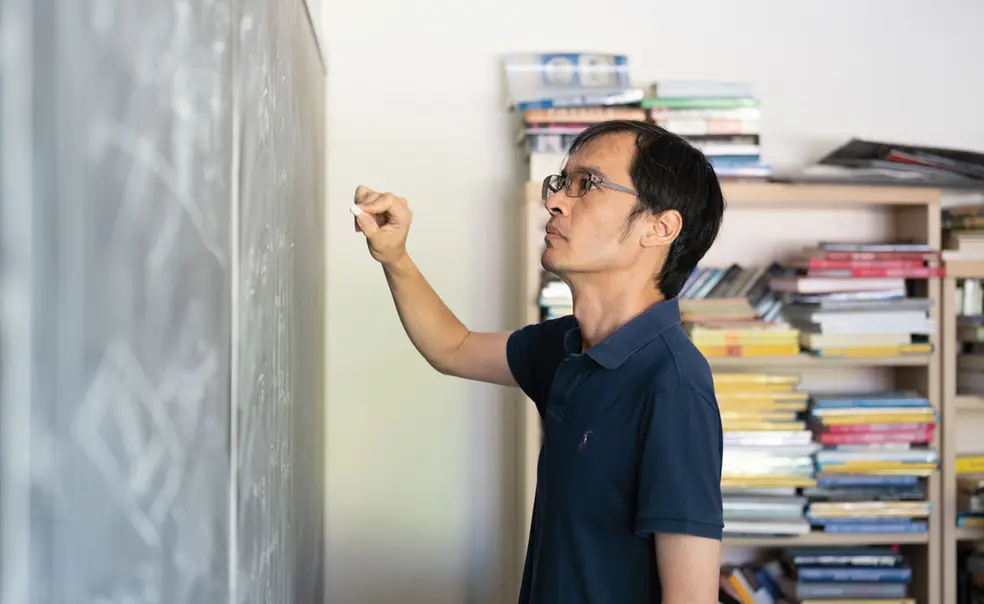
To laypeople, these announcements might seem like cause for celebration or even marvel. For mathematicians, they have been a cause for something approaching existential angst about their future. Emerging as a spokesman for the AI skeptics is Terence Tao *96, considered to be one of the world’s leading theoretical mathematicians.
A professor at UCLA, Tao is an unlikely public figure. He earned his Ph.D. at 20 and won the Fields Medal, the highest honor in mathematics, at 31. Shy and soft-spoken, he rarely gives interviews (although see “Mind of a Mathematician,” PAW, Nov. 4, 2019). But he has joined a public campaign to save math from being cannibalized by AI. “I’m on a war footing,” he told The New York Times in October.
Like almost all mathematicians, Tao uses AI as a labor-saving device in his own research. He had been working with OpenAI to improve its programs but stopped around a year ago when he concluded that the company was using him, and the discipline, to boost its share price rather than to advance human knowledge. Since then, he warns, AI models have gotten even faster and more powerful, with little regard for the consequences.
“We can afford to be slower than this,” Tao said at an October meeting of the Foundation for Science and AI Research, a group he co-founded in 2025 to promote responsible AI use. “OK, fine, [AI companies are] solving major conjectures and so forth left and right, but they’re not actually creating any value.” What AI companies are doing instead, he says, is strip-mining mathematics much the way mineral companies strip-mine a mountain, extracting what is valuable while leaving the area barren.
AI companies, Tao and others complain, have produced hundreds of scientific papers claiming to have solved various mathematical problems, but have made it difficult for humans to check whether they have done so. Often this is because their models are proprietary and hide the steps the AI agents took to arrive at their conclusions. Upon closer examination, some AI-generated mathematical papers have proven to be incorrect.
Mathematics, Tao argues, is about more than just producing the correct answer. The steps taken to arrive at the answer are often equally valuable, both to show that the answer is correct and to point toward other research, which may have little to do with the original problem. Churning out answers by machine can erase years of painstaking research, often done by younger mathematicians trying to gain a foothold in the field, while offering few offsetting benefits.
Tao fears that AI programs may destroy the collaborative nature of higher mathematics, driving scholars to hide their research rather than share it lest AI swoop in and solve their problems for them. In a Sept. 2 blog post, Tao suggested that some types of mathematical problems may have to be declared off-limits to AI, in part to give younger mathematicians something to solve on their own.
“I guess we are seeing the end of the romantic era of mathematics, the age of heroes, which has happened in other disciplines centuries ago,” Tao mused in an Oct. 15 episode of the podcast Numberphile. “I think we are moving to an industrial era. Math will become much more large scale. We’ll work in big teams, more like the other sciences.”
The Latest
See all


Related News


These Young Alumni Balance Tech Careers and Musical Ambitions
‘...I realized that I probably wanted to live a life where I had the opportunity to pursue what I felt like was my purpose,’ says Naaji Hylton ’22
AI and the End of the World
As warnings about artificial intelligence grow louder, four Princeton experts debate how worried we should be
No responses yet