

Alumni-Made AI Hearing Aids Help a Hoops Coach and Others
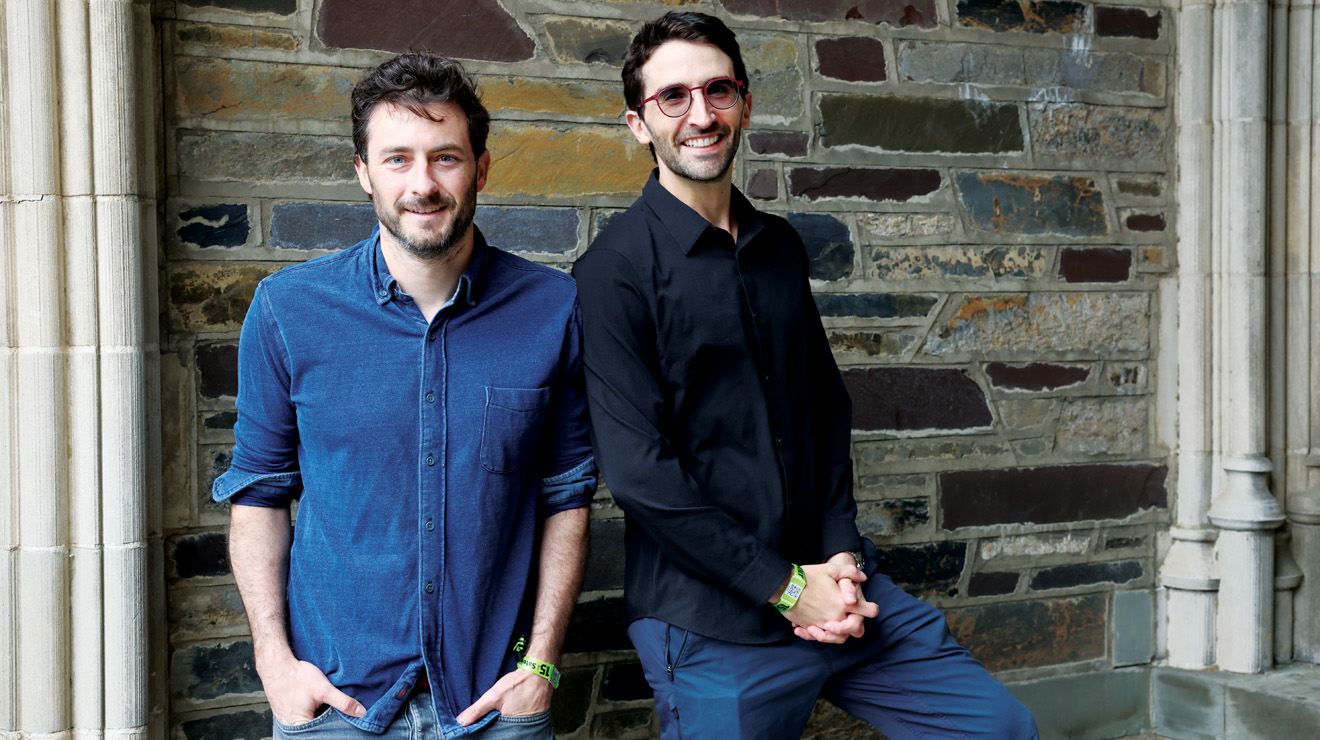
The AI-powered Fortell hearing aids were developed by Matthew de Jonge ’10 and Cole Morris ’10
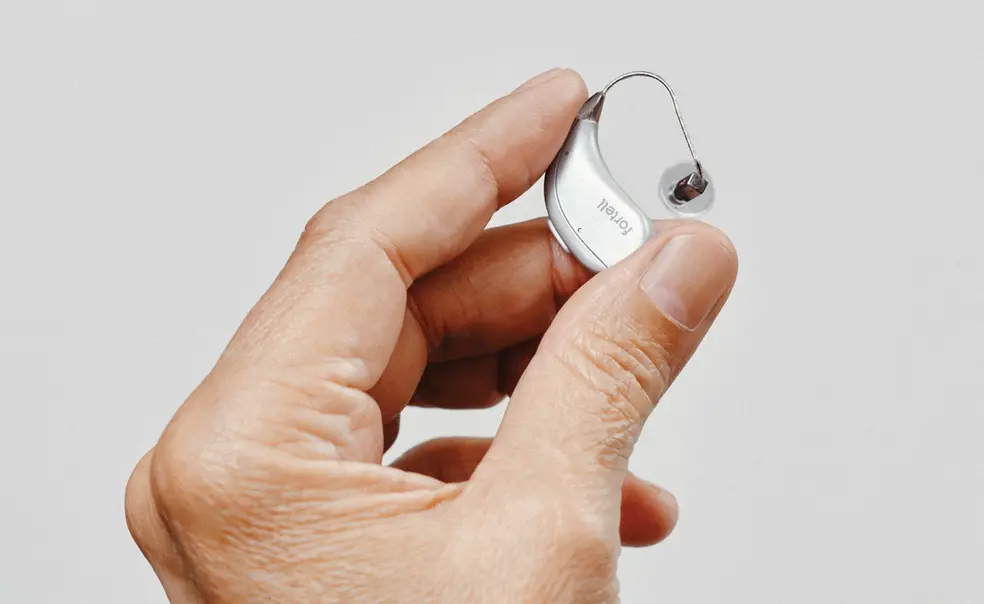

For Princeton men’s basketball coach Mitch Henderson ’98, the loss to Virginia Tech in the opening round of the 2016 National Invitation Tournament was not the worst part of the evening. He had played and coached in raucous arenas before, but something about the crowd noise that night at Cassell Coliseum in Blacksburg, Virginia, affected him differently. It may have permanently damaged Henderson’s hearing.
“Immediately after the game, I could tell that something was wrong,” he recalls.
Henderson eventually saw an audiologist, but he struggled with hearing loss over the next decade. Noisy restaurants were hard, not to mention noisy arenas. Still, he resisted getting hearing aids, saying he felt too young to need them and even a little too vain to be seen wearing them.
Last March, Henderson read about Fortell, a new AI-assisted hearing aid that had just come on the market. A lot of people seemed to be wearing them, so he decided to give them a try. They changed everything. “You can actually feel the difference,” he says. Not until later did Henderson learn that the Fortell hearing aids had been developed by two other Princeton alums, Matthew de Jonge ’10 and Cole Morris ’10.
According to the National Institutes of Health and the Centers for Disease Control and Prevention, about one in seven Americans suffers from some degree of hearing loss. It is the third most prevalent chronic physical condition in the U.S. Nearly 29 million adults could benefit from wearing hearing aids, according to the Hearing Loss Association of America, but even among those who can afford them, many resist because of how ineffective they are.
De Jonge had seen this in his own family, and it provided him with the impetus to invent something better. His grandfather Alfred de Jonge ’49 had enlisted in the U.S. Army after fleeing Nazi Germany. A loud explosion during the war permanently damaged his hearing, but he attended Princeton on the GI Bill and had the enviable campus job of serving as a translator and chauffeur for Albert Einstein at the Institute for Advanced Study.
Alfred de Jonge’s hearing loss got worse as he aged, but hearing aids didn’t help. His grandson noticed how isolated he became and believes that deafness adversely affected his cognitive health as well. He died in 2011.
“I felt like hearing aids and the audiologists failed him,” de Jonge says, “so for the last 15 years or so I’ve been obsessed with the question of building a better hearing aid.”
As de Jonge explains it, hearing loss is a problem of the brain as well as the ears. People with good hearing can sit in a noisy restaurant and focus on the voice of the person speaking to them while filtering out background sounds and other voices. Conventional hearing aids struggle with this subtlety. Most try to address hearing loss by amplifying everything, which can create a cacophony of noise.
De Jonge and Morris, who majored in mechanical engineering and the School of Public and International Affairs, respectively, have been friends for most of their adult lives. Not only did they live together for four years as undergraduates in Butler College, they both joined the same hedge fund, Bridgewater Associates, after graduation. Several years later, de Jonge joined another startup, working on AI, while Morris ran a data science team for a small healthcare company. They founded Fortell in March 2021.
“Among the age-related-hearing-loss set, getting into the Fortell beta test has become a weird status symbol, the aural-prosthetics version of a limited-edition Birkin bag.”
— Wired magazine
The Fortell hearing aids rely on an AI algorithm they developed. They trained it on millions of hours of audio, teaching it to distinguish between a conversation the wearer is likely engaged in and other noise in the room, amplifying the former and filtering the latter. That AI program has been downloaded onto a tiny chip that is implanted in the hearing aid.
Morris and de Jonge worked on their model for five years before they began testing it last fall at an audiology clinic in Manhattan. Working their connections in the New York finance and entertainment worlds, they had no trouble lining up volunteers.
“Among the age-related-hearing-loss set,” Wired wrote in a profile of the company in December, “getting into the Fortell beta test has become a weird status symbol, the aural-prosthetics version of a limited-edition Birkin bag.”
One of those first adapters was comedian Steve Martin. “I’ve tried different brands of hearing aids, and they’re good, but they’re not this good,” he told the magazine. “I used to dread going to a restaurant, and now I don’t.”
Another enthusiastic early adopter is venture capitalist Gordon Ritter ’86. As he aged, he noticed that he was having trouble keeping up during noisy meetings or found himself talking too much or too loudly to compensate for his inability to follow conversations. The change with Fortell, he says, has been “night and day,” and he emphasizes that he is not an investor in the company, just a satisfied customer.
Fortell sells its hearing aids, which are manufactured in Danbury, Connecticut, from a single audiology clinic on the Upper East Side, but de Jonge and Morris plan to add clinics in Boston; Greenwich, Connecticut; and Palm Beach, Florida. As their market choices suggest, Fortell hearing aids are expensive, selling for $6,800 a pair, which de Jonge says is competitive in the current market. (According to the National Council on Aging, prices for some hearing aids can exceed $7,000.) Hearing aids are not covered under Medicare, and other financial assistance is limited, which can limit the availability of high-end models to the well-to-do.
Still, it appears that building a better hearing aid, like a better mouse trap, can also lead the world to beat a path to your door. Morris says Fortell now has nine audiologists working six-day weeks to fit new patients and support existing ones.
Henderson, who has overcome his qualms about wearing hearing aids in his early 50s, wishes he had discovered Fortell sooner.
“I was nervous about what the guys on the team would think,” he admits. “But they have been completely normal, which says a lot about them, and it gave me the confidence I needed.” Not only is he wearing them full time, he is even working them into his recruiting pitches, using de Jonge and Morris, the two former roommates turned tech innovators, to illustrate the lasting value of a Princeton education.
Still, for the coach, one final beta test awaits. Henderson has worn his hearing aids at practice, but they have not yet been arena-tested. When the Princeton basketball season opens, he will be wearing them on the sidelines.
“Professionally, a big part of what I do is being a very good listener, paying attention to a lot of things,” he says. “It’s helping me do that, which makes me better at what I’m doing.”
The Latest
See all


Related News
With Prominent Journalists and Hoagies, the ‘Prince’ Celebrates 150 Years
A gala at the New York Historical raised roughly $400,000 for the independent student newspaper


7 Responses
Katherine Holden ’73, M.D.
2 Months AgoHearing Aid Success Story
Although I am a retired physician, I have rarely had the occasion to feel like I’ve made such a difference in a person’s life as I experienced recently. I read the article about the new Foretell hearing aid (July issue) and sent the article to a friend, who has experienced a profound hearing loss over the past few years. She brought me a bouquet of flowers last week and told me I had “changed her life.” She’s tried every high-end hearing aid available but used the Foretell hearing aid (which relies on AI) after reading the article and was uniquely delighted. Apparently, the quality is excellent and the details of the device have eliminated all the problems she’s experienced with those she’s tried previously. The company has been able to tweak her aids through the internet, totally eliminating her need to travel for minor improvements in the quality of the aids. Many thanks to those two Princeton men, Matthew de Jonge ’10 and Cole Morris ’10, who made such a difference in her life!
Jane Garvey Adriance
3 Months AgoInterested in New Hearing Aids
I am 95 years old and gratefully very healthy. I wear hearing aids because I have a hearing loss. I live in the Princeton area and would like to know where I might buy Fortell hearing aids.
Matthew de Jonge ’10
3 Months AgoFor More Info About Fortell
You can give us a ring at (917) 410-5407 or book a call at Fortell.com. It will be our honor to meet you.
Eric Lieber
3 Months AgoRoom for Improvement in Hearing Aids
I have been using hearing aids since 2018 or 2019. In so many social situations they fail. I am rooting for you. Please do not make your hearing aids exclusive, Birkin Bag-like status symbols; instead, please sell them at Costco.
Marvin Jerry Kenig *65
3 Months AgoAI Hearing Aids
I’m interested to learn more.
Matthew de Jonge ’10
3 Months AgoMore about Fortell
More information is available at www.fortell.com or info@fortell.com.
Matthew de Jonge ’10
3 Months AgoHelping Alumni Hear Better
Mark, Gordon, Coach Mitch — thanks for featuring our story! We are honored by the opportunity to help fellow alumni hear better!