

This Is How Princeton’s Endowment Works
Endowments are back in the news, and PAW is here with a Q&A to clear up any confusion

Editor’s note: This article, originally published in May 2025, has been updated with new information and figures as of October 2026.
Princeton’s endowment has long been a popular topic of conversation, especially since 2021, when the University reported a 46.9% return on its investments. After that, changes to the endowment’s value were modest, with negative returns in 2021-22 and 2022-23 and a 3.9% uptick the following year. In October 2026, the University reported a 23.7% return for fiscal 2026, bringing the total to $42.3.
There are many misconceptions about how endowments function and PAW is here to help.
Let us know in the comments what questions you have, and we will update this article.
How did Princeton’s endowment get to be so big?
The first endowment at Princeton was established in the 18th century to provide student scholarships. Alumni have donated to the University ever since. But it wasn’t until the presidency of Bill Bowen *58 (1972-88), when the endowment more than tripled, that it loomed so large. Bowen’s term coincided with a revolution in University investing as schools across the country tried to diversify their portfolios. During this period the trustees also established Princo in 1988 to manage the endowment.
Although Princeton is also known for its high donor participation rate — with 45% of undergraduate alumni donating to Annual Giving in 2024 — this isn’t necessarily a metric that measures endowment growth. Gifts to the endowment — also known as capital gifts — are separate from the smaller donations that many alumni give.
Over the past decade, Princeton’s endowment has had an average return of 9.2% per year, reaching $42.3 billion in July 2026. As of 2025, Harvard had the biggest endowment at $51.9 billion, but Princeton ranked first in dollars per student at about $4 million per undergrad.
How is the endowment used?
According to the University, about two-thirds of the University’s $3.4 billion dollar operating budget is covered by endowment funds. Within that budget are costs related to faculty, staff, construction, and facilities maintenance. The endowment also pays for 70% of financial aid costs for undergraduate students.
Why doesn’t Princeton withdraw more from the endowment?
More than half of the endowment is restricted, meaning gifts can’t be spent but can be invested, and those returns are what the University taps. In addition, 70% is set aside to be used strictly for the donor’s purpose, such as scholarships or a faculty chair.
In general, the endowment continues to grow because the University spends about the same percentage each year. According to the 2024-25 Report of the Treasurer, that amount equaled about 5% that year. If Princeton were to spend substantially more than that percentage over an extended period, the endowment would likely shrink. As the report notes, the trustees decide each year how much to spend — usually between 4% and 6.25%.
OK, but in times of need or extraordinary circumstances, can’t Princeton take more money out of the endowment and use it to fill a shortfall?
The trustees can and have spent a greater percentage in a given year. For example, when the pandemic disrupted University operations in 2020-21, President Christopher Eisgruber ’83 announced that the spending rate was likely to be more than 6% but that such spending over a longer period would not be sustainable. The University made similar spending adjustments in 2008-09 and 2009-10, during a period of global recession, while also enacting significant budget cuts.
The University could use endowment funds to pay for research impacted by the federal funding pauses. Northwestern University announced in April that it would do just that. However, as Phillip Levine *90, an economics professor at Wellesley, points out, the endowment isn’t a “piggy bank,” and you can’t simply take money out. A large part of the endowment isn’t liquid.
The endowment is structured to be able to sustain large one-time losses, such as in 2008. As Eisgruber explained to The New York Times in April:
“What we are looking at is how best we can use resources to preserve the core mission of the University … . We said we’re going to protect three things that are critical to what it is we do. That’s our teaching, our research, and our affordability, and access to the University. And we’re going to find ways to change other parts of our operation, to draw upon other resources, to allow for temporary increases to our endowment spend rate in order to get us through this period … . We can do that kind of thing, again, with ‘temporary’ being an important word in there.”
What impact will the new endowment tax have on Princeton?
When Princeton was first subjected to a federal endowment tax in 2019, it paid 1.4% on its annual net investment income under the law that applied to private colleges with more than 500 tuition-paying students and endowment assets of at least $500,000 per student.
A new law passed by Congress in July 2025 raised the tax for the wealthiest private universities, beginning with the 2026 tax year. It establishes three tiers based on endowment assets per student: 1.4% for institutions with $500,000 to $750,000 per student, 4% for those with more than $750,000 to $2 million, and 8% for those exceeding $2 million. But the revised tax applies only to private institutions with at least 3,000 tuition-paying students. Princeton’s endowment exceeds $3.5 million per student, placing it in the highest bracket if it meets that enrollment threshold.
In August 2025, Princeton announced a significant expansion of its already generous financial aid program, including free tuition for most undergraduates from families earning up to $250,000 annually. The University projected that undergraduate financial aid spending would rise to $327 million in 2025-26, from $283 million the previous year.
As PAW reported in August 2025, the expansion raised the possibility that Princeton could avoid the new tax by bringing its number of tuition-paying students below 3,000.
In May 2026, The Daily Princetonian reported that Susan Ciniglio ’09, a managing director at Princo, told attendees at a January alumni leadership conference that Princeton was exempt from the revised tax because it had fewer than 3,000 tuition-paying students. The Prince attributed her remarks to several attendees, who spoke on condition of anonymity.
The University has not publicly confirmed that exemption or disclosed its number of tuition-paying students.
How could access to Princeton change if the endowment were to shrink?
Levine showed PAW a graph (see replica below), and explained the function of the endowment in allowing students access to the University.
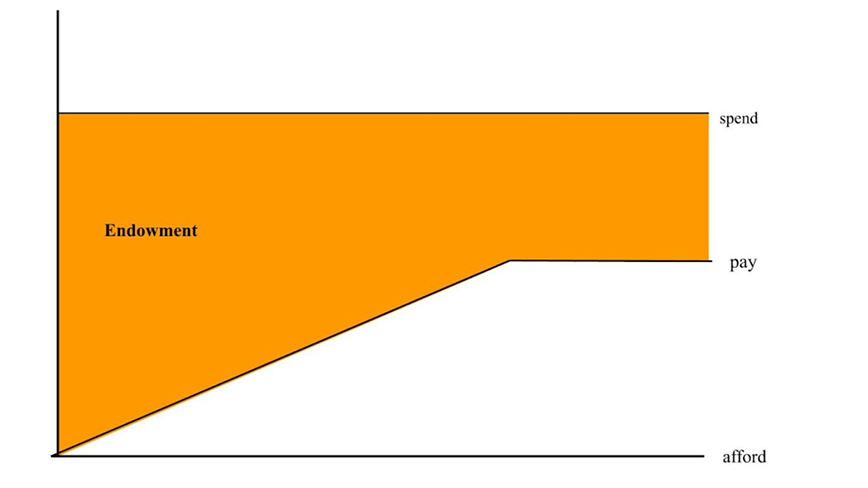
“You have, like, a pretty high sticker price … . But not everyone pays that. If you’re low income, you don’t pay anything,” he explained, indicating the point on the graph where the x and y axes meet.
“So if you can’t afford anything at Princeton, you pay almost nothing. Right as your financial resources increase, you pay more and more and more until eventually you get to full pay,” he said. It’s the endowment that fills in this gap and creates access for students from lower incomes.
In talking with The Times, Eisgruber suggested tough choices could have to be made, for example, between funding research and giving financial aid. “At some point, you get to really tough choices about, how good does your financial aid program have to be in order to be able to sustain the research that you do?”
In early April, Princeton’s trustees approved “preliminary budget parameters” for 2025-26, according to a news release, projecting increases in undergraduate financial aid (up 8% to $306 million) and graduate stipends (up 7% to $365 million).
The Latest
See all


Related News

With Prominent Journalists and Hoagies, the ‘Prince’ Celebrates 150 Years
A gala at the New York Historical raised roughly $400,000 for the independent student newspaper



2 Responses
Grady C. Grissom ’84
1 Year AgoRising Tuition Costs
Can someone explain why tuition has greatly outpaced inflation in the last 25 years? Second, is the gap between tuition and inflation associated with access to federal funding?
William H. Earle ’69
1 Year AgoConfusing Graph on Access
The graph accompanying this article is very poorly done. It clarifies almost nothing. Why are there no labels on the x and y axes?