

The Mr. Christmas Family Spreads Holiday Cheer Year Round
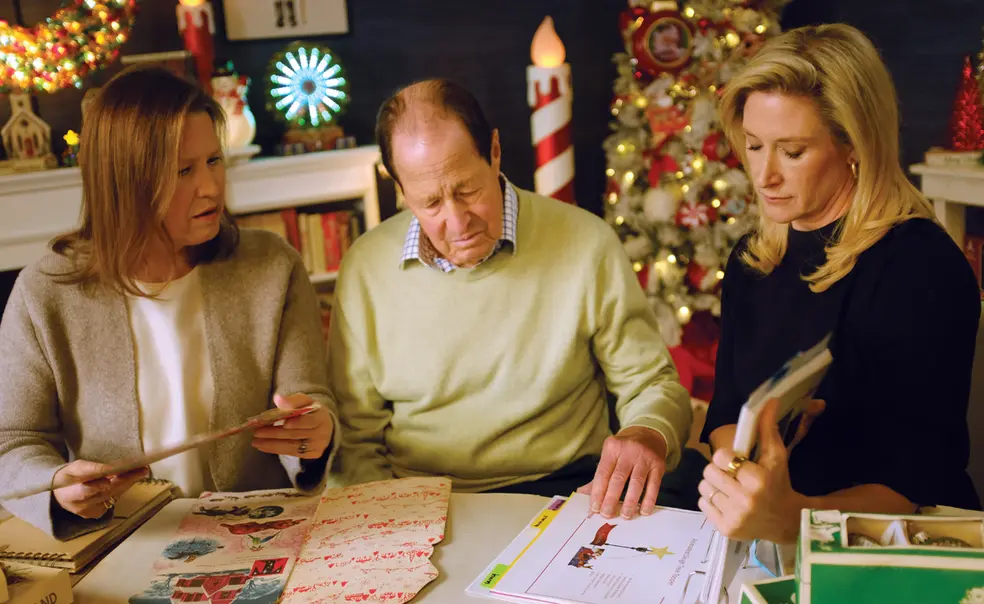

Christmas doesn’t come just once a year for the Hermanson family. It’s a year-round commitment that has spanned three generations.
It all started in the 1930s when Merril Hermanson, who created window displays for local businesses as part of his advertising job, found his creations became incredibly popular at Christmastime. “He realized two things: how window displays captivated people’s imaginations, and they wanted those decorations in their own homes,” says his son, Terry Hermanson ’64.
Eventually, “the Christmas part eclipsed the advertising and doing store windows,” says granddaughter Leslie Hermanson ’97. Merril Hermanson officially founded Mr. Christmas in 1933 in West Virginia. When he married Lydia, the couple dedicated their lives to building the company, which sold holiday items through retailers and catalogs.
In 1949, the company moved to New York City, where it opened a temporary store at Fifth Avenue and 42nd Street during the holiday season. Terry Hermanson remembers that as a tween, “[I would] go down on the weekends during the Christmas season and sell our decorations,” he says. Soon after graduating from Princeton with a degree in philosophy, he went to work for Mr. Christmas full time.
Now, more than 90 years after its founding, the business is still in the family under the leadership of sisters Leslie Hermanson ’97 and Merril Hermanson Pope ’06. Their sister Sarah Meister ’94 is also on the company board of directors (and her son Lee Meister is currently in the Class of 2027 at Princeton). The company expects to sell millions of Christmas items this year, and has also expanded to sell items for Halloween, St. Patrick’s Day, Valentine’s Day, and Easter.
Leslie and Merril took more circuitous routes back to the family business. After graduating with a degree in English, Leslie, CEO of the company, became a lawyer. “I was working for a firm and not really loving it, and thought maybe Mr. Christmas would be more meaningful,” she says.
Merril, the executive vice president, graduated with a degree in art and archaeology and worked at startups and as a teacher while helping out with Mr. Christmas during the summers. During those summers, “I realized how incredible the operation was and so much bigger than I dreamed,” she says. She eventually joined the company full time.
While the company is bigger now, its objective remains the same as when it was founded: to create unique and immersive indoor and outdoor Christmas items. The company was one of the first to use lights, music, and animation in decorations like ornaments, carousels, and artificial trees that they source and manufacture. It has also adapted to changing shopping habits. For example, Mr. Christmas ornaments were on the cover of the 1965 Sears Christmas catalog. As catalogs have gone out of style, the company now sells its products through about 100 retailers as wide-ranging as Walmart, Neiman Marcus, and QVC. The rise of e-commerce and MrChristmas.com has also enabled the company to sell directly to consumers.
Through those changes, they’ve stayed “faithful to that vision of making magical traditions for people at Christmas,” Leslie says.
“It’s unbelievable to see productions that were big 25 years ago are suddenly surging in popularity now. Everybody wants what they had as a kid.”
— Merril Hermanson Pope ’06, executive vice president, Mr. Christmas
While the company works to provide new experiences with new technologies through its products (this year, it is offering a rotary phone with built-in AI so children can speak to Santa), its most popular items are nostalgic ones — ceramic light-up Christmas trees, Christmas carousels, and an animated, ladder-climbing Santa. For Christmas 2026, the company obtained a license from Mattel to reissue an animated Barbie carousel tree topper that it first sold in 1994.
“It’s unbelievable to see productions that were big 25 years ago are suddenly surging in popularity now,” says Pope. “Everybody wants what they had as a kid.” Family connections are important, too. Another popular Mr. Christmas item is a “message in a bottle,” which features a mini Christmas tree and recording device. When someone opens the bottle, the message plays.
Terry has kept sustainability in mind throughout his career. The Dec. 1, 1983, issue of PAW profiled his efforts to make a recyclable Christmas tree. While the idea didn’t take off, he’s now working on developing more sustainable packaging through his startup Papyros Packaging, while being semi-retired from Mr. Christmas (he is also on the board of directors).
All three credit Princeton for giving them an education that helped broaden their understanding of the world.
“I had no practical education at all from Princeton, and I’m proud and glad,” Terry says wryly (while his daughters groan in the background). “Because of that I was really learning about the world.”
But the apple hasn’t fallen far from the tree. “Terry is one of the most intellectually curious people I know,” says Leslie. She learned how to go down rabbit holes chasing an interest (such as Walt Whitman, who was the subject of her senior thesis), which she’s carried forward. “Learning about very obscure corners of any subject was truly invaluable,” she says.
Merril adds, “My best memories I have were of taking classes where I was a fish out of water. It kept me curious and wanting to learn more.”
The Latest
See all


Related News

These Young Alumni Balance Tech Careers and Musical Ambitions
‘...I realized that I probably wanted to live a life where I had the opportunity to pursue what I felt like was my purpose,’ says Naaji Hylton ’22

AI and the End of the World
As warnings about artificial intelligence grow louder, four Princeton experts debate how worried we should be

No responses yet