

‘Jimmy’ Revisits a Princeton Hollywood Legend
A new biopic explores how World War II shaped Jimmy Stewart ’32’s career and invites a fresh look at his legacy
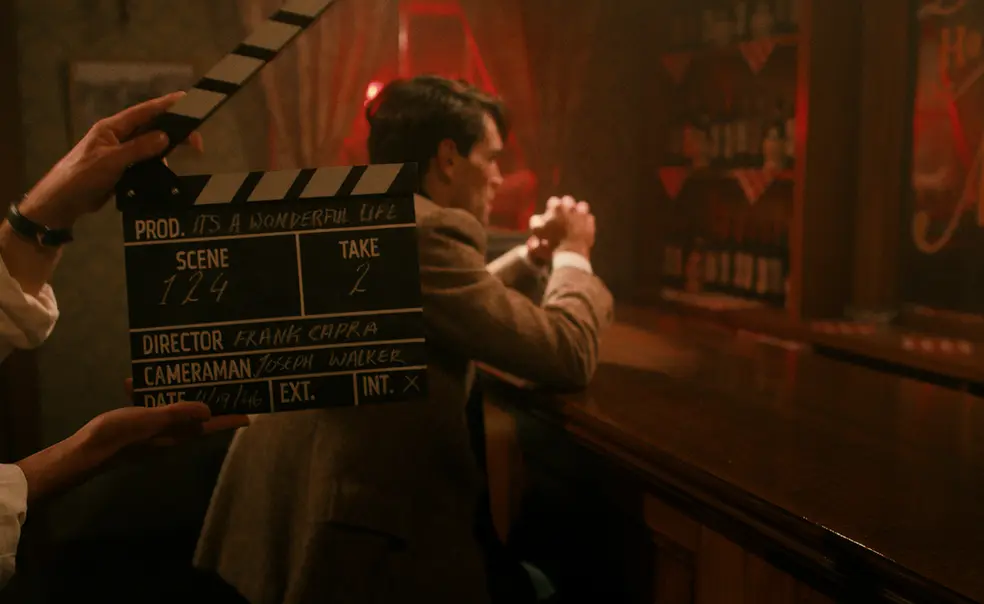

Writing for Guideposts magazine in 1987, the actor Jimmy Stewart ’32 admitted that after returning from three years in World War II, he “was just a little bit scared” to confront his old Hollywood career. Stewart had enlisted in early 1941 against the wishes of producer Louis B. Mayer, flying 20 combat missions in the European theater between 1943 and 1945.
Stewart came home flak happy, an antiquated term for PTSD. He kept quiet about his B-24 missions and meanwhile “wondered aloud,” according to biographer Donald Dewey, whether he would ever return to the screen. His acting career resumed only with a shove from a friend, director Frank Capra, who was going out on a limb with a much-rejected Christmas screenplay called It’s a Wonderful Life.
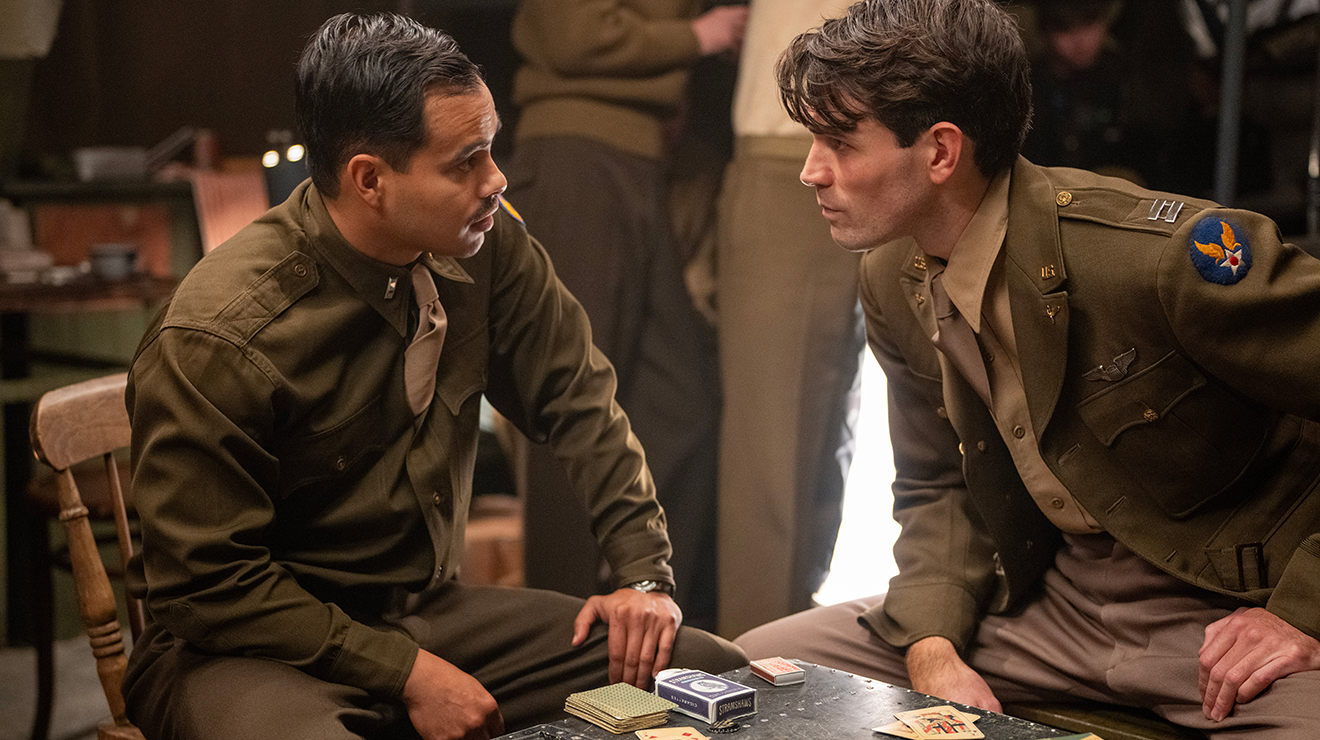
Director Aaron Burns stumbled upon the Guideposts article in 2021 and knew he had a story worth telling. Stewart’s wartime experience forms the crux of a new Stewart biopic, Jimmy, out Nov. 6. The film stars KJ Apa as a convincing Stewart. “He’s from New Zealand,” Burns told PAW of his lead. “So his native accent is not American. I really think that helped.” Apa constructed a dialect by studying Pennsylvania accents; screenwriter Justin Strawhand wrote Stewart’s stilted cadence into his script. The portrayal is impressive.
In a line of alumni that includes actors José Ferrer ’33, Brooke Shields ’87, and David Duchovny ’82, Stewart is unquestionably the highest-profile, most decorated film star to ever graduate from Princeton. But his presence isn’t felt on campus as it once was. After all, Stewart’s Best Actor Oscar (he later received an honorary award) came way back in 1940.
“His name is on one of the major theaters we have on campus,” says Connor Odom ’27, a founding member of the student filmmaking club Princeton Pictures. “And my professors mention him in class. But most of our visual arts and theory courses are rooted in modern, postmodern, or contemporary stuff. The majority of the films we study are from the ’60s on.”
Stewart was still acting in those years, but professors can be excused for sidestepping his late-career Western streak: The Rare Breed, Bandolero!, The Cheyenne Social Club. Most of today’s filmgoers remember Stewart for his first postwar role, George Bailey in It’s a Wonderful Life. Odom says, “The Garden Theater screens it every year.”
There are those around campus for whom Stewart still looms large, but they tend to be specialists. French and Italian Ph.D. candidate Yassine Ait Ali, who focuses on interwar cinema, uses Stewart as a fulcrum in arguments about the centrality of Princeton in early Hollywood culture. “Princeton and cinema were born in the same place at almost the same time,” says Ait Ali, referencing the fact that Thomas Edison’s Kinetoscope and Kinetograph patents — 1891 and 1897, for inventions developed just up Route 1 — bracket the College of New Jersey changing its name to Princeton University in 1896.
Ait Ali has been leading cinematic walking tours of campus for the past year. “Princeton has been aligned with Broadway and with Hollywood ever since the beginning,” he says. “Cinema used to be very linked to theater — it was just theater that was filmed. And Jimmy Stewart was able to wear both hats. It’s fascinating that one of the biggest movie stars of all time went to Princeton.”
But Stewart almost didn’t go to Princeton. And he didn’t plan to study acting once he got there.
Growing up, Stewart had his eyes on the Naval Academy in Annapolis. His father, Alex Stewart 1898, wanted his son to follow in his footsteps and leaned on connections to enroll him at the prestigious Mercersburg Academy in Pennsylvania, where a staggering 54 of Stewart’s 104-man class would attend Princeton. Stewart was sold when his father took him on a morning walk through FitzRandolph Gate, Nassau Hall rising across the quad.
Planning an aviation career, Stewart entered Princeton’s engineering department. He switched to architecture after struggling in math. A scholarship for architectural graduate studies appeared to solidify his next few years — but he’d been making simultaneous inroads with a much different crowd, performing on his old accordion with Princeton’s Triangle Club.
Asked as a sophomore if he might consider acting as a profession, Stewart replied, “Absolutely not.” The question was posed by Triangle Club member Joshua Logan 1931 (eventual co-writer of the musical South Pacific), who later said of Stewart, “He winced as he sang my corny rhymes. … But he was so good. I knew deep down he loved acting but was too embarrassed to admit it.”
Stewart’s nascent acting career, says Ait Ali, emphasized the degree to which early Hollywood derived from the stage. “The difference was not big when cinema was young. Film was looking for its own visual poetics. Stewart used what he learned in the Triangle Club and on Broadway in cinema. It was easy for him.”
Stewart joined a summer theater group on Cape Cod before his architectural studies began, following the group to Broadway and postponing graduate school. Hollywood scouts found him in New York and brought him in for a screen test on a Hell’s Kitchen soundstage.
While Ait Ali’s studies demonstrate a link between Princeton and the Hollywood of yore, Odom says these connections have diminished. “We have great graduates in cinema,” he says, “people like Ethan Coen ’79 and Ellie Kemper ’02. But I wish there was more of a centralized way to build connections from here to the film industry.” Not easily discouraged, Odom has been forging his own path. His Princeton Pictures screenings have lately surpassed the 194-seat capacity of the James Stewart Film Theater.
Watch the official trailer for Jimmy:
The Latest
See all


Related News

New Women’s Basketball Coach and Stellar Seniors Shoot for Another Ivy Title
Lauren Gosselin called the senior class ‘a shining example’ of different development paths
Experienced Men’s Basketball Team Looks to Prove Last Season’s Dip Was an Outlier
Tigers’ 2026-27 roster returns 100% of its minutes played and 100% of its scoring

Podcasters Lester Nare ’14 and Krishna Choudhary ’14 Created an ‘ESPN for Science’
WIRED magazine named ‘From First Principles’ one of its top science podcasts

No responses yet