

Juju Lane ’23 Brought Irish Folklore to a Brooklyn Garden
As artist-in-residence with the Brooklyn Greenway Initiative, Lane created a performance out of an Irish myth

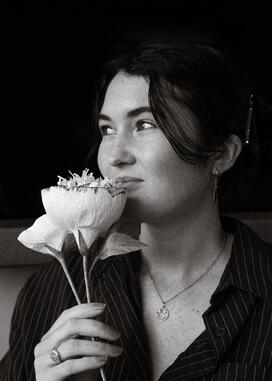
It makes sense that Juju Lane ’23 would eventually write a musical about an ancient Irish myth, performed in a botanical garden on a beautiful September evening while sirens wailed on the adjacent Brooklyn-Queens Expressway. Meadow Song: The Ballad of Airmed’s Cloak, which was performed at the Brooklyn Botanical Gardens last month, ties together experiences from both Lane’s background and her studies.
Lane came to Princeton planning to be a philosophy major, but she switched to religion with a certificate in environmental studies after taking a class called American Scriptures with associate professor Seth Perry. “I was totally hooked,” she says. “For me, it brought what I thought was interesting in the realm of philosophy and applied it to the lived experience of people in the world now.”
Lane’s maternal grandmother is Irish, and Lane spent a year between high school and college on a working holiday visa in Dublin. These experiences, along with her studies in religion and being pre-med for most of her junior and senior years, coalesced with her junior year paper on the rise of pseudoscience around essential oils. For her senior thesis, she went back to Ireland for a summer and traveled around the country to get a better understanding of what alternative medicine looks like there. She found “a deep and incredibly rich history and traditions of herbal medicine,” which is protected there as a historical practice, and she saw a “fascinating overlap between Irish paganism and pagan spirituality and the practice of herbal medicine.”
At the same time, she watched the rise of the MAHA movement in the United States and the reemergence of spirituality outside of traditional religion here, through practices like witchcraft, tarot, and living by cycles of the moon. She published a segment of her thesis in the journal PSYCHE in 2023.
After graduating, she started leading “nature bathing” programs, where participants immersed themselves in nature while engaging their senses, through the Brooklyn Botanical Garden at the Naval Cemetery. The garden is part of the larger Brooklyn Greenway Initiative, which also offers an artist-in-residence program for people already working in that space. Lane won the residency for 2026 and used some of the research from her senior thesis to create Meadow Song, a theatrical retelling of The Tale of Airmed’s Cloak, a short Irish myth in which the god of healing loses his way from both natural healing traditions and his family. Lane expanded it into a play told in a bardic method with 10 original songs by three performers.
On the September night the performance was staged on a floating boardwalk over the garden’s native pollinator meadow, there was an accident on the Brooklyn-Queens Expressway. The play’s climax was accompanied by sirens in the distance. Lane says that when she read audience feedback, she found that some people found the “sound of ambulances fit with the dramatic arc of the play (which is literally about illness, death, healing, rebirth), and made them reflect on those themes in a more visceral, immediate way.”
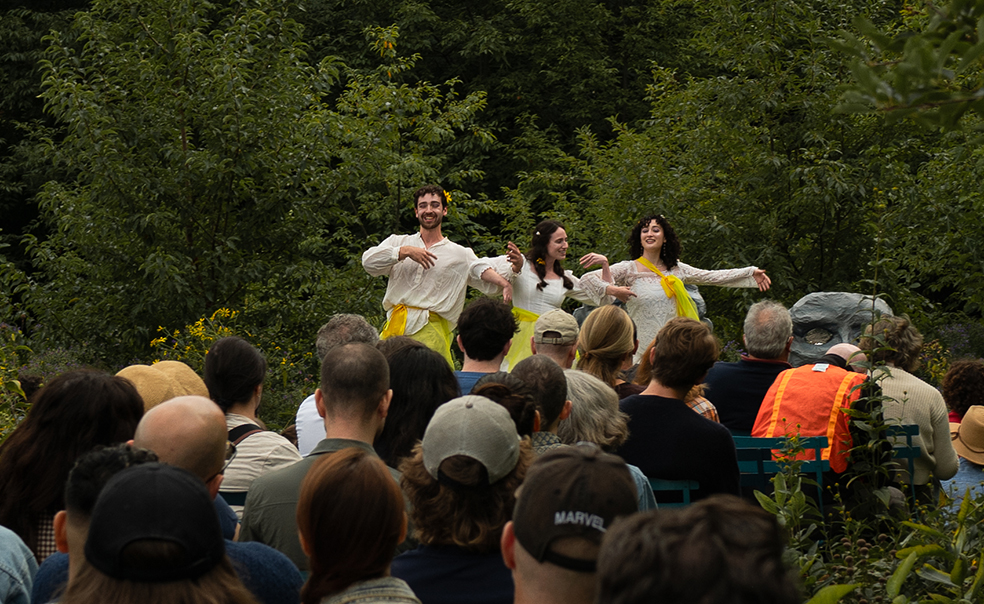
Meadow Song draws from Lane’s academic experiences, but also on the history of the Brooklyn Botanical Gardens. Formally known as the Naval Cemetery Landscape, it was the site of the Brooklyn Naval Hospital Cemetery where at least 2,000 people were buried from the late 1800s and early 1900s. And while many individuals buried there were moved to the Cypress Hills National Cemetery in 1926, archival and archaeological investigations found that hundreds were not, and their burial sites still have not been identified. The path that now winds through the garden and the platform Meadow Song was performed on are elevated so as not to disturb the soil below.
The Meadow Song story “maps unbelievably well to the history of the land of the botanical garden,” Lane says, with themes of death, burial, and rebirth through plant life and ecology. More than 100 people attended including Perry, who was Lane’s senior thesis adviser. “It was a beautiful full circle moment,” she says.
As her residency winds down, she is developing plans to perform Meadow Song at other greenspaces in the future, in addition to working her full-time job as lead of cultural intelligence at Osmo, an olfactory science company that digitizes smell to create custom fragrances. She thinks the two tie together well. “The experience of being in the meadow is immensely olfactory, and [it’s] one of the things I loved about having this outdoor beautiful space.”






No responses yet