

Professor Jennifer L. Jennings ’00 Explores Inequality in Schools


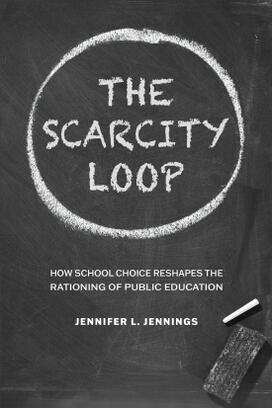
The book: The Scarcity Loop (Russell Sage Foundation) examines the promises and limitations of school choice through the lens of New York City’s high school admissions system. Jennifer L. Jennings ’00 explores how a system designed to expand educational opportunity can actually create new forms of competition, shifting the burden of navigating complicated admissions processes onto students and their families. Drawing on more than 450 interviews, participant observation, administrative data, and archival research, Jennings follows students, parents, counselors, and principals as they navigate a complex system in which demand for desirable schools exceeds available seats. She reveals how access to opportunity increasingly depends on families’ ability to navigate deadlines, gather information, and understand admissions rules, allowing existing inequalities to persist in new forms.
The author: Jennifer L. Jennings ’00 is the Class of 1988 Professor in Domestic Policy and professor of sociology and public affairs. She is also the director of the Education Studies undergraduate minor, Teacher Prep Program (TPP), and the Education Research Section (ERS). As an undergraduate at Princeton, she majored in School of Public and International Affairs. Her research interests encompass matters relating to racial, socioeconomic, and gender disparities in educational and health outcomes.
Excerpt:
INTRODUCTION: THE WORK OF GETTING IN — WHEN PUBLIC EDUCATION BECOMES A PRIVATE PROJECT
Every September, a line forms outside Brooklyn Technical High School. It starts with mothers holding folders close to their chests, a teenage boy tugging at a backpack strap, phones glowing like fireflies. Within minutes, it stretches 40 people deep.
The line advances in uneven jolts. Men in crisp shirts slip through the crowd pressing test prep advertisements into open palms, offering anxious parents 25% off in a city where admission to eight high schools, Brooklyn Tech among them, hinges on a single exam. “What’s Your Child’s Status: Passing or Failing?” demands another man’s flyer, the words stamped in bold green and scalding red.
Beneath a towering rainbow balloon arch, the line spills inside. Teenagers hopscotch up the grand staircase, weaving past towers of high school directories. The air smells of hot dogs and carries chatter that crests and breaks across the room.
For one weekend, Brooklyn Tech transforms into a seven-floor shopping mall, a citywide expo of 440 high schools. The bustle inside exists because here, in New York City, a home address guarantees no specific high school. Since 2004, every eighth grader must apply, and can rank up to a dozen options. Some schools open their doors to all. Others consider test scores, grades, interviews, essays, or auditions. Once applications are filed, an algorithm assigns each student to a single school.
At the fair, schools distinguish themselves by styling their tiny piece of real estate. Some tables are draped in the Department of Education’s standard-issue red plastic tablecloths. Others are brightened with posterboard and marker, and a few gleam with professionally designed banners. At one, 10 students in matching shirts leap over their table to reel in traffic; at another, a single adult lingers. A few tables sit empty behind only a printed sign.
Parents and teenagers move between these tables searching for a high school. Sweat beads along their brows. Families fan themselves with brochures, trying to read possibility from fragments: a smile, a poster, or a tone of voice.
The urgency in these hallways belongs to the present, but the building behind them carries another story. A century before the balloon arches and tote bags, a different ambition shaped this place. It began with Dr. Albert Colston, a Cornell-trained engineer with two decades of chalk dust on his sleeves. Colston spent his life in machine shops and classrooms and believed a city could be built through its public schools as surely as through steel.
In October 1918, with the last tremors of war reverberating across the Atlantic, Colston stood before the Brooklyn Engineers Society and spoke not of battles fought or lives lost, but of New York City itself — a city he believed would fade without a new modern technical high school. It was an audacious idea in a year defined by scarcity, grief, and the end of a global war. But Colston, remembered as a man who refused to hear the word “No,” moved only in the direction of possibility. New York City needed skilled men ready to mold and lift the skyline rising around them. Public schools were the city’s scaffolding — what held New York City’s next century in place long enough to build it. Brooklyn Technical High School threw open its doors four years later, in 1922, with Colston at the helm. Fifteen million dollars produced a 594,000 square foot academic fortress — a monument not only to “the educational ideals of one man,” as the New York Times put it — but to recovery, modernity, and progress itself. Brooklyn Tech’s seams ultimately stretched to educate 6,800 students a year. Colston would not have predicted the global city these halls would come to contain. When Brooklyn Tech opened, the country stood on the brink of the 1924 Immigration Act, which barred nearly all immigration from Asia. A century later, the hallways carry voices from every corner of the globe: students speaking Mandarin, Bengali, and Korean; new arrivals from Latin America and the Caribbean; and White families returning to blocks their grandparents once left behind.
The city’s oldest patterns also remain visible here, their depth evident in the fact that New York City’s school system is the most racially segregated in the United States. Colston could not have foreseen the rising number of teenagers living in homeless shelters, their school searches constrained by the uncertainty of next year’s address. Or the fierce choreography of intensive parenting unfolding alongside the long hours of parents working second shifts, their absence the price of trying to build something better for their children. A hundred years after Colston’s dream, a paradox persists. In a city overflowing with schools, there are still too few good ones to go around. In one of the wealthiest cities in the world, how can a great public education remain out of reach for so many?
Excerpted from The Scarcity Loop by Jennifer L. Jennings. Copyright (c) 2026 by Jennifer L. Jennings. Used with permission of the publisher, Russell Sage Foundation, and the author.
Reviews:
“The Scarcity Loop is essential reading for anyone seeking to understand why school choice policies so often fail to deliver on their promise. With a rare combination of meticulous research and genuine readability, Jennings shows that a policy conversation focused on who gets access to too few ‘good schools’ is one that has already conceded too much.” — Jon Valant, director of the Brown Center on Education Policy, and senior fellow of Governance Studies at The Brookings Institution
“Jennings provides a definitive answer to one of the most vital policy questions of our time: What to do when there aren’t enough good schools? School choice is not the answer or a golden ticket to a good education. Encompassing in breadth and penetrating in depth, this is a ground-up view of the nation’s largest school choice system as it is experienced by the students, parents, counselors, teachers, and principals who inhabit it. The Scarcity Loop should be required reading for educational researchers, practitioners, and educators, and anyone who cares about fairness in our schools.” — Kathryn Edin, William Church Osborn Professor of Sociology and Public Affairs at Princeton
The Latest
See all


Related News
Before Orientation Change, Administrators Say They Should Have Talked to More Students
Administrators said they should have gathered more input from upperclassmen



No responses yet