

Mentors Help First-Generation Princeton Students Find Community
The Scholars Institute Fellows Program launched as a small peer-mentorship program in 2015

Hannah Faughnan ’23 had never taken a chemistry class before her freshman year at Princeton. A first-generation, low-income (FLI) college student, she came from a public school in rural Florida that had ranked in the bottom two-thirds of high schools in the state when Faughnan enrolled. On top of managing a demanding workload, she was also coping with a parent’s cancer diagnosis and changes to her own health.
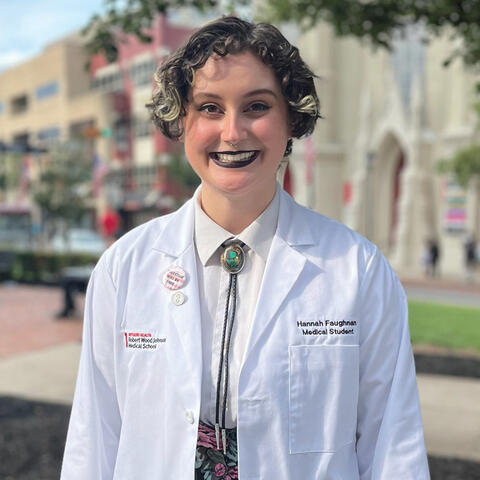
Faughnan, now a third-year medical student at Rutgers, credits chemistry tutoring sessions organized by the Scholars Institute Fellows Program (SIFP) for helping her succeed during a difficult freshman year.
In her junior year, she became a head fellow for the SIFP program, and through that experience, she realized that her challenges, which she often heard staff and faculty describe as “unique,” were in fact widely shared.
“There were students … who had suffered loss of parents, immigration issues, so many real-world things, along with being first-gen low-income,” she said. “My experience wasn’t actually that special.”
Faughnan said her ability to relate to adversity made her a better resource for her peers.
SIFP, pronounced “SIF-pee,” is housed within the Emma Bloomberg Center for Access and Opportunity and launched as a small peer-mentorship program in 2015 after years of student lobbying by the Hidden Minority Council for more FLI support throughout the academic year.
Before SIFP, programming for FLI students started and ended with the Freshman Scholars Institute, a summer program that allows incoming FLI students to take courses on campus before their freshman year. But the program did little to dispel the stigma around the identity, according to Ana Maldonado ’16.
Maldonado remembered being reprimanded by a residential college adviser for speaking openly about her FLI identity and asking others about their experiences during the Freshman Scholars Institute. Her openness, according to the adviser, made her cohort worried that she would “out” them to the rest of the student body if she continued speaking candidly during the academic year.
The wealthy campus community could be an alienating place for FLI students, who according to Maldonado often faced biased comments from peers about their low-income communities. When SIFP launched, Maldonado signed up to be a head fellow in the inaugural cohort.
In its first year, the SIFP mentorship program served around 100 students and, with funding from philanthropist Bob Peck ’88, hired 16 upperclassmen to lead the groups as head fellows. Those numbers have since grown to between 500 and 600 student participants and around 30 head fellows each semester.
“We really built it from a kind of wish and a prayer and a lot of student work,” said Khristina Gonzalez, who first led SIFP as an associate dean of the college and now directs the Emma Bloomberg Center. She said her goal is to make sure all students can experience joy while they’re at Princeton.
SIFP has since expanded to offer a wide variety of programming outside of mentorship and also serves transfers, veterans, and other nontraditional students. From faculty-led campus tours to a hair braiding workshop for Black students to a collaboration with the Office of International Programs to demystify fellowships, SIFP traffics in experimentation to fit students’ needs.
Academic support is still a major focus. In addition to providing tutoring, SIFP organizes specific precepts in collaboration with various departments to provide a more supportive learning environment for FLI students.
“There’s a lot of research out there that shows that some low-income students often feel a sense of imposter syndrome, particularly in gigantic STEM lectures,” said Andy Hakim, SIFP’s director for college success and academic affairs, referring to science, technology, engineering, and math disciplines. When students can instead opt into a precept with peers of a similar background, that’s led by someone more versed in the FLI experience, “it can make [them] feel a little less anxious,” he said.
Simone Acosta ’27, a current Emma Bloomberg Center student coordinator, works with Hakim to introduce and explain the FLI experience to faculty members who may not be familiar with the concept. Having once struggled with imposter syndrome, Acosta focuses on structural factors and not individual shortcomings when describing the challenges FLI students face.
“For example, what’s the level of math that your high school offered, or what was the level of college prep that your school gave you? Did you have a guidance counselor who could help you through that process?” she said.
Framing her explanations in a nonjudgmental way makes faculty receptive to her feedback, Acosta said.
Princeton’s awareness and solidarity around the FLI experience are not always found at peer institutions. Faughnan said she felt more comfortable talking about her FLI background at Princeton than at Rutgers. She attributed this to SIFP’s presence in the campus culture: “SIFP is so strong, in numbers, in support, in level of visibility. It’s not some office in the basement.”
Josh Faires ’20 is a former Emma Bloomberg Center program coordinator and current assistant director for FLI students at Yale. There, he is working to build a similar model of support for FLI students that is “basically mapped off of Princeton’s work.”
For Faires, FLI work is an important part of the American Dream at a time when access to higher education is under attack.
“[Whether] you are a white rural family in Nebraska or you are from an urban city in Manhattan, I do not care,” he said. “What we’re talking about is class mobility, and that ability to say, here’s something that I think resonates with … the vast majority, if not all Americans.”






No responses yet