

Plasma Physics Lab Celebrates 75 Years as New Device Gears Up
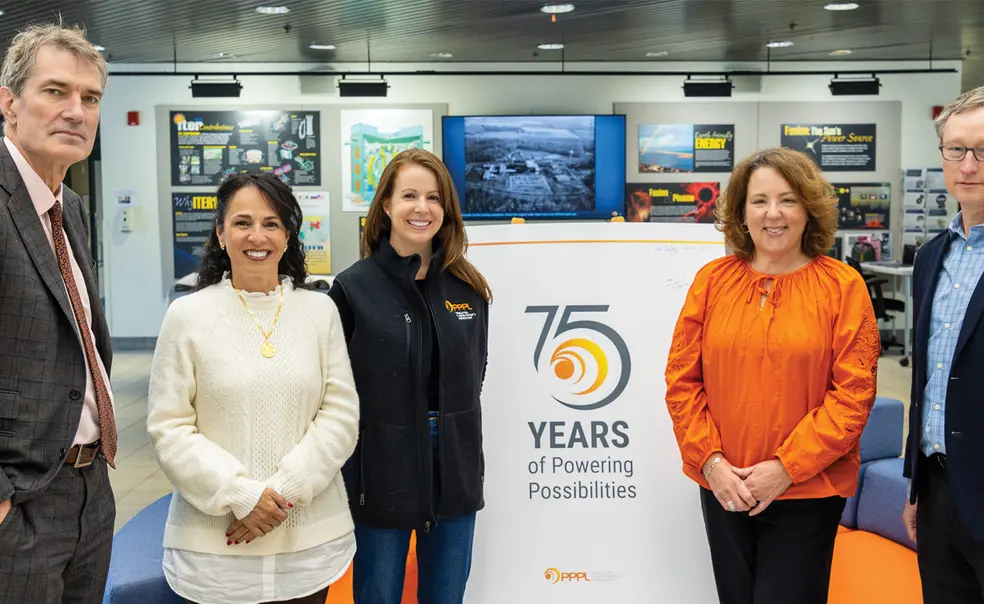

At a celebration marking the Princeton Plasma Physics Laboratory’s 75th birthday this fall, current and former staff reminisced about past achievements over the decades, but the real excitement came in talking about the lab’s future, both in fusion and beyond.
It’s an old joke that fusion energy — a powerful, abundant, and sustainable energy source — is perpetually just around the corner, but PPPL, one of 10 national laboratories stewarded by the Department of Energy’s Office of Science and one of 17 DOE labs across the country, really does seem to be on the cusp of something big. The world’s largest and most powerful spherical tokamak — a device that produces the high-pressure plasmas needed for fusion energy — is scheduled to come online at PPPL this spring.
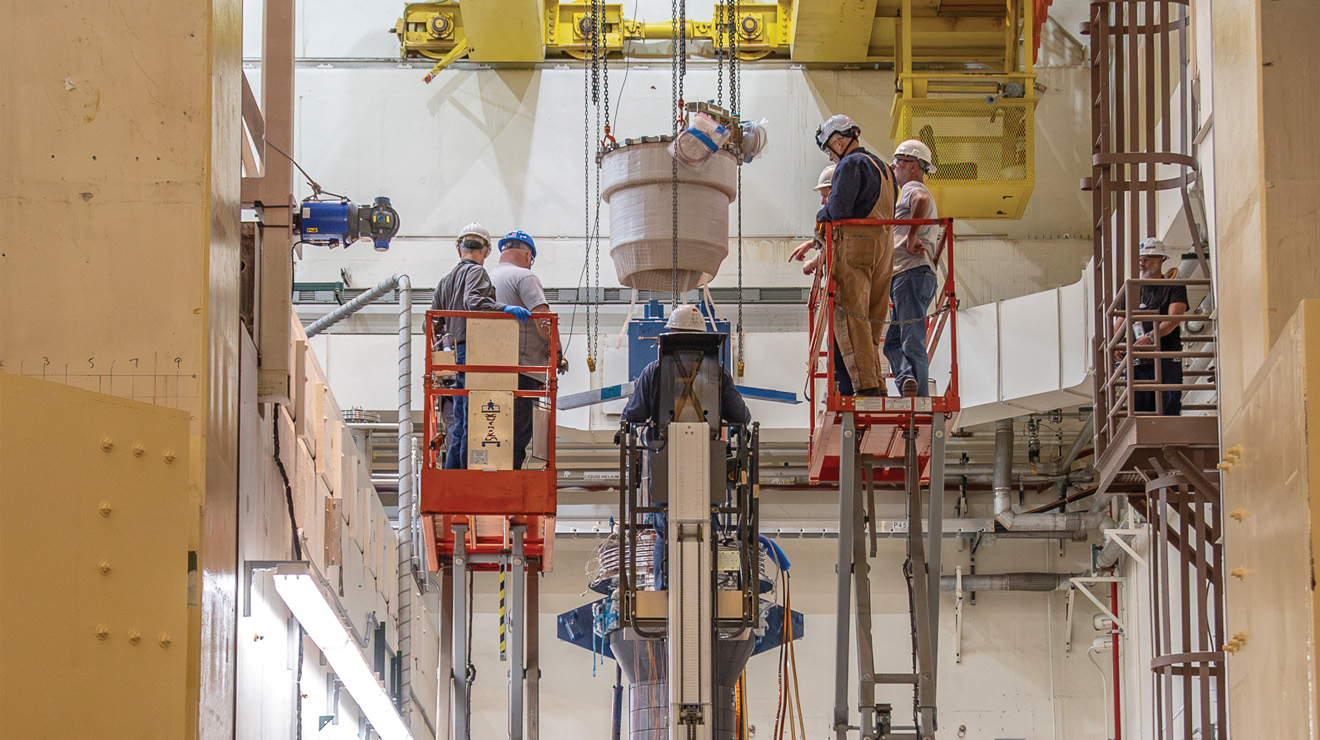
Laura Berzak Hopkins *10, deputy director for research and the first female chief research officer in the lab’s history, tells PAW that delivery in June of the National Spherical Torus Experiment-Upgrade’s (NSTX-U) final major component, a 23,000-pound, 20-foot cylinder roughly the size of a school bus, was one of the most exciting moments she’s had in her three stints at PPPL.
Berzak Hopkins was a PPPL intern while she was an undergraduate at Dartmouth and returned to the lab after enrolling at Princeton for graduate school. She came back to PPPL two years ago, after nearly 15 years at Lawrence Livermore National Laboratory, another DOE lab, and was promoted to her current role in July.
NSTX-U will be PPPL’s primary fusion experiment, and scientists across the globe will be invited to submit proposals to use the device for research. It will also be the world’s first fusion system built with AI incorporated from the start, rather than retrofitted, which Berzak Hopkins says will be transformative in accelerating “the pace of research and analysis and how we’re bringing together these different components. So, I think the next decade in fusion will be instrumental.”
In June, the DOE published a roadmap to achieve commercial fusion power by the mid-2030s.
NSTX-U will be near the room that formerly housed the Tokamak Fusion Test Reactor, which produced the highest plasma temperature ever recorded in a lab and stopped operating in the ’90s. It took a few years to decontaminate and dismantle the facility, but over the past year PPPL has begun envisioning possible paths for its future. The 900,000-cubic-foot space will soon be “opening for business,” Berzak Hopkins says.
PPPL is also continuing to expand its research beyond fusion, including the study of plasmas at different temperatures for a variety of uses. For example, low-temperature plasmas are used to produce thermal barrier coatings for jet engines.
Emily Carter, a Princeton professor in energy and the environment and mechanical and aerospace engineering, has been working as a senior strategic adviser with the lab since 2022 “to diversify the research portfolio beyond both fusion and astrophysics, to be thinking about what else can the tremendous expertise of the lab be used to really contribute to national priorities,” she said at the event.
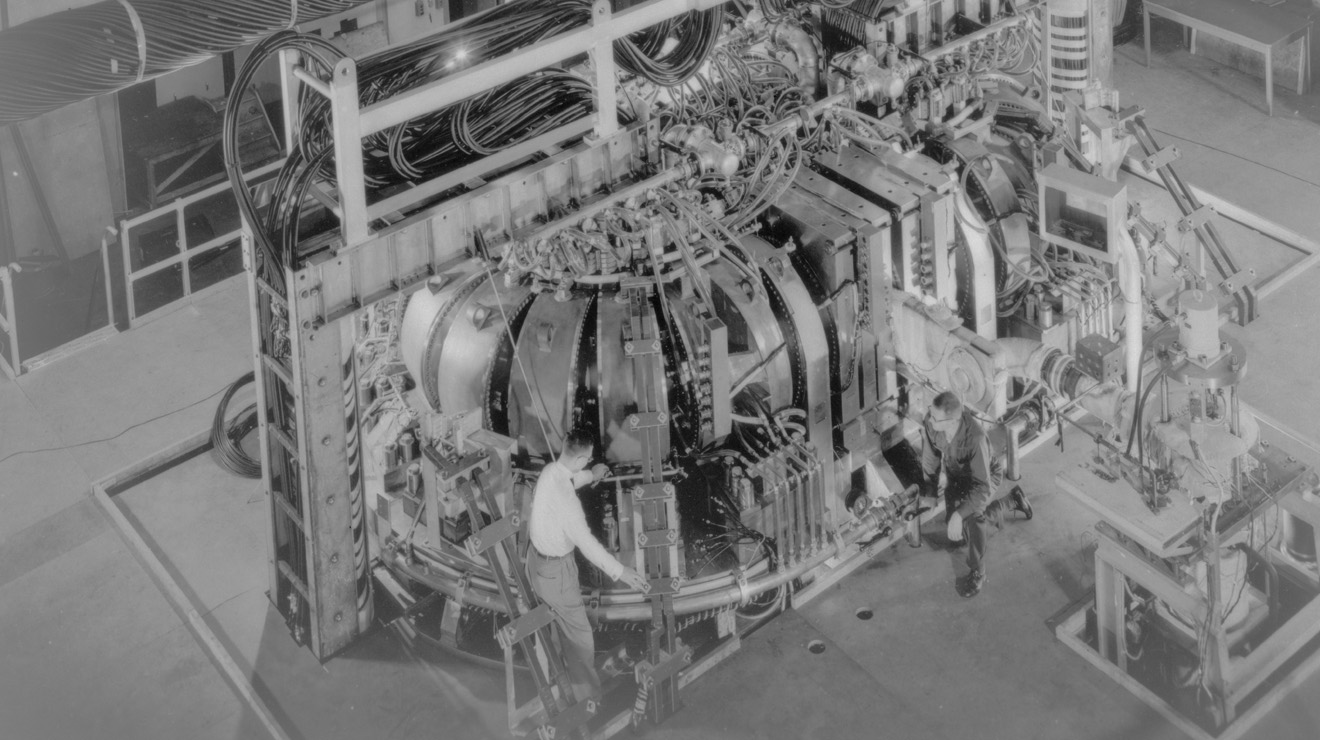
PPPL’s origins date back to the Cold War, when Princeton professor Lyman Spitzer Jr. *38, then chair of the Department of Astrophysical Sciences, sought to build the first device that would use external magnets to contain the incredibly hot plasma needed to produce fusion power. He received funding from the U.S. Atomic Energy Commission, and Project Matterhorn was born in 1951.
The current PPPL facility on the Forrestal Campus in Plainsboro was built in 1958, though the lab wouldn’t take its current name until the project was declassified three years later.
Princeton University has managed PPPL throughout its existence and announced another five-year extension agreement with the lab earlier this year.
The 75th birthday celebration on Sept. 23 included a partial tour of PPPL, brunch for the roughly three dozen retirees who attended, and a panel discussion with past and current staff on the historic legacy of the institution and what lies ahead.
Hutch Neilson spent five decades as a physicist at PPPL before largely retiring in 2023, but he couldn’t miss the chance to see the lab again.
“It is great to see the progress that the lab continues to make,” said Neilson, who drove from his home in Massachusetts to attend.
Rich Hawryluk, who worked at PPPL for more than 45 years, said he was happy to reunite with old colleagues “and to realize what we accomplished and what more we have to do in the future and how the laboratory will and can contribute.”
Robert Goldston, former laboratory director and a professor at Princeton, said during the panel that even once commercial fusion energy is realized, PPPL’s work will not be done. “I think that’ll be the time when improvements are going to be incredibly valuable,” he said, adding that even a “5% improvement on something that costs billions of dollars — that’s a huge, huge effect.”
Steven Cowley *85, director of PPPL, concluded the event by stating that Princeton has always been and continues to be at the heart of development of fusion science, and that’s not changing. “We’ve got some innovation to do.”
The Latest
See all


Related News

These Young Alumni Balance Tech Careers and Musical Ambitions
‘...I realized that I probably wanted to live a life where I had the opportunity to pursue what I felt like was my purpose,’ says Naaji Hylton ’22

AI and the End of the World
As warnings about artificial intelligence grow louder, four Princeton experts debate how worried we should be

No responses yet