

Political Topics, Academic Freedom, and Scholarly Obligations
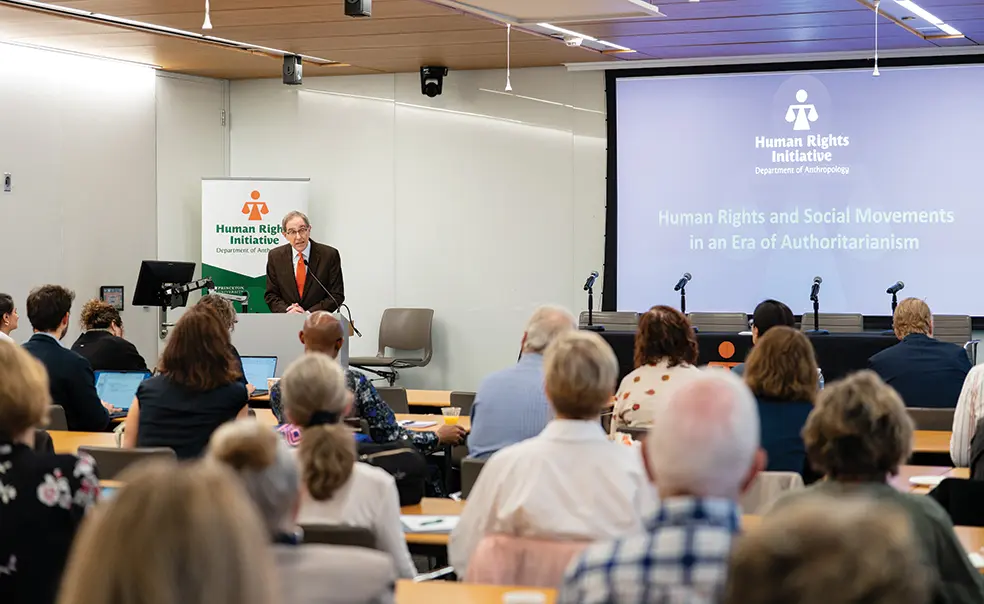

In October, I was honored to offer opening remarks at the conference, “Human Rights and Social Movements in an Era of Authoritarianism,” hosted by the Department of Anthropology’s Human Rights Initiative. It was a pleasure to welcome the distinguished group of scholars who convened on campus for the initiative’s inaugural conference. It was also an opportunity to reflect on where our obligations as scholars lie when academic topics are political in character.
These are my remarks, lightly edited for publication.
— C.L.E.
The topic of this conference is dear to my heart. Indeed, almost exactly twenty-three years ago, in October 2003, Professor András Sajó and I convened a conference at Princeton titled, “Universalism and Local Knowledge in Human Rights.”
That conference, like this one, brought together anthropologists, lawyers, and political scientists, among others, to consider the relationship between universal rights and local context.
In 2003, much of our conference focused on the possibility that local cultural commitments might interfere with the vindication of human rights. This conference, convened at a different time, will examine—among other questions—“local and decentralized forms of protecting human rights and the rule of law.”
Whatever their differences, these two conferences reflect shared assumptions that human rights exist, are worth vindicating, and are under threat. These assumptions are undoubtedly political in character, in that they assert contested values and make controversial claims about the legitimacy of governmental action.
The endeavor of these conferences might therefore seem inappropriately “activist” to certain critics of higher education who imagine that universities and scholars should be studiously and consistently “apolitical” or “neutral.” Given my role as a convener of the 2003 conference, I obviously disagree, and I thought it might therefore be valuable to say a few words about the ways in which scholarship should or should not be “political.”
Scholars must have the freedom to choose research and conference topics on the basis of judgments about their importance, and some of those judgments will inevitably be political in character. I ran a conference and studied human rights because I think them valuable to the world and care deeply about them; I assume that is true for most if not all of you. Indeed, indifference to human rights is not in my view a virtue in scholars or in anyone else.
In many fields, scholars must also be able to offer arguments that are political in character. For example, I am a normative political and constitutional theorist; I have spent my scholarly career studying justice, equality, religious freedom, the rule of law, and related topics. These are political ideas, and normative claims about them will inevitably have political characteristics and consequences.
Scholars may also legitimately use their research as a foundation for political engagement. For example, when I was publishing articles about the law of religious freedom, I testified both in Congress and before the New Jersey state legislature about the implications of my research for pending legislation.
I expect that many of the participants in this conference not only seek to advance knowledge about human rights but work actively to promote them. Indeed, the conference announces that its aims include identifying “ways of advocating for human rights” that are effective in the current era. Such activity can, in my view, be entirely consistent with our responsibilities as scholars.
What scholars must not do is to allow our political commitments, whatever they are, to interfere with our dedication to the pursuit of truth, the advancement of knowledge, and the deepening of understanding. Our obligation as scholars is to advance reasons candidly, to test arguments and assumptions rigorously, to seek out alternative perspectives energetically, to consider criticisms respectfully, and to modify our views when given adequate reasons for thinking them wrong.
This responsibility extends even to propositions that are fundamental to our scholarly projects. For example, we are free to organize conferences on human rights, and there is no obligation to include a panel of rights-skeptics in every such conference—but if someone offers good-faith, scholarly reasons for denying the existence or conceptual coherence of human rights, we must consider seriously the arguments they have advanced and respond in kind.
Scholars, in other words, must follow reasons and evidence where they lead, even when they take us to places that are deeply uncomfortable from a personal or political perspective. Our scholarly discipline, not any partisan or political allegiance, must ultimately guide our path.
I will close by saying how delighted I am to welcome this outstanding group of scholars to Princeton. I am pleased both that the Department of Anthropology has a Human Rights Initiative and that Princeton is once again hosting a conference on universal rights and what my co-author András Sajó liked to call “the bulwarks of localism.” I thank you for your attention, and I wish you well in the scholarly discussions to follow.
The Latest
See all


Related News


These Young Alumni Balance Tech Careers and Musical Ambitions
‘...I realized that I probably wanted to live a life where I had the opportunity to pursue what I felt like was my purpose,’ says Naaji Hylton ’22

AI and the End of the World
As warnings about artificial intelligence grow louder, four Princeton experts debate how worried we should be

No responses yet