

Professor Gerald Carter Observes the Social Bonds of Vampire Bats


Professor Gerald Carter studies the causes and consequences of social relationships among animals, using a familiar creature of the night as his test subject: the vampire bat. “Our relationship with others is important to our survival,” Carter explains, since social integration is a crucial component in the evolution of most animal species. In humans, our relationships have a direct impact on our physical and mental health.
Carter says he has been a “bat-fanatic” since he was a kid, citing the fact that bats account for about a quarter of all mammal species and have great ecological diversity among them. Carter chose vampire bats for his research because “we can completely simulate their natural social life in a lab [and] manipulate all the relationships [to] really measure their investments in each other.” His team maintains a captive colony of vampire bats near Princeton, as well ones in Panama and Costa Rica. He attests to the advantage he and his students have in being able to observe the bat population firsthand, as they can generate hypotheses and then test them with the bats.
Quick Facts
Title
Associate Professor of Ecology and Evolutionary Biology
Time at Princeton
2 Years
Recent Class
Animal Societies
Carter’s Research: A Sampling
Friendly Feeding
Carter’s team is researching reciprocal food-sharing among vampire bats that are not genetically related but form a close bond and engage in mutually beneficial behavior. Vampire bats feed on blood, typically from livestock. Carter notes that, for this reason, “vampire bats are named after the European monster … not the other way around.” When one bat is at risk of starvation, another can regurgitate blood, at a potential cost to itself, in order to provide sustenance. This feeding is unique to three species of vampire bats and mostly occurs between bats that have formed a strong social relationship. Much like humans, the stronger the relationship between the bats the more likely they are to perform a potentially risky but helpful action. Only around 10% of vampire bats end up forming a food-sharing relationship. Carter’s research has demonstrated that the bats will establish simpler helping behaviors, such as huddling for warmth or grooming one another, before building to a food-sharing relationship.
Custom Communication
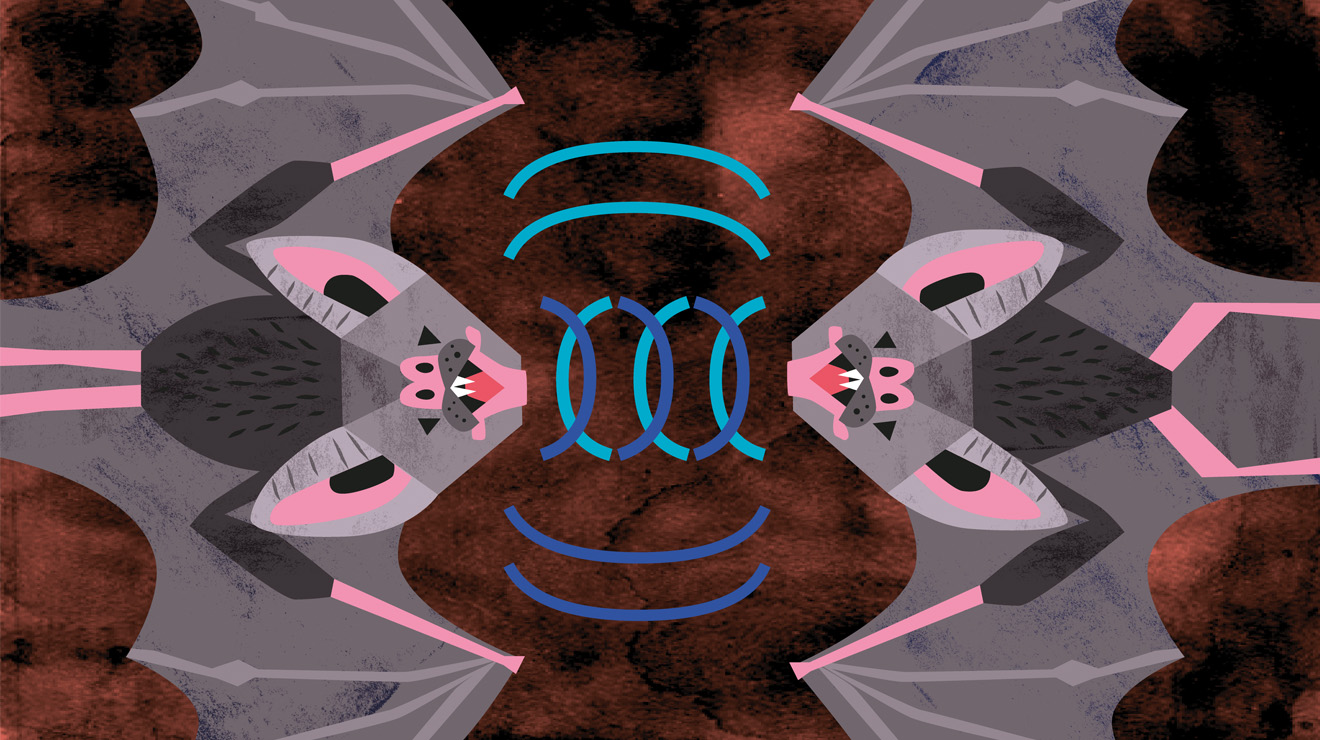
Vocal communication can play a large role in establishing communal bonds among animals. Carter and his team are also studying vocal convergence in bats and the role vocal communication plays in forming or failing to form social relationships. He explained that when vampire bats form relationships, their calls can become similar. In fact, when two vampire bats call to each other, they can rapidly match each other’s calls as a way of “labeling” the intended recipient of the call, a behavior that has also been demonstrated in dolphins. His team is studying whether the calls follow certain vocal sequences and whether those sequences have particular meaning.
Birds of a Feather
Carter’s work also extends beyond bats to examine cooperative relationships among other animal species. He was recently involved in a study of superb starlings, birds that develop helping relationships similar to those of vampire bats. The starlings demonstrated a phenomenon known as cooperative breeding. Certain birds will forego breeding for a cycle and instead choose to assist the birds that are breeding by feeding or guarding their offspring. Of the approximately 10,000 species of birds that exist, only around 10% of them are known to breed cooperatively. Similar to the vampire bats, this action was not only relegated to genetic relatives.
The Latest
See all


Related News


These Young Alumni Balance Tech Careers and Musical Ambitions
‘...I realized that I probably wanted to live a life where I had the opportunity to pursue what I felt like was my purpose,’ says Naaji Hylton ’22

AI and the End of the World
As warnings about artificial intelligence grow louder, four Princeton experts debate how worried we should be

No responses yet