

Students Report Life With Proctored Exams Isn’t Much Different
Dean of the College Michael Gordin said only one referral was made during midterms to the Honor Committee for an Honor Code violation
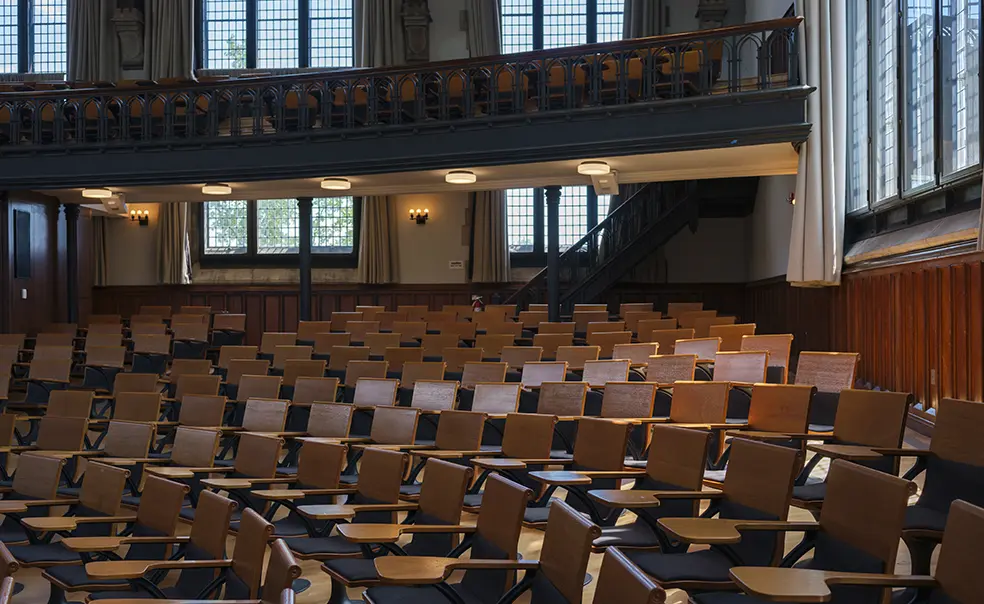

Despite the outcry from dismayed alumni and national news media outlets this spring after faculty voted to end the 133-year-old Princeton tradition of unsupervised exams, students told PAW that taking midterms in the presence of proctors this semester didn’t feel much different.
“I was really happy when I first heard about the policy change because it felt like a weight taken off,” said Jenna Duong ’29, a chemistry major. Previously, she was intimidated by the Honor Code’s requirement to report peers suspected of cheating “because it almost gives you a second job to do on top of your exam.” But this semester, she was able to “just focus on my midterms.”
Crystal Duan ’29 agreed that her proctored midterm was uneventful. “With or without the proctor, it didn’t really make a difference for me,” Duan said.
Faculty voted in May to begin proctoring exams this fall, in part to counteract the illicit use of AI to cheat. In August, the University published “requirements and recommendations” for proctoring to the Scholarly Integrity website to clarify details such as who should serve as proctors — instructional staff including teaching assistants, but not undergraduate course assistants.
The document said that proctors should communicate course-specific exam procedures, such as what materials are permitted and how to respond to student questions, monitor the room, and remind students to write and sign the Honor Pledge, promising not to “gain an unfair advantage” or to “attempt to give assistance” to others.
If cheating is suspected, proctors should not intervene but instead report it to the Honor Committee after the exam. The committee is a student-led group responsible for upholding the University’s Honor Code. The guidelines also recommend not allowing students to use laptops during exams. The recommended ratio is one proctor for every 35 to 50 students.
Dean of the College Michael Gordin said at the Nov. 9 meeting of the Council of the Princeton University Community that one referral was made to the Honor Committee for an Honor Code violation during midterms, which is less than usual.
Chantal Valdivia-Moreno, a Ph.D. candidate in the Department of Psychology who proctored this semester, said, “As far as my class went, I think everything was really, really smooth. The students knew what to do, we knew what to do, which was nice.”
Valdivia-Moreno said the course’s lead lecturer held a meeting with TAs to discuss the rules and followed up with instructions via email. During the exam, Valdivia-Moreno worked on her laptop.
According to The Daily Princetonian, the guidelines published by the University over the summer incorporated student input. The Prince also reported that, in October, about 55 students attended a feedback session on proctors with the Undergraduate Student Government Academics Committee. Some students said they didn’t mind the proctors’ presence, while others felt stressed.
Julian Mišút ’28, clerk of the Honor Committee and a philosophy major, said based on the feedback he’s received, the transition seemed to have gone smoothly and the presence of proctors may have discouraged cheating.
He said he hopes to one day return to exams without proctors, “but for now, this seems like a very effective policy.”
Audrey Tan ’29 contributed reporting to this story.
The Latest
See all


Related News

These Young Alumni Balance Tech Careers and Musical Ambitions
‘...I realized that I probably wanted to live a life where I had the opportunity to pursue what I felt like was my purpose,’ says Naaji Hylton ’22

AI and the End of the World
As warnings about artificial intelligence grow louder, four Princeton experts debate how worried we should be
No responses yet