

Understanding the Internet — the ‘Experiment That Escaped the Lab’


Maria Apostolaki’s research focuses on something billions of people use every day, but few fully understand: internet networks. Despite their ubiquity, these systems largely operate out of public view. Apostolaki’s work to make networks more secure helps protect everyone who uses the internet.
Originally from Greece, she studied electrical and computer engineering at the National Technical University of Athens. While pursuing her Ph.D. in information technology and electrical engineering at ETH Zurich, Apostolaki worked at Microsoft and Google in research and software engineering. Since joining the Princeton faculty, Apostolaki has won a National Science Foundation award and a Sloan fellowship, totaling $675,000 in funding for her research.
Apostolaki’s lab focuses on making internet networks secure, drawing on multiple disciplines, including machine learning, data processing, and hardware. “Just understanding that there is this issue, there is this risk, I can make multiple different choices to reduce my risk and also push toward a more universal solution that would make the internet more secure,” Apostolaki says.
Quick Facts
Title
Assistant professor of electrical and computer engineering
Time at Princeton
4 years
Recent Class
Computer Networks
Apostolaki’s Research: A Sampling
Data center traffic
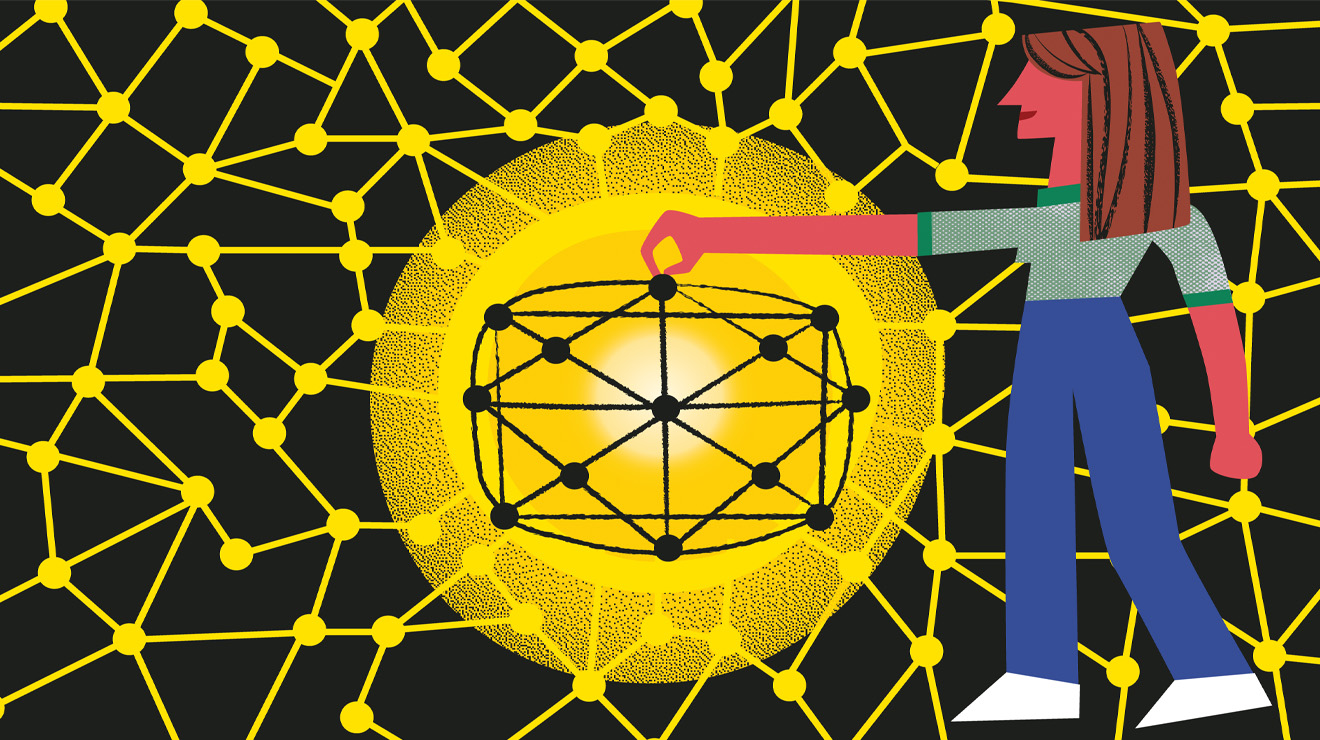
Researchers such as Apostolaki talk about internet networks in terms of their topology or graphs, which show how devices like phones and TVs on a network are connected with one another. The internet is made up of thousands of interconnected networks. Data centers host websites, artificial intelligence models, and games, and act as the “cloud” where information is stored.
Apostolaki recently co-authored a paper exploring ways for smaller data centers to process traffic. Most studies about data center efficiency have focused on large-scale producers, such as Google and Microsoft. But it’s important for data centers of every size to perform efficiently in order to route information appropriately.
“Improving the efficiency and connectivity of smaller data centers is important because many of them rely on the public internet rather than private backbone networks,” Apostolaki says. “If we can help these data centers communicate more efficiently over the internet, typical users may see better performance for the services hosted there.”
Middle Monitoring
Another recent paper Apostolaki co-authored focuses on routing attacks on networks. Apostolaki compared it to someone reading the exterior of envelopes in the mail. “They may not see the message inside, but they can see who is sending mail to whom, how often, and how large each envelope is. That information can still reveal a lot,” she says.
Her work aims to reduce this exposure by preventing any single intermediate network from seeing the full communication pattern. Instead of sending all traffic over one path, we can split traffic across multiple internet paths, making it harder for one network to infer what the user is doing.
This issue is “fundamentally hard to solve,” Apostolaki says, in part because it is difficult even to know that there’s a middleman there, and it can take significant time to identify an attack. The one thing attackers can’t hide is latency, Apostolaki says, which is the time delay for data to travel. Deploying a latency monitor at the border of a network could allow a network to stop traffic if it senses latency. Apostolaki said that many networks already have such a monitor in place.
Security Solutions
Apostolaki’s lab is currently working toward the creation of what’s known as a neurosymbolic network. The term “neurosymbolic” combines two concepts: “neural” referring to machine learning, and “symbolic” referring to the creation of math equations that logically run the network. Apostolaki says that right now it is difficult to have a good model of an internet network, meaning that it is more difficult to solve security issues and create efficiencies.
The internet, Apostolaki says, was not designed to be secure — it’s “an experiment that escaped the lab.” Creating a mathematical model for internet networks that would collaborate with machine learning combines what she calls the “creativity and power” of machine learning with the “guarantees and the trustworthiness” of mathematical models. “Networks are actually critical infrastructure,” she explains. “So we cannot afford [to be] making mistakes.”
The Latest
See all


Related News


Janice Lee ’09 Worked to Renovate One of Hollywood’s Best-Kept Secrets
An engineer by training, Lee has been deputy project manager on the renovation of Hollywood Burbank Airport

No responses yet