
Why Princeton Took So Long to Become One
Fifteen years ago, consolidation brought the borough and township together — and changed the University’s relationship with its neighbors

Robert Durkee ’69, Princeton’s longtime vice president and secretary, tells a story that he believes is true but has never tracked down. When the University sited Fine Hall in the 1960s, the architect, “who was not attentive to municipal boundaries,” proposed building it on the line that divided Princeton Borough from Princeton Township. The University opted for simplicity, nudging the new math building south into the township.
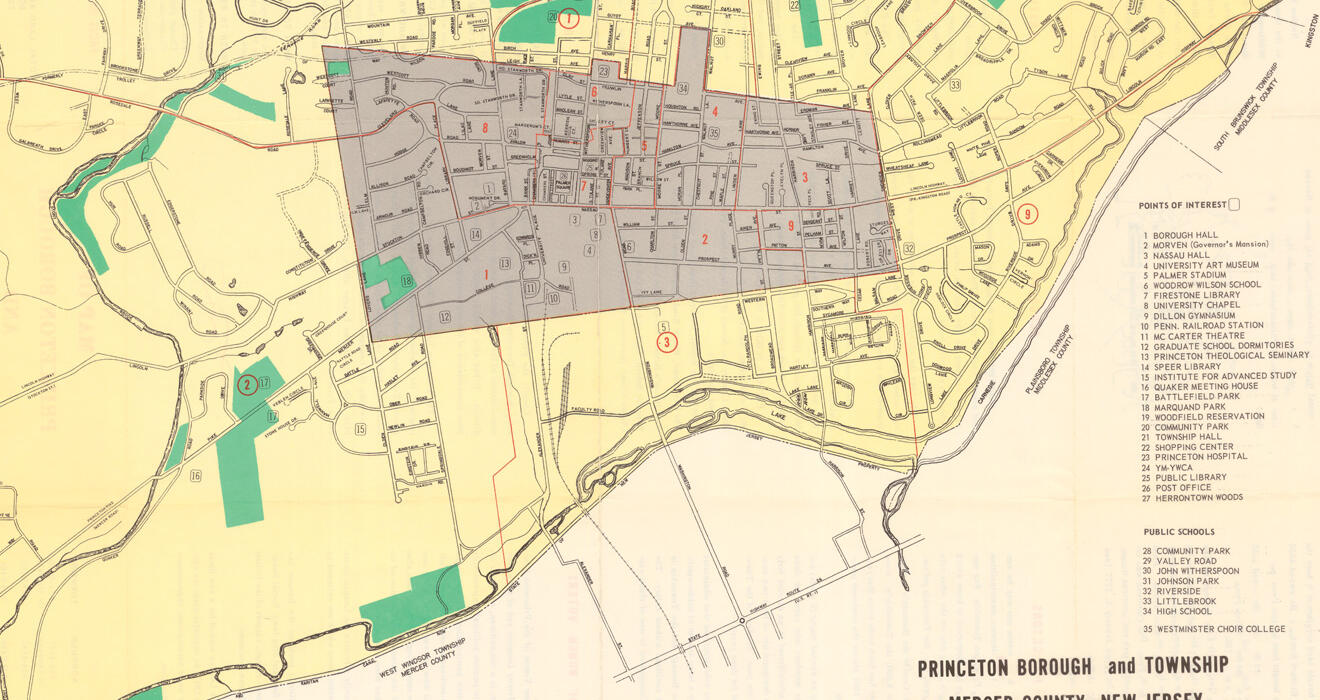
For nearly two centuries, that line bisecting borough and township ran through Princeton and the University — through laboratories and dormitories, through the site where the Lewis Center for the Arts now stands, through houses whose owners slept in one municipality and ate breakfast in the other. On Nov. 8, 2011, however, voters permanently erased it: Princeton Borough approved consolidation with 61% in favor, while 85% of Princeton Township voters were on board. A unified Municipality of Princeton took effect on Jan. 1, 2013.
This month marks 15 years since that referendum. At the time, the University officially kept clear of the campaign for consolidation, yet many Princetonians did not. Alumni and staff members were involved in running both the borough and township and sat on study commissions examining the consolidation question over five decades of attempts. On the other side of the results, the University found a different neighbor and a different relationship.
Princeton’s consolidation also serves as an intriguing case study of the promises and limits of dissolving local governments. This is particularly salient today, as property taxes and the cost of living rise everywhere, including in the Garden State. Consolidation, normally a political third rail, is back on the table in New Jersey, with Gov. Mikie Sherrill touting school district mergers as an attractive means of achieving savings and efficiencies. But in a state with a penchant for “home rule,” what lessons does the Princeton experience suggest about consolidation’s feasibility? Could it be easily replicated? And why has the rest of New Jersey refused to follow?
The College of New Jersey moved to “Prince-Town” in 1756, drawn by local landowners led by Nathaniel FitzRandolph, who raised some 1,700 pounds (about $450,000 today) and offered more than 200 acres of woodland and a 4.5-acre plot for campus. Municipal government came later, and for less elevated reasons.
When the college arrived, Princeton belonged to Somerset County’s “western precinct” and to Middlesex County’s Windsor Township, which split in 1797, leaving Nassau Hall in West Windsor. In 1813, Princeton’s townspeople petitioned for a borough charter, arguing that suppressing “acts of vice and immorality” (drinking) and “unlawful meeting[s] of [B]lack people” required the powers of a free-standing municipality. The state legislature granted their request to form a semi-autonomous borough. A separate Princeton Township was then incorporated along with Mercer County in 1838, wrapping around the borough in a classic New Jersey “doughnut-hole” shape after 1853, when annexations of West Windsor land brought portions of the present-day University campus above the Delaware & Raritan Canal into the township. The borough became fully independent in 1894.
Though unseemly, Princeton’s messy incorporation was hardly unusual: Roads, railways, reading, rum, and racism — five “R’s” representing the factors that Andrew Bruck ’05, former acting New Jersey attorney general, identifies as explaining New Jersey’s municipal multiplicity — fractured America’s fifth-smallest state into its 564 municipalities.
University alumni governed both Princetons from the start. Samuel Bayard 1784 was the borough’s first mayor, and Moses Taylor Pyne 1877 was the township’s first mayor. B. Franklin Bunn 1907 remains the only person to have been mayor of both.
In 1935, Charles Erdman Jr. 1919 *1923, running for borough mayor, campaigned with a goal of consolidating the two Princetons. Erdman belonged to the Princeton Local Government Survey — a group of University professors and experts, chaired by then-President Harold Dodds *1914, that analyzed redundancies in New Jersey’s municipal governments. Announcing his candidacy, Erdman noted that the borough and township had already fused their sewage, garbage, and fire services, and argued that “further steps in this direction should lead to further savings.”
The Princeton survey’s pamphlet, Local Government in New Jersey: A Political Patchwork, also judged the state’s number of municipalities too many and urged larger units of government. It named four obstacles: local pride and community consciousness; inadequate legal authority; widely varying school tax rates, debt service, and delinquencies; and clashes between urban and rural districts. Nearly a century on, the list still reads as a forecast for the inflated property taxes that many residents of tiny, ratable-poor New Jersey municipalities (and school districts) pay to support their operations.
Erdman, who took office in 1936 and served six terms, came to think of shared services between towns, though politically palatable, as an insufficient solution. “Cooperation is a lovely theory, but it just hasn’t worked,” he wrote. After leaving office, Erdman championed a ballot measure proposing the consolidation of the Princetons in 1953. Voters rejected his recommendation that November, and they rejected Princeton consolidation twice more in the decades that followed. A joint borough-township study commission recommended a merger in 1979; the ballot measure failed in the borough by 33 votes. In 1996 — after a commission co-chaired by Donald Stokes ’51 *52, dean of the then-Woodrow Wilson School of Public and International Affairs, again advocated for consolidation — borough voters rejected the recommendation by a wider margin.
“In general, my feeling is that people in the township were more accepting of the concept [of consolidation] than the residents of the borough, historically,” says Kevin Wilkes ’83, an architect and former borough councilman. The two municipalities were slightly different: The smaller borough, centered on the pedestrianized and denser downtown Nassau Street core, had older housing stock and longer-tenured residents; the larger township, in the words of Yina Moore ’79, also an architect and the borough’s last mayor, was more suburbanized, sprawling, and “auto-dependent.”
Still, over the years the towns steadily voted to merge functions without merging governments — a joint public library in 1960, a regionalized school system in 1966, and a regional planning board in 1969. A total of 13 shared agencies and services ranging from animal control to recreation were created by 2011.
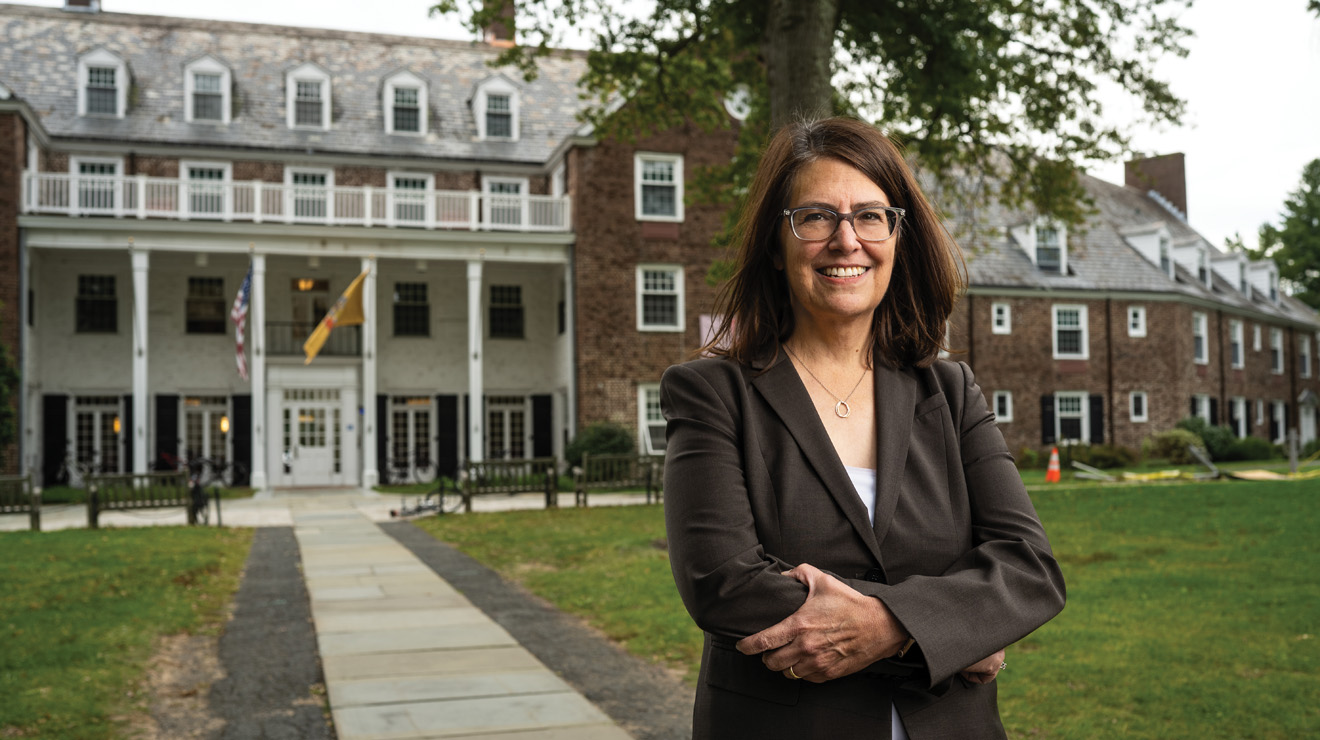
For the University, the borough-township border cutting straight through campus was less a philosophical problem than an administrative one. As the campus expanded toward Lake Carnegie, the border became nonsensical. In Butler, Forbes, and Whitman Colleges, says Kristin Appelget, the University’s assistant vice president for community and regional affairs, “the municipal boundary ran through individual rooms and suites,” requiring “coordination with the municipal clerk to determine, on a room-by-room basis, where students would register to vote, which sometimes required re-registration when students moved year to year.” (Graduate student housing, save for the Graduate College, was all located in the township.)
Liz Lempert — a former township committeewoman and later the merged Princeton’s first mayor — saw serious consequences of the divide for undergraduates on Election Day in 2008. “It wasn’t even just that you are in the wrong polling location in your town — it was like, no, they were in the wrong town. And their names weren’t on the list.” A significant number of students voted provisionally on paper ballots that do not “really get counted in the same way unless there’s a tie,” which was “one small example of how having this artificial line down the center of town was disenfranchising students,” she says. Nor did the line run tidily: “It wasn’t like the borough-township line went down the center of the hallway. It would go through the dorm in a really weird way.”
Public safety was likewise complicated. Three police forces operated in town: Princeton Borough, Princeton Township, and University Public Safety. Forbes College straddled the borough-township line, Lempert says, so “you’d have multiple responders. And it’s like, who’s in charge?” Heather Howard, a School of Public and International Affairs (SPIA) professor who previously served on the borough council and then on the consolidated council, called the jurisdictional blurriness “definitely suboptimal.”
In 2009, amid rising real estate values post-reassessment and concerns about affordability post-recession, another joint study commission was formed to explore whether the Princetons should consolidate. Yet again, it recommended doing so, in 2011. But tensions that year between the borough, the township, and the University plunged town-gown relations to a nadir, threatening to derail the consolidation push. The reason was controversy over the relocation of the Princeton Dinky’s branch terminus. In 1984, with the commuter rail line facing closure, the University had bought the 1918 station buildings, the land beneath the train tracks, and the parking lots, receiving in return from New Jersey Transit a contractual right to move the terminus slightly south.
Now the University was planning to exercise that right by moving the station 460 feet south to make room for the $330 million Lewis Center for the Arts. Relocating the station farther away from downtown would decrease passenger ridership, opponents argued. The change would also move the Dinky station from the borough into the township. “All of a sudden, you’ve got this uproar,” Durkee says. “‘The train is leaving Princeton!’ No, it’s still going to be in Princeton, but it’s not going to be in the borough anymore.” By early 2011, the project had stalled because of borough objections. And because the site spanned the line, each municipality had to grant zoning changes separately.
With opposition mounting, on Jan. 31, then-University President Shirley Tilghman told both towns’ governing bodies and the joint planning board that the University was at a critical “go-no-go” moment: Absent approval of zoning changes, she would instruct her colleagues to plan another site for the proposed arts center. Still, the project went ahead in December 2012. Moore cast the lone dissenting vote in a 9-to-1 decision by the planning board, arguing, as she recalls, that the Dinky shuttle had essentially been privatized out of the public realm by the “influence of money,” and that by demolishing the old station’s platform canopy, the University had violated state and federal landmark protections.
Lempert, who now works as assistant director of research development at the University, calls the Dinky episode “a really low point in the relationship … a communication breakdown” rooted in the discovery that “the University unbeknownst to the community had ownership and control over the public train station.” Wilkes thought the University had legitimate goals it declined to primarily emphasize — creating a western entrance to the Theater Drive Parking Garage, mitigating heavy traffic on Alexander Street and Faculty Road, and integrating Forbes College into the campus fabric — but instead “put out the Trojan horse of the Lewis Center for the Arts.”
Resolution of the crisis came through negotiation. Chad Goerner, the township’s last mayor and a consolidation proponent, convened two township and two borough officials, himself and Wilkes included, to meet with Durkee and Appelget. The result was a memorandum of understanding barring any further truncation of the 2.7-mile-long Dinky. Even so, approval of the Lewis Center project took six years, in part because of the complications caused by the municipal boundary that ran through the site, Durkee says.

Meanwhile, the 2011 consolidation campaign ran on a parallel track, in a changed climate. In October 2009, both municipal governing bodies had formed a joint commission under the flexible 2007 Local Option Municipal Consolidation Act, which sought to incentivize mergers by allowing towns to keep pre-consolidation variations in ordinances, service levels, and debt apportionment. The commission hired an outside consultant and recommended full consolidation, with the borough council and township committee’s endorsements, to the Princeton electorates in mid-2011, setting up the November 2011 vote.
Through it all, the University said nothing publicly. “The University did not facilitate or play an active role in the consolidation process, nor did it take a position in support of or opposition to consolidation,” Appelget says. But it supplied data on request, joined public forums like any other stakeholder, and offered the commission the use of the Princeton Survey Research Center.
The University’s posture of silence was strategic, recognizing that consolidation was a matter solely for local voters to decide. “They took two steps backward and made all attempts to not inflect this decision,” Wilkes says, “although it is clearly to their benefit that the two towns consolidate[d].” Had residents believed the University wanted it, he says, “that would have [had] an inverse negative impact on the opinions of the public at large.”
After the successful vote, the implementation phase began. “In 2012, it was this transition year where we knew we were going to be consolidating, but we were still two governments,” Lempert says. A task force scrutinized the logistical details department by department. Once it was set up, the University became “more involved,” per Lempert — its liaisons sat on the task force’s facilities, information technology, and public safety subcommittees, alongside Goerner, Howard, Lempert, Moore, and Wilkes.
According to Lempert, policing structure between the municipality and University Public Safety was a delicate issue: The question was “what agreements can we work out” so there were “clear lines of responsibility of who’s responding and who’s in charge.” The University further contributed $500,000 toward subsidizing implementation costs, split evenly between the soon-to-be-eliminated towns.
During this period, Howard also advised a group of SPIA students who sat in on the task force’s meetings and conducted interviews. They wrote an independent postmortem evaluation of the consolidation effort, later published on the task force’s webpage. “I think we give undue attention to the legislative process or the voting, and sometimes we forget what happens after [that],” Howard says. For Princeton students, it was “an amazing opportunity … to observe government work in the real world.”
When consolidation took effect in January 2013, Lempert was sworn in as the first mayor of a merged Princeton, six months before Christopher Eisgruber ’83 became University president. “There was this new-start opportunity all around,” she says. Working from recommendations by experienced community members, she instituted certain traditions: quarterly meetings between the mayor, town administrator, and the University’s community and regional affairs office — “so nobody surprises one another” — and an annual public conversation between the invited University president and municipal council.
Money moved in tandem with the improved town-gown relationship. An annual unrestricted payment from the University to the borough had been institutionalized in the early 1970s, reaching $100,000 by 1999 and $1 million under a 2006 accord. Goerner then had negotiated the University’s first payment in lieu of taxes (PILOT) to the township with Durkee and Appelget in 2011. Under a seven-year agreement in 2014, the University committed to the now-amalgamated municipality $2.75 million escalating 4% annually — faster than the town’s 2% capped growth in tax levies. By 2020, the University also paid $9.5 million in property taxes, including some $6.4 million voluntarily. The latest PILOT deal in 2024 made possible the expansion of consolidated Princeton’s Loop bus to two routes — as Councilwoman Michelle Pirone Lambros contends, “Two towns would not have been able to collaborate to create these routes and manage the financial structure for underwriting this transit option.”
What remains, Appelget says, is “ongoing dialogue” and “a ‘healthy tension’ in the relationship between the town and the University. However, on most issues we work in alignment.” Consolidation meant “one less governing body to engage with,” and its benefits “were especially evident during the COVID-19 pandemic. With a single mayor and council, decision-making was coordinated … and the community was able to respond with a unified voice.” Here, the University chipped in with $250,000 for a resiliency fund that gave out more than 90 matching grants to small businesses to weather the pandemic, adds Pirone Lambros. As Howard says, “having good services, whether it’s public safety or health, those questions don’t stop at Nassau Street.”
“Princeton is the exception that proves the rule that consolidation isn’t going to work [elsewhere]. Because Princeton already had the same name. Princeton already had the same school board. Princeton already had the same planning board. Princeton had a leg up on all 564 municipalities."
Kevin Wilkes ’83, former borough councilman
Fifteen years on, the ledger is generally positive on consolidation: The estimated annual savings of approximately $3 million were “accurate,” according to current Councilman Brian McDonald ’83. Princeton retains Mercer County’s lowest effective tax rate (not to be conflated with lowest tax bill) and holds triple-A bond ratings. And consolidation helped spur the establishment of a townwide special improvement district that boosted local commerce and delivered increased services, employment opportunities, and tax relief — a “real win-win-win,” says incumbent Councilman David Cohen.
Merging alone was never a silver bullet. The rate of municipal tax growth may have slowed, but a 2014 Rutgers study claimed that the combined town shaved a miniscule 5% off its 2013 expenses. Nor is all perfect today in Princeton’s nonfiscal affairs: Dinky ridership has dropped considerably, and the harmonization of dated borough and township regulations is unfinished. Wilkes is the resident realist: “The town zoning [code] still hasn’t been completely ironed out. Many wrinkles exist. However, five years from now when it’s 20 years, I think this will be worked out, and the future is much brighter than the immediate time post-consolidation.”
Statewide, however, prospects for municipal subtraction elsewhere appear dim. No cascade of imitations has occurred. The only merger in New Jersey since Princeton’s was in Camden County, where Pine Hill absorbed 17-home Pine Valley in 2022. That plodding pace is familiar to former congressman and state legislator Leonard Lance *82, who wrote the law enabling the 1997 Pahaquarry-Hardwick Township merger, the last before Princeton’s. He remembers needling the dual Princetons: “I used to say that Pahaquarry and Hardwick have merged and the Germanys have merged. But the Princetons have not merged.” Now that the Princetons have indeed merged, “I can’t give that speech anymore,” he jokes.
Wilkes offers a blunter take: “Princeton is the exception that proves the rule that consolidation isn’t going to work [elsewhere]. Because Princeton already had the same name. Princeton already had the same school board. Princeton already had the same planning board. Princeton had a leg up on all 564 municipalities. And it was really hard for Princeton to get it done. No one who has two different names, two different high schools, two different public works and planning departments is ever going to get through the maze of resolving who wins and who loses.”
Much the same could be said, too, about the two former Princetons’ striking similarities in resident demographics and socioeconomic status, including levels of wealth, education, and ideological or partisan composition.
Howard’s SPIA students weighed whether Princeton’s case was generalizable or exceptional in their report. The conclusion was both, though it may not seem that way today. “At the time, it felt like we were building momentum, and other municipalities were going to follow,” she says. “So it’s sad.”
Goerner’s frustrations run deeper. “There’s an emotional component to all of this. And that’s one of the things that makes consolidation so challenging,” he says. “People don’t realize: It’s not just about consolidating governments to save money. It’s also about the lack of efficiency that we have in governing as a result of all of these separate entities” — water, transportation, affordable housing, all “held up on all of these small, provincial town structures. And so I don’t [foresee] really big movement in the state of New Jersey.”
But perhaps the best evidence that Princeton did get it right, despite all the challenges, is the collective amnesia over consolidation. “If you go to the average Princetonian today, they didn’t know where the boundaries were in 2012,” Goerner says. “A lot of them don’t even know that there was a township.” Howard proposes a comparable test: Stop people on Nassau Street and ask, “‘Do you live in the old borough or the township?’ How many people don’t even know?”
In 1953, Charles Erdman Jr. had asked for “one governmental unit for Princeton, not two.” It took another 60 years to fulfill that vision, thanks to the labors of alumni, staff, students, and others. But until more Garden State towns follow in Princeton’s footsteps, home rule — New Jersey’s enduring “religion,” as Gov. Brendan Byrne ’49 once opined — is here to stay.
Henry Hsiao ’26 is a native of Central New Jersey. As a politics major, his independent work examined the structuring of state and local governments.
Related News
Dung Beetles Do ‘the Job That Is Necessary’
Princeton researcher Finote Gijsman *25 studies crucial links between the insects and elephants in a new paper
No responses yet