

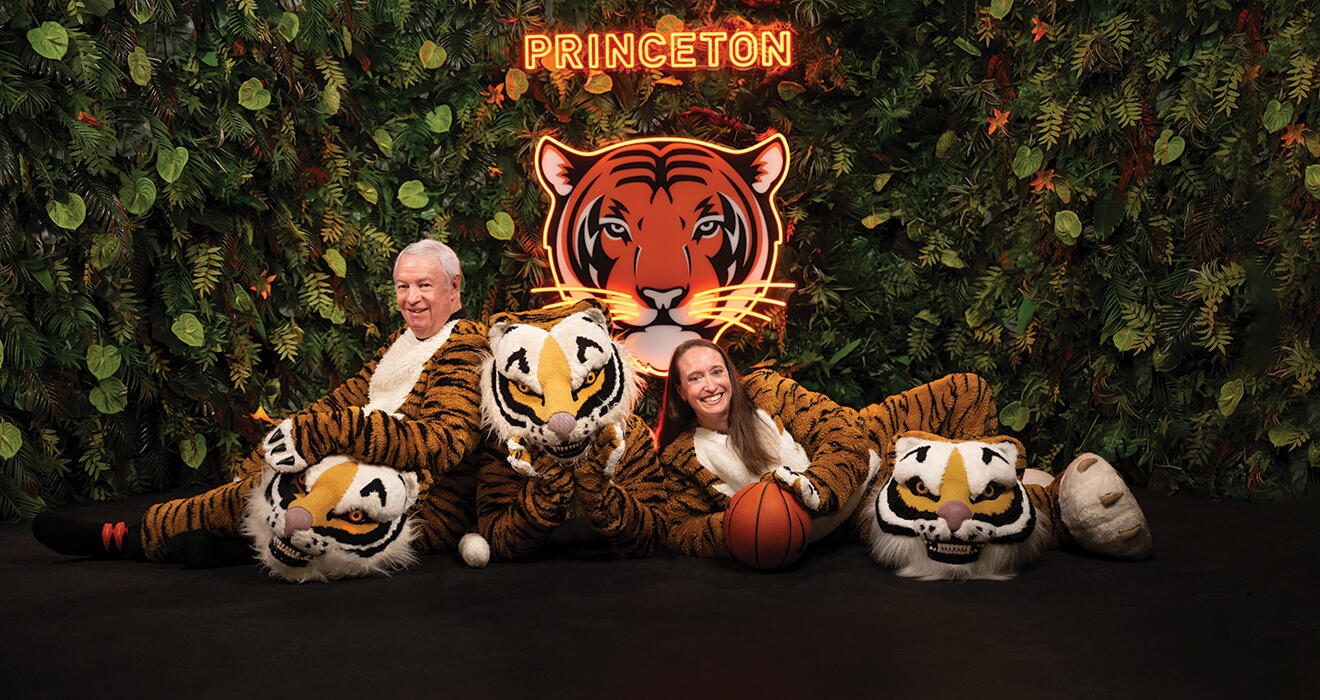

The original tiger, naturally enough, was a fox.
The fox in question was Frederic Fox ’39, the University’s longtime recording secretary, known to many as “Mr. Princeton,” and possibly the most rah-rah alum who ever lived. As an undergrad during the Great Depression, Fox became the first Princeton student to dress up as a tiger at an athletic contest. Or so he claimed.
Back in 1936, in the depths of the Depression, Fox’s father could not send him money for tickets to the Yale game. But he did work out a deal with a New York furrier for the loan of a genuine Bengal tiger pelt. Thus attired, Fox found that he could not only walk into Palmer Stadium free of charge but wander down onto the sidelines.
“It was a roving 50-yard seat, and I didn’t pay a nickel for it,” he boasted in a 1975 report, “A Natural History of the Princeton Tiger,” for Tiger Magazine.
However, even Fox conceded that his claim to be the first guy in a tiger suit might not stand up to scrutiny. “I’m sure there must have been crazier students here before me,” he wrote. What we do know is that no one else tried it until 13 years later.
In 1949, J. Edward Craig ’53 tried out to be a cheerleader. Undeterred when he didn’t make the cut, he had his mother rent him a tiger suit from a New York City costume shop, and he wore it to the Penn game at Palmer Stadium on Oct. 8. With temperatures over 80 degrees that day, Craig sweated off as much as 12 pounds in water weight, according to his granddaughter, Emelee Craig, but he continued to perform for the rest of the football season. His antics proved so popular that the University made the Tiger mascot an official part of the cheerleading squad the following year. It also sprang for a better suit, upgrading from cloth to rabbit fur. A year later, it upgraded again, this time to a suit made from four and a half real tiger skins sewn together by a taxidermist.
Princeton’s teams have been known as the Tigers since the late 19th century, but when it comes to the Tiger mascot, history tends to be murky. A few, like Fox and Craig, are remembered. One, Blanche Rainwater Kapustin ’95, wrote a book about it: Tigering: Memoir of an Ivy League Mascot, published in 2013. The rest, sadly, are largely forgotten.
Hoping to rescue them from obscurity, PAW has delved deep into the archives and rounded up 10 former mascots, one of the current mascots, and a few other sources. They all want a chance to tell their tail. Er, tale.
Just to be clear, we confine ourselves to the human Tiger mascot. From time to time, Princeton has put a real, live tiger on the sidelines — heavily sedated, one presumes. That is worth a story of its own. But not this one.
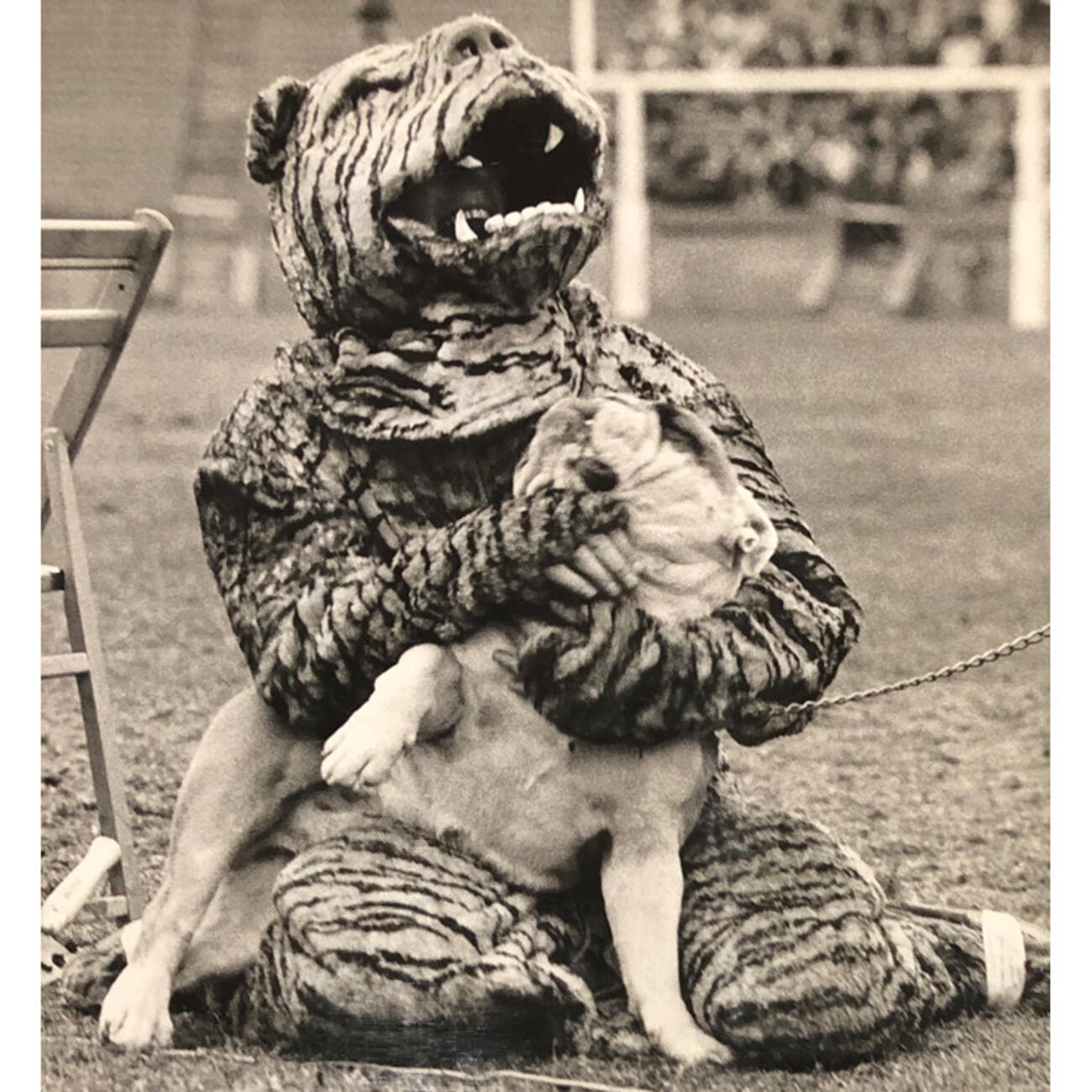
When it comes to the mascot, usually the student seeks the suit. Sometimes, though, the suit seeks the student.
Tom Culp ’69: I was a cheerleader at Lawrenceville. When I got to Princeton, the head cheerleader was Tom Handy [’69]. Both our fathers had gone to Penn State, and Tom knew that my father had been the Nittany Lion mascot. He approached me at tryouts and said, “You’ve got this in your blood.”
Peter Maritz ’79: We had no tryouts. A good friend of mine, Leslie Brooks [Bennett ’80]
was the captain of the cheerleaders, and she said, “Hey, I need help. Are you willing to do this?” And I said, “Well, that sounds like it’d be fun.”
Dan Davenport ’00: My freshman year, there was a sign in my entryway announcing tryouts for the mascot. I thought, that sounds like the most terrifying, awful, out of character thing I could possibly think of doing. That’s what I’m here to do. Let’s go try it.
Emily Henkelman ’04: I was a gymnast through high school and had a coach who was the [Philadelphia] 76ers’ mascot. What I didn’t realize was that his costume consisted of just sneakers and spandex and a very small head. When I got to Princeton, I tracked down the assistant athletic director and was told, “OK, if you’re interested, you can come shadow at a football game.” When I showed up, they told me that the real mascot had not been able to attend, so I should get in the suit. The only instructions they gave me were, “Don’t take the head off. Don’t talk. And have fun.”
Sam Ruona ’26: My freshman year, I saw a campus job posting for the mascot and considered it but decided not to apply. The next year, I saw the same posting and thought, why not? When I showed up for tryouts, there were about 15 other people there and they were all talking about their dancing experience. So I thought, ‘Oh, I’m screwed. I’m not getting this.’ And then I found out that they were all there to try out for the cheer team. After a while, someone came over to me and said, “You’re the only one here for the mascot. When can you start?”
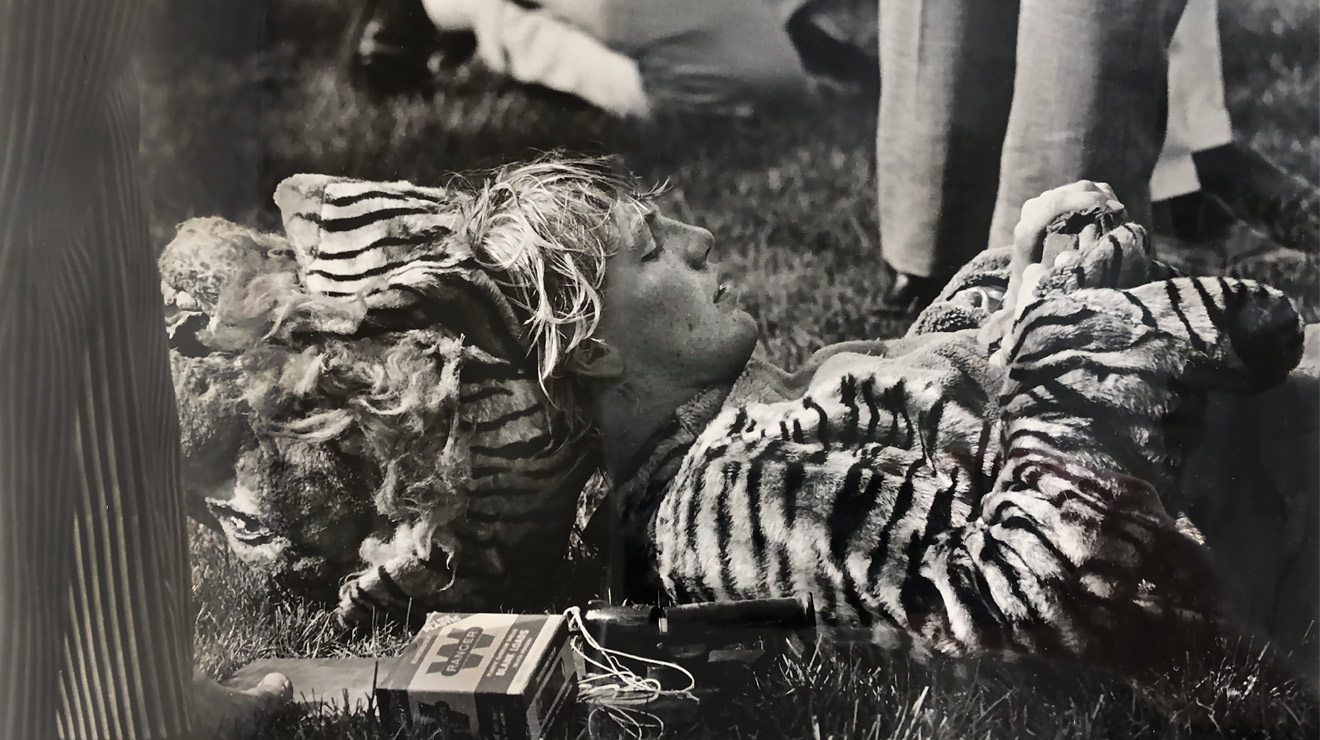
The costume has evolved considerably over the generations. But one constant is that it is hot, stuffy, and smelly inside. In 1953, PAW reported that mascot William Garton ’55 passed out from the heat during the second quarter of the Lafayette football game. Fortunately, his predecessor, Craig, was in the stands and finished the game.
Charles Stephenson ’62 *64: It was miserable in there. You were doing it out of love, but it was not a pleasant place to be.
Culp: It was just exhausting. It was a lot of fun but wearing one of those costumes for three or four hours was pretty tough, especially when the weather was warm.
Maritz: It was hot, sweaty, scratchy, stuffy. Most of the time I wore a T-shirt and gym shorts under the suit and just dealt with it from there.
J. Graham Findlay ’66: The only thing I wore under it was a jockstrap.
Henkelman: We had more than one mascot and of course we all shared the same suit, which gets really sweaty and smelly inside. On weekends when there were back-to-back games on Friday and Saturday nights, it was tough to be the Saturday mascot. I learned to pick the Friday games whenever possible.
Ruona: The new suits aren’t too uncomfortable, but they are hot and the visibility is pretty bad. We had the Tiger’s birthday party recently and invited other mascots from around the area to attend. They were all appalled at how little vision we have.
The mascots also agree that there is something about artificial fur and a ferocious headpiece that turns them into a different animal.
Ruona: That’s one of the reasons why it’s nice being anonymous, because you’re free to do whatever you want. I definitely am a lot more mischievous and flamboyant.
Culp: It was a chance to go out and say hello to anybody, sit down with anybody, and get your picture taken. Everybody enjoyed an outgoing Tiger that went into the crowds. I did all sorts of things that I wouldn’t have done otherwise.
Henkelman: I always thought of myself as more of the Disney World type of mascot than the professional sports team mascot, so it was all about the interactions with the kids.
Blanche Rainwater Kapustin ’95: I’ve given that a lot of thought over the years, and I don’t think it’s just the suit. I think that we become different people for different roles we have in our lives. We always wear masks, whether it’s literal or physical.
The mascot does not have a gender, but for several years after the advent of coeducation, Princeton had two mascots, a Tiger and a Tigress. The Tigress first appeared in 1973 and was discontinued in the late-’80s.
Martha (Marty) Paxton Franchot ’77: I was the first Tigress. My freshman year, I went to the opening football game and thought, this is a co-ed school. Where is the tigress? I asked the Tiger after the game and he said, “We don’t have one.” I said, “Well we should,” and he said, “It’s a big job, you should check it out first. Why don’t you go to the Cornell game and wear my suit?” So I did. The suit stunk — I don’t think it had ever been cleaned — and it was made for a 6-foot man, so the crotch was around my knees and I kept having to push the head up to see. But I had a blast. Freddy Fox thought it was a wonderful idea, so he found a rich alum who paid to have an extra suit made for the Tigress, with bows and big eyelashes.
Kathy Kovner Kline ’79: The year I was mascot, I drove myself up to New Haven for the Yale game, with the suit in a bag next to me. I parked at the Yale Bowl but had no idea where to change. Finally I saw a tent and ducked in there to dress behind some boxes. Just as I was finishing, I heard a loud and somewhat inebriated voice shout, “Hey guys, it’s the Princeton Tiger!” There were a bunch of guys in their 40s — I had wandered into the Yale 25th reunion tailgate. I ran out of that tent and into the stadium pretty quickly!
During the 1950s and ’60s, the names of the Tiger mascots were widely publicized. A few of them even became minor celebrities. A 1965 story for Sports Illustrated, possibly written by Frank Deford ’61, said: “Princeton, which is already losing All-America Basketball Player Bill Bradley [’65] and Fullback Cosmo Iacavazzi [’65 *68] ... may also have to do without the services of J. Graham Findlay. ... Findlay, you see, is the Princeton Tiger, by consensus the best Tiger ever. To earn his stripes, Findlay had to qualify in size, authenticity of roar, length of tail and savagery of mien. Furthermore, he has not lost a hair of his $665 tawny fur suit, though last year 50 Penn freshmen tried to skin him.”
By contrast, most recent Tiger mascots have preferred to remain anonymous until their careers were over.
Culp: My five roommates knew who I was and the guys in my eating club. The Trentonian even did a story about me. But generally I didn’t want people to associate me with the Tiger because the Tiger is the Tiger.
Kapustin: When I started, only the cheerleaders knew who I was. Maintaining my anonymity was so important that when I left my dorm carrying the mascot suit in a bag, I would use different entryways, just to be on the safe side.
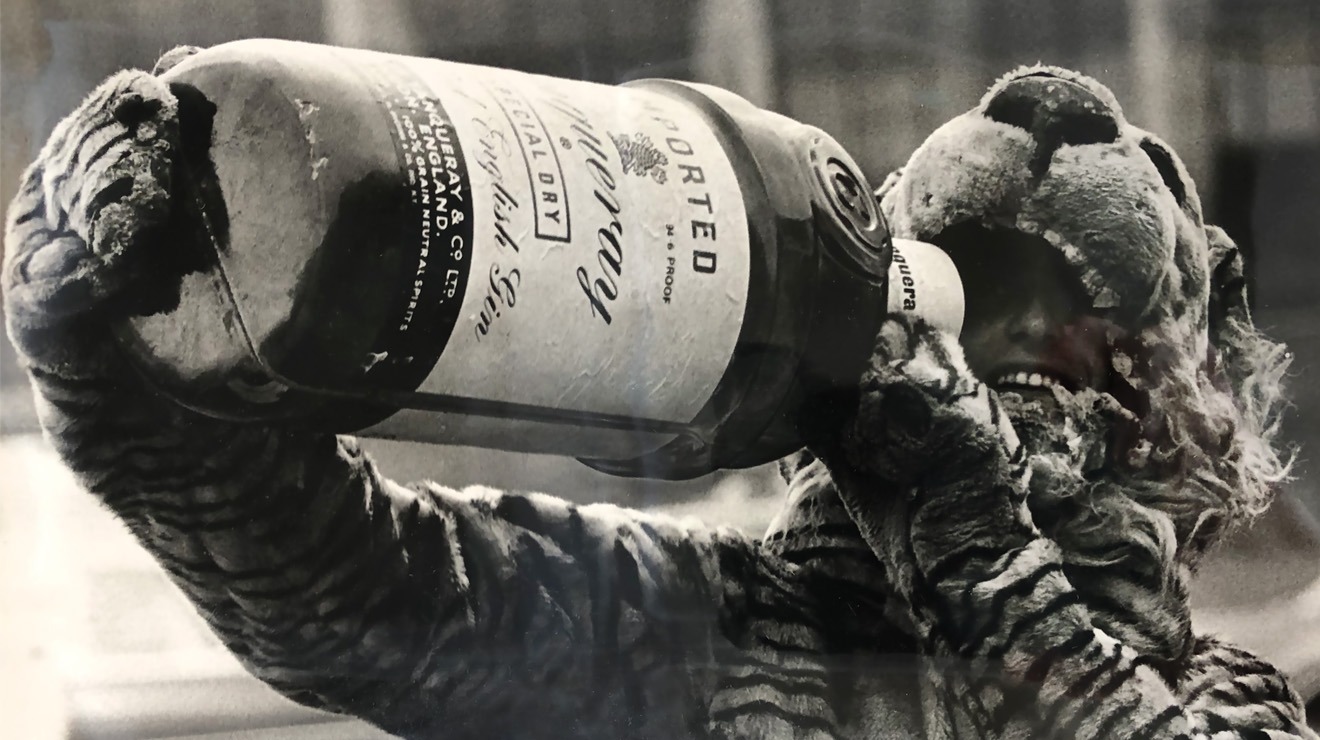
Mascots are supposed to have fun, but from time to time, they can get carried away. Football games against Dartmouth have seemed to bring out the worst mischief.
At the 1952 Dartmouth game, for example, Garton, in his mascot suit, fielded one of Princeton’s extra points and ran it back the length of the field, earning Princeton a 5-yard penalty on the ensuing kickoff. A dozen years later, Findlay fortified himself with something a little stronger than usual before a contest up in Hanover.
Findlay: Oh, yeah, I got s--- faced prior to the Dartmouth game thinking it might enhance my performance. Wrong! It was a disaster. Lesson learned. I never had a drop of controlled, or more commonly uncontrolled, substance after that.
Stephenson: My most mortifying moment was standing up in front of 40,000 fans at Franklin Field. Some Penn student came up behind me and sawed off my tail while I wasn’t paying attention and ran away with it.
In 1985, the officers of the Princeton University Band felt compelled to write a letter to The Daily Princetonian addressing complaints about their performance during the halftime show at the Lehigh football game. “To our knowledge,” the band members wrote, “the negative [comments] all stemmed directly from the actions of the two Tiger mascots. For the uninformed, the Tiger mascots simulated the process of creating little tigers on the field. It is our goal in this letter to inform our audience and the public that the Tiger mascots are not in any way connected with the Princeton Band.”
Even well-meaning fans, though, can be a problem.
Ruona: It’s hard to advocate for yourself in the suit, while not speaking and staying in character. Like, getting your tail pulled. When the kids do it, it’s fine. But when it’s a grown adult, I’m like, ‘There’s a person in here. Can we respect that?’
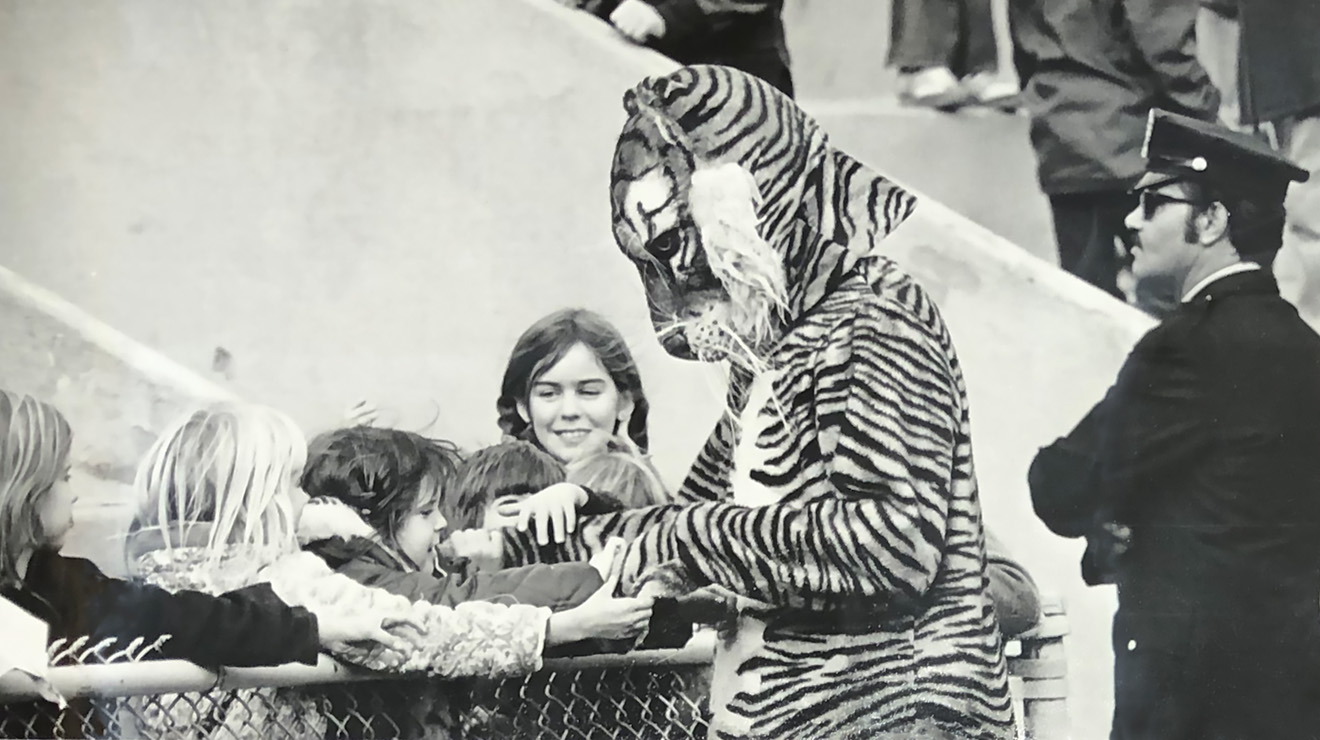
Then there are the fans, usually for the opposing team, who are not so well-meaning. On several occasions over the years, serving as the Tiger mascot has been downright dangerous.
In 1963, for example, a group of Harvard students swarmed the field in Cambridge after the final gun, knocked the mascot down, and stole his head and tail. Athletic director R. Kenneth Fairman ’34 told the Prince that there were no plans to buy another suit for the rest of football season and that the Yale and Dartmouth games might be played without a mascot. Seven years later, Dartmouth rowdies also jumped the Tiger. “[M]any attempts at patching notwithstanding,” the Prince reported, “the sacred costume had seen its last day.” An alum, Robert Campbell ’46, purchased a new tiger suit for the cheerleaders the following year.
A generation after that, more than 30 Penn fans mobbed mascots Jeremy Glantz ’90 and Denis Curran ’93 at Franklin Field in 1993, making off with their headpieces. “Our general feeling was that this was a great joke, but not the way they went about it,” Glantz said afterward. “I was lucky to get away without injury.”
Kapustin, on the other hand, was not so lucky. In probably the worst mascot attack, 14 Cornell band members jumped Kapustin during a game in Ithaca in 1994, pinned her to the ground, and tried to rip off her headpiece, which was held on by a chin strap. Kapustin, who was taken to the hospital, suffered a scratched throat. The Cornell band sent her a written apology and voted to suspend itself from playing at the following week’s game.
Davenport: My sophomore year [1997], Palmer Stadium had just been torn down, so all our games were away. When we went up to Harvard, there was a rumor that they wanted to kidnap the mascot, and so I could only have limited range of movement, closely followed by security.
Henkelman: By my time, I could not go to away games because of prior crimes against the mascot. But the Penn Quaker always came to Princeton for basketball and football games and brought supplies, including a cleaver at one point, which he planned to use to chase me around. He approached me out of costume before the game and said, “I’m going to fight you.” He tried very hard. Security broke us up a couple of times.
Ruona: The only games I traveled to were the Ivy Madness and March Madness tournaments, and there haven’t been many problems other than heckling student sections. Things have calmed down.
The athletic department washes the mascot suits, sprays the headpieces with disinfectant, and patches them as needed. Often, though, the costumes remain in use until they wear out, leading to complaints from students as well as alumni.
“It is an outrage that this flea-bitten rug will be strolling onto the floor tonight to represent the University on national television,” the Prince editorialized before the 1998 NCAA men’s basketball tournament. “Surely the school with the fourth-largest endowment in the nation could afford to fork over the paltry sum that would finally give athletic teams and the student body an honest-to-goodness Tiger they could be proud of. Take a lesson from Clemson. They have a tiger. We have a cut of upholstery held together by duct tape and chewing gum.”
John Gore ’68: In 1992, I was working in the Annual Giving office, and we wanted to invite the Tiger to a staff birthday party. I called over to the athletic department and they said, “You don’t want the Tiger. It stinks so bad.” So I put together a consortium to buy some new suits. You can’t go to Macy’s for that, but eventually I found a supplier in the Garment District in New York who had done costumes for Broadway shows. The guy got a couple of people to work doing sketches and found a place up in Massachusetts that would make artificial fur. They spray-painted the black stripes onto it. We decided that it wasn’t fair to have just one suit. So we got one made for someone about 5-foot-8 and then a bigger one in case we had some galoot who was over 6 feet.
Greg Manger, owner, Costume Specialists Inc., Columbus, Ohio: We designed and manufactured the current Princeton Tiger suits in 2013. Our company has done a lot of mascots, including the Columbia Lion and Brutus, the Ohio State Buckeye. Princeton worked closely with our design team. We then sent over material samples and, once those were approved, we sculpted the headpiece. The whole process takes about 12 to 14 weeks. Those suits cost $4,400 apiece, but they would be a little more now.
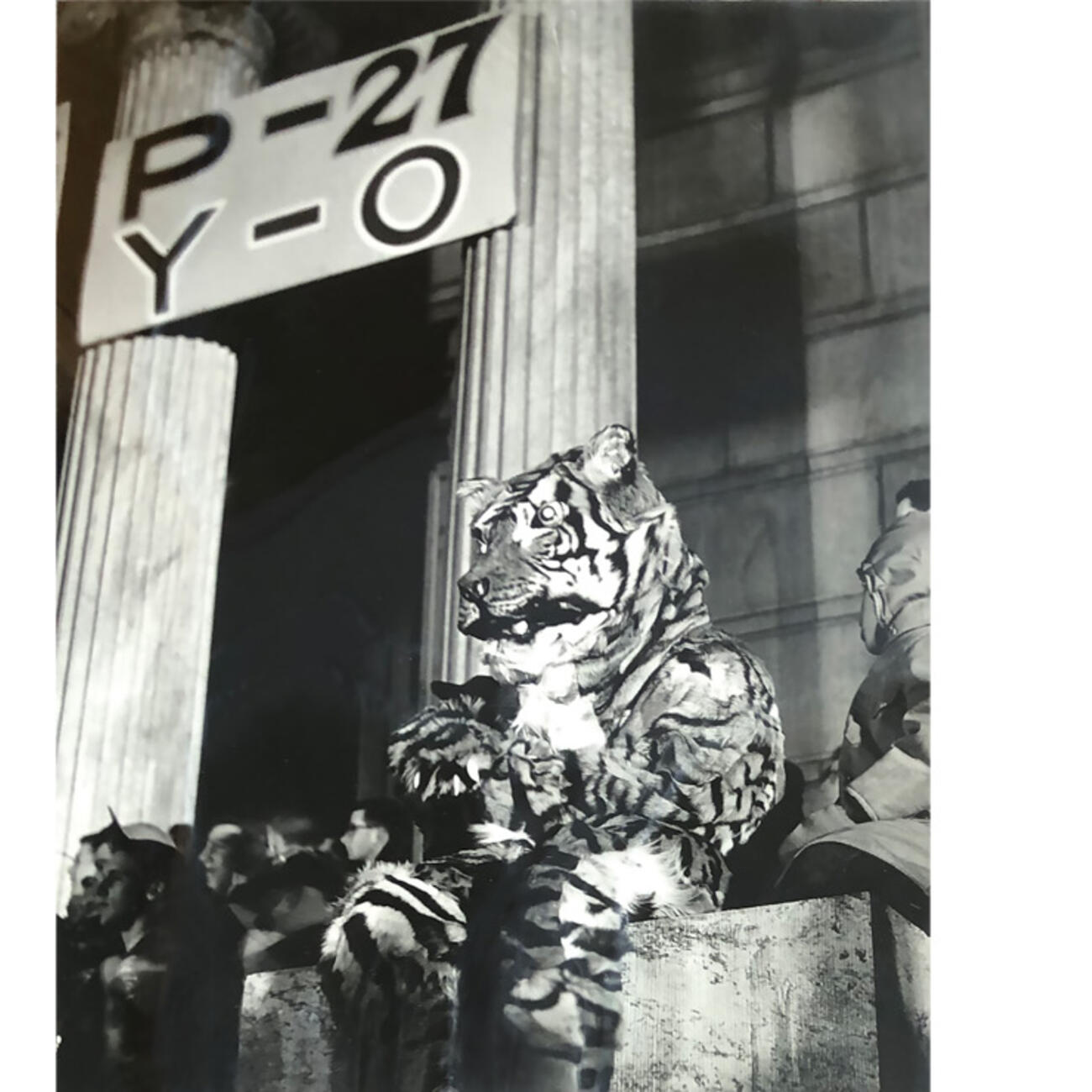
Given the number of events they must cover, there is now more than one person serving as the mascot. Here’s a little secret: They are not always students.
Kapustin: I’ve been at Reunions where I’ve chatted up the mascot and told them, “Hi, I was the mascot, just wanted to wish you luck.” And they’d say, “Actually, I work on campus. I’m not a student.” I was so surprised the first time they told me that.
Maritz: There are a hell of a lot of games. Doing it by yourself is a big time commitment. As a student at Princeton, time is one of the most precious things you’ve got.
Ruona: Before me, we would hire out to an ex-professional mascot who lives in the area. Now it’s transitioned primarily back to students. We’re trying to build our network to have five to eight students who can rotate between all the sports.
Although the mascot once attended only football games, today’s mascots try to support all Princeton teams, as well as other events such as the P-rade and the Special Olympics. Wherever they go, they serve as a symbol of the University.
Kapustin: I felt like I should be everywhere. I had friends who were on the track team, and no one goes to cheer for track and field. So I went. I also went to a baseball game, a soccer match, some rugby games. I mean, I had never seen rugby before. It wasn’t about the Tiger wanting to be seen. It was about me wanting to make those students feel seen.
Kline: The mascot is there to galvanize the crowd’s attention and focus everyone on pulling together as a community. You’re sort of a nonhuman embodiment of Princeton, so you don’t represent just one type of person. Everyone is unified in those orange and black stripes. That’s something we need more of these days.
Mark F. Bernstein ’83 is PAW’s senior writer.
Related News

Janice Lee ’09 Worked to Renovate One of Hollywood’s Best-Kept Secrets
An engineer by training, Lee has been deputy project manager on the renovation of Hollywood Burbank Airport


13 Responses
Wiz Lippincott ’82
5 Months AgoTiger Twirls at Baker Rink
I fully related to Mark Bernstein’s piece “Behind the Stripes,” but was I the only Tiger who braved the ice during hockey games? I spent my undergrad winters figure skating at Baker Rink and remember agreeing only once to suiting up and sharing the ice with the Zamboni. Skating backwards tamed my blind ambition; the weight of the head made jumping a heavy task; and the tail loved to whip me off course as I spun or changed direction. It was a fun and wild ride. I regret not lacing up hockey skates instead and joining the fledgling women’s team.
Peter Wetzler ’76
6 Months AgoTeaming Up With the Tigress
I read with curiosity the article on the history of the Tiger, “Behind the Stripes,” and thought you would enjoy hearing a tale or two from the “transition” Tiger as I started solo in 1972 and then shared the role during the first year of the introduction of the “Tigress.”
I loved the anonymity of being the Tiger, showing up at art openings, walking down Witherspoon and high-fiving kids on the street. I remember walking on campus and having to stifle a wave to a band member or cheerleader with whom I’d just spent an entire afternoon on the football field together after realizing that they had no idea who I was.
The Princeton/Syracuse game at Palmer Stadium stands out. It was my first shared event with the Tigress and when I arrived at the stadium she informed me that she had promised the Syracuse athletic director that we wouldn’t interrupt their halftime show! “But that’s what we do!” was my response. I acquiesced, and the best I could do was mime yawning and portray boredom on the sidelines as the Syracuse drum majorettes twirled onto the field with a very buttoned up band compared to our ragtag and hilarious counterparts in the Princeton Band.
I was marveling at how 1950s this Syracuse performance was with a sequined Barbie majorette leading the performance when one of the Princeton Band members tapped me on the shoulder and said, “Hey Tiger, turn around” and I turned to discover a sea of Princeton fans in the bleachers chanting “Tiger: DO SOMETHING!” What went through my mind was, “The Tiger is the embodiment of the spirit of Princeton and that spirit is imploring me to act!” I told Marty I had to do something and she reiterated her promise to the athletic director. I decided to tiptoe down the 50 yard line up to the solo baton twirler with her back to me performing to the Syracuse bleachers. I mimed an exaggerated tap on her shoulder. In the next instant I was on the ground under a pile of Syracuse cheerleaders that got heavier as they piled on and then lighter as the Princeton cheerleaders joined in to pull them off. The crowd was roaring and I was thankful the new Tiger suit that we had just been given was heavily reinforced. The tradition of stealing the Tiger’s tail had been cleverly thwarted in the new suit design, which had a wire reinforced tail that attached to a separate belt inside that strapped to the body.
After a rocky start with the Tigress, we did come together beautifully at the Yale Bowl when during halftime the Yale Bulldog mascot kept annoying the Tigress with theatrical attempts to hug and kiss her — at which point I sneaked up behind him and got down on all fours while the Tigress motioned the Bulldog to kiss her cheek and then, with brilliant theatricality, pushed him to fall backwards over me.
Stephen T. Whelan ’68
7 Months AgoBroadcaster’s Costume Critique
Your splendid article contained the 1998 Prince editorial lamenting the sad condition of the Tiger costume, which doubtless inspired CBS sportscaster Gus Johnson, during a break in the Princeton-Michigan State tournament game, to comment, “This is the sorriest looking Tiger I’ve ever seen,” and then use a Telestrator to identify the frayed and torn spots on the costume.
L. Peter Smith ’70
7 Months AgoSaved by the Rugby Team
As the Princeton Tiger (1969-70) I read with interest your cover story on “Tiger Tales.” I have three comments, as follows:
1. The reason I became the Tiger was because of my predecessor Peter Plympton Smith ’68, who proceeded me by two years — two Peter Smiths in three years!
2. My best story was being hijacked from the Princeton side of the field in Hanover by a large gang of Dartmouth freshmen who definitely “had me” only for them to be stopped dead by the Princeton rugby team, which was just entering the stadium. The battle was fierce and I was nose down in the scrum, but when it was over, I was triumphantly carried back to the right side!
3. I believe that’s me in the photo in your article with the bottle of gin! Unfortunately, I later might have had a little too much of something and fell on the bottle as it popped apart. Oh well!
My favorite thing about being Tiger was wearing the uniform in Manhattan on Saturday nights after the games. You can imagine how much fun that was!
Great article, thank you. Here’s to all Princeton Tigers!
Donald H. Fox
7 Months AgoFox’s Sequel: Returning a Soggy Suit
A natural, or rather a family bias added to my enjoyment of Mark Bernstein ’83’s excellent cover article, “Behind the Stripes,” about the generations of Princetonians who have played the role of the Tiger mascot. Our family will always be proud of how Fred Fox ’39 was the first person to don a tiger skin and march in as a member of the band. He loved to tell that story, as it included the generous creativity of his father, who got him the costume at a New York City furrier for the 1936 home game against Yale. But he would sometimes also tell a not-so-glorious sequel: the 1937 game when he tried to do the same thing in New Haven. That game was played in a downpour. And when my father left the very wet costume at the Princeton Club in New York for the furrier to pick up, he was not charged the $15 rental fee, but its total cost (of $178.50) as the owner deemed it “ruined beyond repair.” The damaged tiger suit turned into … a lawsuit! It eventually got settled in what my father called “an initiation into adulthood.”
And a P.S. about the Nov. 14, 1936, game: The Pathe newsreel of it contains about 10 seconds (out of almost four minutes) where one can see the Tiger cavorting on the sidelines. But perhaps only real Fox and Tiger fans will want to watch that!
Josh Libresco ’76
7 Months AgoA Hot Day in the Tiger Suit
I was the tiger once, and only once, during my senior year, in late March of 1976. Princeton qualified to play in the NCAA basketball tournament that year, against undefeated Rutgers — ranked third in the country. The game was in Providence, Rhode Island, and I happened to run into a friend who was generally the tiger but who could not make it to the game. I volunteered.
It was a great experience, except that the tiger suit was really, really hot, as some in the article noted. There was a problem with the air conditioning in Providence that day, and that made the temperature in the tiger suit even higher. Sadly, Princeton lost the game by a point.
Christopher Pullman ’63
7 Months AgoThe Tiger Mascot’s Essence
I read your “Behind the Stripes” mascot article with interest, but nowhere could I find mentioned the most essential concept for this critical role.
I happened to be the head cheerleader, so for several seasons I had the opportunity to study Charles Stephenson ’62 *64’s interpretation at close range, yearning to have the experience.
Eventually Stephenson gave me the honor to inhabit the dank mammal for the second half of the 1961 Brown game my junior year. When he agreed to let me do it, I asked him for advice.
He looked at me and said, “Remember: It’s not a man trying to act like a tiger. … It’s a tiger trying to act like a man.”
Doug Harrison ’72
7 Months AgoPhoto of the Tiger at Rest
The “unnamed” Tiger mascot in your 1970 photo is the late, great Jim Brink ’72.
Paul Gazzerro ’92
7 Months AgoOne Night at the Carrier Dome
I was a substitute Tiger in 1991 for a single basketball game the men’s team was playing as the 8th seed in the March Madness tourney against the 9th seed Villanova Wildcats at the Carrier Dome in Syracuse. My girlfriend at the time was the actual Tiger but couldn’t go and sent me. This was during a run of several years in which we made the tourney, and being seeded 8th was a big deal. Each year, we’d managed some TV time, and the Tiger had gotten a teeny piece of it, so I prepped my best Dancing Homer routines, but to no avail. This was the one year when the Tiger would not be televised. I did get into a small brouhaha with the Wildcat after the game ended and had to turn on the jets to escape with my dignity (and costume) intact. And yes, it smelled really bad. Unfortunately, we lost by two at the buzzer, 50-48, so my Tiger time came to an abrupt end, but I’ll never forget it.
John Fisher ’67
7 Months Ago‘The Tiger Never Apologizes’
I enjoyed the article featuring some of my fellow Tiger mascots.
In the fall of ’65, I had the dubious distinction of following the previous year’s great, inimitable tiger, Graham Findlay ’66, whose hilarious halftime antics I tried and miserably failed to emulate. Perhaps the closest I came was at the home game against Penn, a warm day when I discovered too late the inadvisability of imbibing a few beers before donning the sauna-like tiger outfit. That may have been why, as the band formed a mattress on the field while playing “A Hard Day’s Night,” I found myself in the middle of the formation trying some gyrations which might have made sense if I’d remained upright but seemed to capture unusual notice in the sellout crowd since I was prone as I went through my limited repertoire of dance moves. As I returned to the sidelines at halftime’s conclusion to what seemed like thunderous applause, the head cheerleader, Phil Handy ’67, asked me if I had any idea of what I was doing out there. The truth? Not a clue.
The epilogue came a few days later, when Dean of Students William Lippincott, ‘41 “invited” me to his office to tell me about all the angry letters about my unseemly antics he’d received from irate alumni. He told me I’d likely have to write an apology in the PAW, to which I replied that I agreed that I probably should do that, except, as I explained to him, “The Tiger never apologizes.” He laughed and shooed me out of the office.
John Edie ’66
7 Months AgoPlaying to the Crowd as Substitute Tiger
For the 1964 football season (my junior year), I was a cheerleader (all guys in those days). Graham Findlay was our tiger, and he was hilarious. For one of our early games (maybe against Rutgers), it was very hot. The tiger costume was thick and designed for cold weather. By halftime, Graham was close to heat prostration and could not go on. I was designated by the head cheerleader to take his place, so I stripped down in the locker room and climbed into the totally sweaty tiger suit — ugh. Shortly after I got back on the field, it dawned on me that I sort of had a license to do a bunch of crazy things. So, I first got the student section’s attention and snuck up behind at campus cop. Then I grabbed his policeman’s hat and ran around with it to thunderous applause and laughter. Thus encouraged, I thought, what else can I do? So I walked up into the stands near the 50-yard line seats to where President Goheen and his wife were sitting. I waved to all my new fans and then proceeded to sit on Mrs. Goheen’s lap — a bit outrageous but one of my best memories, not to mention that the football team went on to be 9-0 and undefeated.
Michael Scharf ’64
7 Months AgoA Mascot at the White House
My favorite Tiger is my son, Will Scharf ’08, who is now assistant to the president and White House staff secretary. Good training for the vicissitudes of life in the political arena.
Stephen Graham ’69
7 Months AgoCheerleaders Defending the Tiger
I would like to offer a minor correction to Tom Culp’s contribution. I was in Tom’s class and was a cheerleader my junior year. When Tom arrived at Princeton the head cheerleader was Phil Handy ‘67, Tom Handy’s older brother. Tom Handy was my roommate and a cheerleader but never the head. That honor in 1967-68 was held by Bruce LaPierre. Our gang successfully fended off an attack on Tom Culp by Yale cheerleaders during the 1967 Yale game. I’ve often related that it was my first, but far from last, strong objection to the actions of George W. Bush, a Yale cheerleader during that era.