

Ben Denzer ’15 Makes Art with ‘Pieces of Tape and Luck’
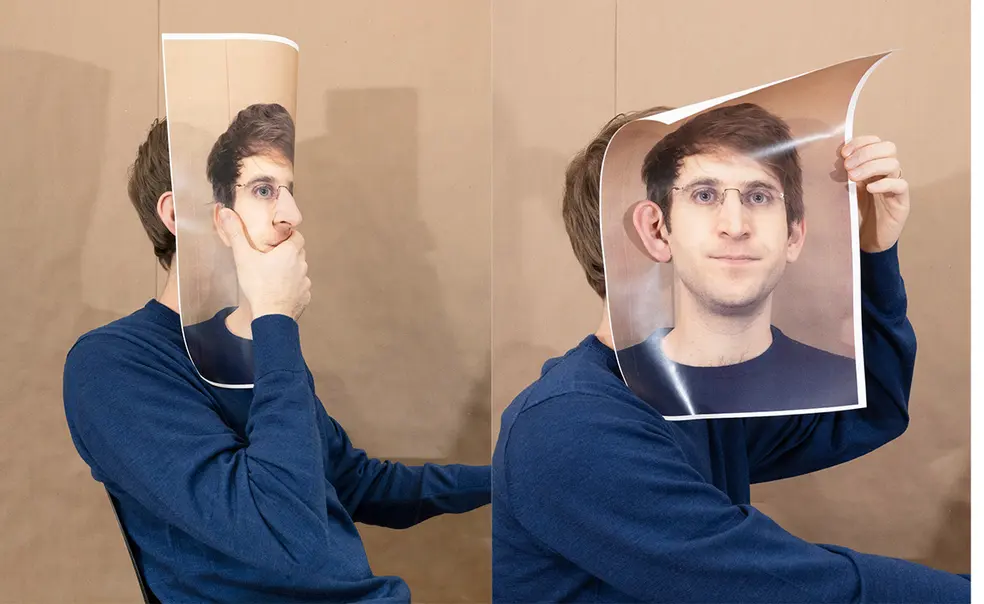

In May of 2023, Ben Denzer ’15 and several friends transported more than 800 pounds of overwintering plastic to a field on Tillinghast Place, a beach side property of the Rhode Island School of Design. They unfolded the plastic strips and fastened them together with duct tape. A drone recorded as Denzer and his friends tugged open the cover of the 125-foot by 100-foot book, which Denzer created to complete his master of fine arts degree. He had worked months for that moment, tracing, painting, rolling, and unrolling plastic, often on his hands and knees.
This was one of the many times Denzer, a New York-based artist, designer, publisher, and teacher, has prodded assumptions about what makes a book, a book; what makes art, art; and what makes a thing worth doing. Sheets of foam, files of paper bags, and rolls of tape adorn his walk-in closet, also known as his studio. Whether designing book covers or building Birkin bags out of vegetables, Denzer takes a hands-on approach.
“Most of the things I do are just kind of held together by pieces of tape and luck,” he tells PAW. “You kinda capture it before it falls apart.”
Growing up in a suburb of Kansas City, Denzer spent much of his free time making sculptures out of tubes of masking tape. A tape-tube creation from 2003 — when Denzer was 10 — is a seascape featuring a squid with tiny suckers, fish with curved fins, and shells piled on the seafloor. For his Halloween costume in seventh grade, he built a Star Wars stormtrooper helmet out of tape and paint. Denzer’s parents, neither of whom are artists, encouraged his creativity.
This support continued at Princeton, where Denzer majored in architecture and pursued a certificate in visual arts. As he experimented with woodworking, sculpture, typesetting, and other media, his flexibility stood out. “He’s interested in the situation at hand,” says visual arts professor David Reinfurt, who advised Denzer for two years, “not, like, the ideal situation.” Denzer engaged in design outside the classroom, joining the Beekeeping Club and remaking its logo. His design, a bee with the Princeton crest as its abdomen, stuck.
Soon after graduating, Denzer took a job as a junior designer at Penguin Random House before earning his MFA in graphic design. Now, he teaches full time at Parsons School of Design. For his class, Physical Design, he asks students to bring in a range of materials, from crayons to mustard, and form words with them. The exercise can get sticky, slimy, and wet. That mess is part of the charm. Through working physically, students must think carefully about formal choices — choices which, today, algorithms often automate.
“It’s not like the class is anti-computer,” Denzer says. “You can get stuff by coming outside the computer, and going back in, and going out, and going back in.”
In his own work, Denzer highlights the value of working with his hands. For the first issue of his new series Process Pamphlets, set to come out in early April, he documents the steps that went into creating and publishing an image for The New York Times sports section of football players atop a stopwatch, the minute and hour hands marking a line of scrimmage. Through pictures and text, Denzer reveals the tools he used — paper, glue, scissors, and Photoshop among them.
Denzer’s designs, however professional, involve messy experiments. The video documenting Denzer’s monumental thesis captures some of this chaos. As the book billows, small gaps form between the plastic panels. An “H” zigs and zags. To Denzer, such a quirk only enriched the final presentation. “It kinda makes it better,” he says. “It shows that it’s, you know, real.”
The Latest
See all


Related News


Janice Lee ’09 Worked to Renovate One of Hollywood’s Best-Kept Secrets
An engineer by training, Lee has been deputy project manager on the renovation of Hollywood Burbank Airport


No responses yet