

Did Hobey Baker 1914 Suffer From Repeated Brain Injuries?
A new research paper examines the sports legend’s exposure to violence and the circumstances of his death
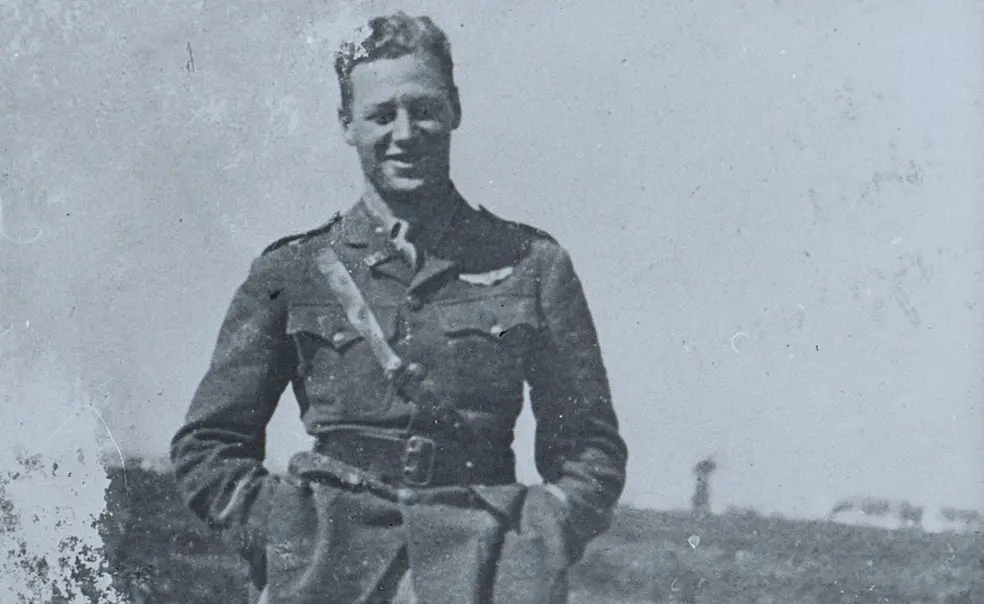

When Michael Popkin ’65 returned to Princeton for his 25th reunion, he knew there was one stop he had to make. He wanted to take his 11-year-old son, Charles, to see Baker Rink, the University’s historic hockey facility and a shrine to Hobey Baker 1914, widely regarded as one of the greatest athletes ever to compete for the University and one of the best amateur sportsmen in American history.
Popkin learned to skate at Baker Rink as a youngster growing up in Trenton, but the visit wasn’t driven by nostalgia. Charles, born and raised in Minnesota, loved sports and was a good athlete. His sporting idols were Minnesota Twins center fielder Kirby Puckett and U.S. Olympic gold medalist Neal Broten, the youngest player on the “Miracle on Ice” team that beat the Soviets in Lake Placid in 1980. But now, it was time for him to be introduced to Baker.
The lesson took root for young Charles Popkin, lighting a Hobey Baker lamp that still hasn’t gone out. Shortly after his visit to the rink, he did a book report on The Legend of Hobey Baker, a biography by former PAW editor John D. Davies ’41. He read voraciously about Baker’s feats, imagining his end-to-end hockey rushes, weaving through opponents as if they were traffic cones, and his punt returns, which he’d field on a dead run almost daring defenders to try to bring him down, playing both hockey and football without a helmet and without fear. He learned, too, about the tragic end of Baker’s life in a mysterious plane crash amid widespread accounts of erratic behavior, depression, and rampant risk-taking.
Years passed. Like his father, Charles Popkin became a doctor, a prominent orthopedic surgeon who has been the team physician for a number of USA Hockey youth teams. With player safety top of mind, he immersed himself in scientific studies linking repetitive head impacts to neurological damage and chronic traumatic encephalopathy (CTE), a progressive degenerative brain disease. His fixation on Baker only intensified after reading Tim Rappleye’s 2018 book, Hobey Baker: Upon Further Review, and rereading Davies’ work, which recounts the hits Baker took on the field and ice.
Popkin couldn’t stop asking himself one question: “How could a guy who embodied everything an American should strive for, who was literally the golden Adonis who could do no wrong on the field and was kind and humble off of it, wind up the way he did?”
Popkin posits his answer in a new paper in the journal Frontiers in Neurology called “Consequences of repetitive head trauma: a historical reappraisal of Hobey Baker.”
Baker went to work on Wall Street after graduating Princeton. He got his competitive fix playing in an adult hockey league that was amateur in name but populated with semipro Canadians, many of whom lived by the same credo as Baker’s Ivy League opponents: “Get Baker.” He was routinely tripped, kneed, punched, and smashed into the boards. In one game, Baker received such a fierce beating that a fan in the stands shouted, “Why do you not get a club and finish the task quickly?” In the same season, he was tripped and crashed into an iron goal post, hitting it with such force that he was unconscious for minutes. The gridiron had been no different, with Baker routinely getting roughed up because it was the only way to beat Princeton.
Rappleye’s account chronicles Baker as a man adrift in the world and in a downward psychological spiral in his post-Princeton years. The same person whom his fellow Princetonian, author F. Scott Fitzgerald 1917, extolled as “an ideal worthy of everything in my enthusiastic admiration” often seemed dark and distracted, and searching.
“I realize that my life is finished … no matter how long I live, I will never equal the excitement of playing on the football fields,” Baker once confided to a friend.
Baker had little use for finance or the business world. He began to smoke heavily and engaged in risky antics. He had taken aviation courses while he was a banker and enlisted in the Army Air Service, joining the World War I effort in France. Although logistical problems kept him out of combat for more than a year, he was eventually credited with shooting down as many as four enemy aircraft and got promoted to captain. He was energized by the thrill of combat but remained troubled by what he considered an uncertain future.
Baker tried to extend his time in France but was denied. On Dec. 18, 1918, he was given his papers to return home. He decided to take one last flight, but instead of flying his own plane, he opted to fly an aircraft that he was unfamiliar with. It had just come out of the repair shop. He took off in a driving rain and leveled out at 600 feet, and then the engine failed. Rather than glide the plane down to an emergency landing, he reversed course and headed back to the airfield, a cardinal sin among experienced aviators. The plane plummeted, crashing nose first. Baker was dead at age 26. His discharge papers were in his pocket.
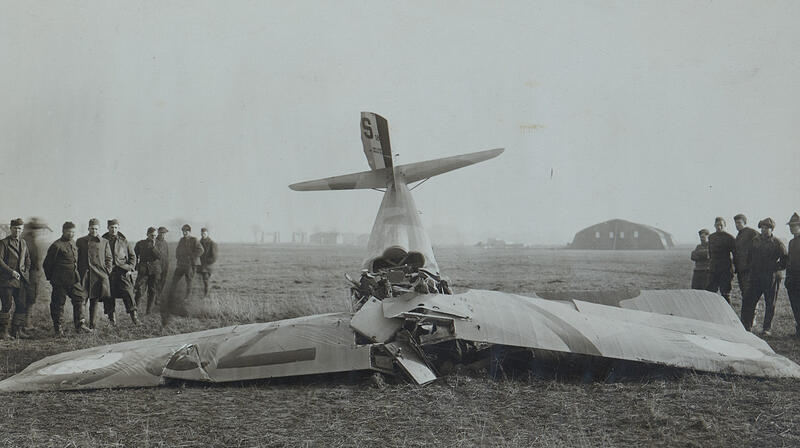
The initial reports cited engine failure as the cause of the crash, but people close to Baker, who knew how stressed he was about returning home and how despondent he was about his recent broken engagement, wondered if that’s all there was to it — and whether he may have wanted to take his own life. It has been the subject of debate for over 100 years, no closer to resolution than it was in 1918.
“At the end of the day we’ll never know if Hobey Baker had CTE or not,” Popkin says. “[But] I don’t think anybody can argue that he had the exposure for this diagnosis, and the altered decision-making and personality changes certainly fit it.”
Twenty years have passed since CTE was first scientifically linked to football, and the data — for all sports that involve violent collision — only seems to get more alarming. According to a study published in August in The BMJ, at least 215 of the 878 NFL players who died between 2016 and 2021 — or 24.5% — had CTE. That does not include the 643 brains that were not examined. Of those 235, more than 90% had CTE. Popkin called the results “deeply concerning.”
CTE can only be diagnosed by studying someone’s brain after death, which makes it difficult to pin down how widespread it is. But Popkin believes it’s imperative to understand the risks of sports that he calls “intrinsically dangerous.” In a 2023 study published in JAMA Network Open, Popkin looked at life expectancy data for 6,039 NHL players from the period of 1967 to 2022. He found that enforcers — a group he defined as players who engaged in 50 or more fights in their careers or averaged more than three penalty minutes per game — died on average 10 years younger than their peers. Moreover, enforcers died in disproportionate numbers from drug overdose and suicide.
A separate study in 2024 of 77 deceased male hockey players by the Boston University CTE Center found that the odds of having CTE increased by 34% every year of a player’s career. It found that 18 of the 19 NHL players studied had CTE.
Alan Reynolds ’11 was a four-year goaltender for Princeton men’s hockey team. He went on to medical school, studied as a fellow under Popkin at Columbia, and says he was honored to work on Popkin’s draft of the Frontiers paper. While he’s an orthopedist and not a neurologist, Reynolds says he was impressed with his mentor’s commitment to unraveling the Baker conundrum: “Charlie has devoted a lot of time, effort, and research into making hockey safer. … The more information and research we have, the more we are able to make informed decisions about safety.”
This December, Popkin will be the Team USA doctor for the world junior championships in Canada. For a former hockey player and lifelong fan of the game, assignments don’t get much better. Popkin will say goodbye to his wife and kids, and his 3-year-old dog — named Hobey — and head to western Canada, his singular mission to make the game safer. It’s the best way he knows to honor the legacy of Baker.
“Taken together, I think the football and hockey data send the same baseline warning: Cumulative exposure to repetitive head impacts matters, and we should reduce avoidable exposure wherever possible,” Popkin says. “I would argue that is the lesson we learned from Hobey Baker, too.”






4 Responses
Tom Healey
1 Day AgoOne-and-Done Approach to Head Injuries
As a lifelong hockey fan and frequent visitor to Baker Rink, I wanted to add to the conversation.
I attended Xavier High School in New York City. Longtime football coach Leo Paquin (one of Fordham’s “Seven Blocks of Granite” and Vince Lombardi’s college roommate) had a one and done policy with regard to concussions and head injuries. Many friends were disappointed to never play again after suffering an head injury. But they include dentists and successful business people. I wonder if a future study might include coaches who had similar policies.
Bill Tresham ’78
1 Month AgoHobey and the High Cost of Contact Sports
I played hockey all my life including at Princeton and afterward. It is certain that many people I have played with had CTE. It is certain too that Hobey was “injured” after all of that contact. He also likely had some sort of depression. What he did was reckless and be sure he knew that. Some people pay a much higher price than others for the exhilaration and fame that sport has given them. He was surely one of them.
Jeffrey R. Abergel
1 Month AgoOn Hobey, the Dog
I would just like to add that Hobey (the dog) is the fluffiest dog I have ever met. ( I have no first-person knowledge of the fluffiness of Hobey the hockey player.)
Don Kessler
1 Month AgoPrinceton Trainers’ Approach to Concussions
A very interesting supposition. It makes it interesting to think of other old time athletes’ lives like Jim Thorpe and how tragic his life ended. Ice hockey without helmets certainly could have been a factor in Baker’s case.
During my years at Princeton as an athletic trainer, legendary head athletic trainer Dick Malacrea always stressed helmet safety and concussion recovery. Way ahead of his time, he hid helmets of players who had suspected head injuries so they wouldn’t return to the game. Dick had a strict return to play of days of rest, light activity, and increased stress until full recovery. It is a policy that the NFL has finally come around to that Dick and Princeton were practicing in the 1970s.