

A Documentary Film Class Led Us To Paris
Years after watching an Agnès Varda film at Princeton, Daniel He ’16 and Maggie Zhang ’16 retraced her footsteps in the city she called home

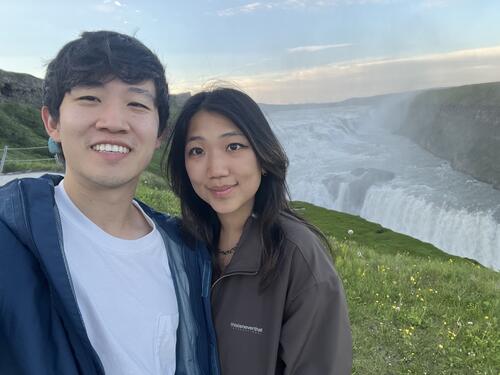
We first discovered the French filmmaker Agnès Varda in 2016 while taking a documentary filmmaking class at Princeton taught by professor Su Friedrich. As part of our assignments, we watched one film a week, ranging from Werner Herzog to the Coen brothers. All of the filmmakers were incredible, but we were most struck by the spontaneous, intimate, and playful style of Varda.
Her film The Gleaners and I was unlike anything we’d seen. It’s about the lives of people in France who “glean” objects that have been thrown away — for example, gathering leftover fruit from marketplaces or scavenging items to reuse.
In the film, Varda concludes that she herself is a gleaner, in an artistic way. “You pick ideas, you pick images, you pick emotions from other people, and then you make it into a film,” she explains.
When we learned that Varda died in 2019, we happened to have a trip to France planned. After we arrived, we wanted to dedicate time to learning more about her life in Paris.
We’d heard that she was buried in Montparnasse Cemetery with her partner, filmmaker Jacques Demy. One evening we scootered across the city, only to find that the cemetery gates had closed a few minutes before we’d arrived. We were disappointed, but decided to try again the next morning.
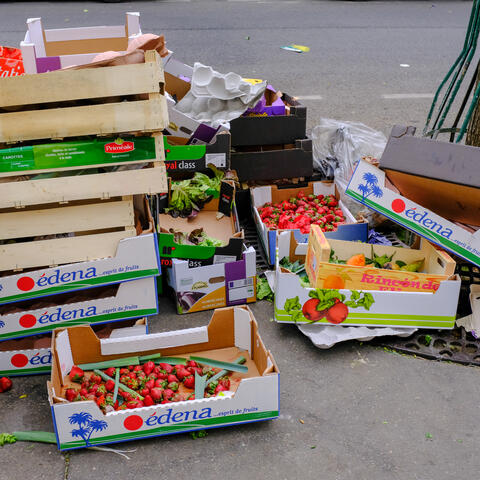
On our way to the cemetery we passed a market that was just wrapping up. It looked so familiar. And then it hit us — could this be the market from The Gleaners and I?
Though we could never confirm, it sure looked like it.
The market vendors were packing up, but many boxes of produce were left behind. And as depicted in Varda’s film, gleaners arrived to collect the still-fresh fruit and vegetables.
It was eye-opening to see this in real life. We instantly felt the power of documentary — its ability to capture snapshots that the filmmaker finds special, and share them with others so that they too can experience them.
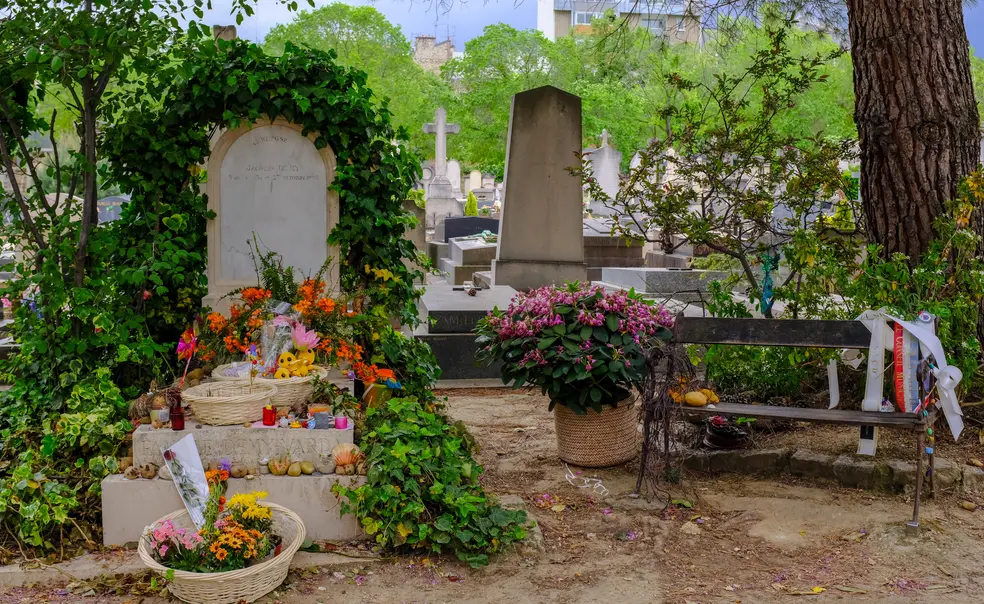
After the market, we continued to Montparnasse Cemetery. As we got to Varda’s grave, we saw piles of gifts and mementos left by visitors.
It was clear that so many people had been touched by her films. There were flowers, handwritten notes, and pinwheels spinning in the wind, adding a sense of life to the otherwise still scene.
There were also many, many … potatoes?
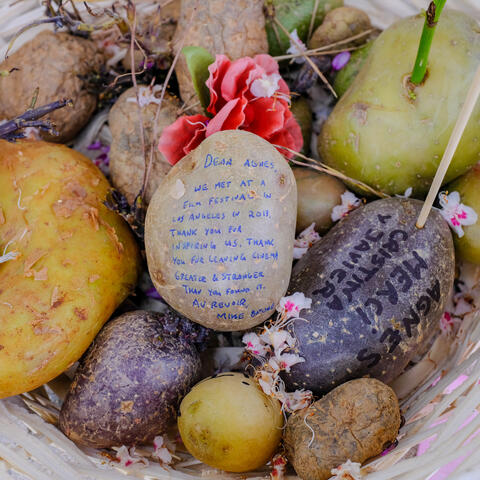
These potatoes weren’t random — they had meaning. In The Gleaners and I, Varda goes to a farm to see how imperfect potatoes are discarded and gleaned.
She expresses her love for heart-shaped potatoes in particular, which are thrown away by farmers for being misshapen.
Visitors also left her bottles of sand and seashells, references to one of her last films, The Beaches of Agnès. In the film, Varda revisits the places and memories that were important in her life.
She uses beaches as a metaphor, poetically sharing, “If we opened people up, we’d find landscapes. If we opened me up, we’d find beaches… . Memory is like sand in my hand. I keep some and some are going. The beaches are the thread, and it’s true that I’ve been on beaches all my life… . And it allows me, as a metaphor, to believe that I was always on the beach in my mind.”
Varda would have smiled at the creative ways people paid their respects to her.
We continued on, heading to the house where Varda lived for decades — just a few blocks over, dressed in layers of pink.
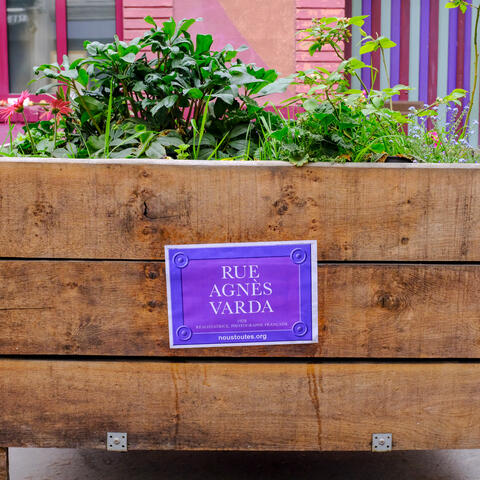
The street, Rue Daguerre, is named after Louis Daguerre, who invented the daguerreotype process, one of the earliest forms of photography where images were set onto silver-plated copper. (On the street, someone put up a makeshift sign that declared “Rue Agnès Varda.”)
Of course, this didn’t escape unnoticed for Varda, who made a film called Daguerréotypes, where she captures the lives of shopkeepers on her street. She was fascinated by their everyday interactions, the boredom and silences they encountered in between customers, the “mysteries of the daily trade.”
In the film, you really feel Varda’s close attention to the lives of strangers. For example, she visits a perfume store that her daughter frequents, and ends up curious about the owner’s silent wife.
That quality is what we appreciate about her work: Her films focus so much on other people and letting them tell their stories, but she also makes them autobiographical by reflecting on her connection with the subjects.
Inspired by Varda, we decided to wander the street, to see what we might discover. Though Daguerréotypes was released in 1976, we wondered if there were any stores on the street that had been around at the time.
As we walked along Rue Daguerre, after passing mostly modern-looking shops, we saw Paris Accordeon. It was an old storefront, which had since shut down, but next to it was a new store that sold accordions as well, called Accordéon Paris Gourmands.
After going inside, we met the owner, Danielle Pauly, who told us that she had taken over the shop.
While she still sold accordions, she also shared the space with her husband, who converted his side into a wine store. She remembered seeing Varda all the time, as the filmmaker would stand across the street waiting for her car.
One time, Varda came in and asked Pauly to slowly open and close an accordion, because she liked how the flaps looked like billowing skirts in the wind. We loved getting this glimpse into Varda’s sense of wonder with the tiniest things.
These were the kinds of chance encounters, the connection with strangers, that Varda had loved. We were able to pay attention to things that we wouldn't have noticed otherwise.
Even though Varda had died, her insatiable curiosity inspired us to be “gleaners” of the world around us. She had gleaned for her films — we gleaned for our writing.
As we reflect on this trip now, it’s amazing how you never know what classes will stick with you. Maybe it’s a psychology class that shapes how you see the world, or a quote from a book that becomes a life motto.
When we first took that documentary filmmaking course at Princeton years ago, we didn’t know that one of the films we’d watched would end up taking us far beyond the classroom, across the ocean and all the way to France.
The journey of following Varda’s footsteps reminded us that traveling itself can be a form of education, a reason to open up your curiosity and dive deep, and a way to become a gleaner of the unexpected experiences in life.
The Latest
See all


Related News
With Prominent Journalists and Hoagies, the ‘Prince’ Celebrates 150 Years
A gala at the New York Historical raised roughly $400,000 for the independent student newspaper

No responses yet