
Eisgruber Letter Warns University Community of Additional Budget Cuts
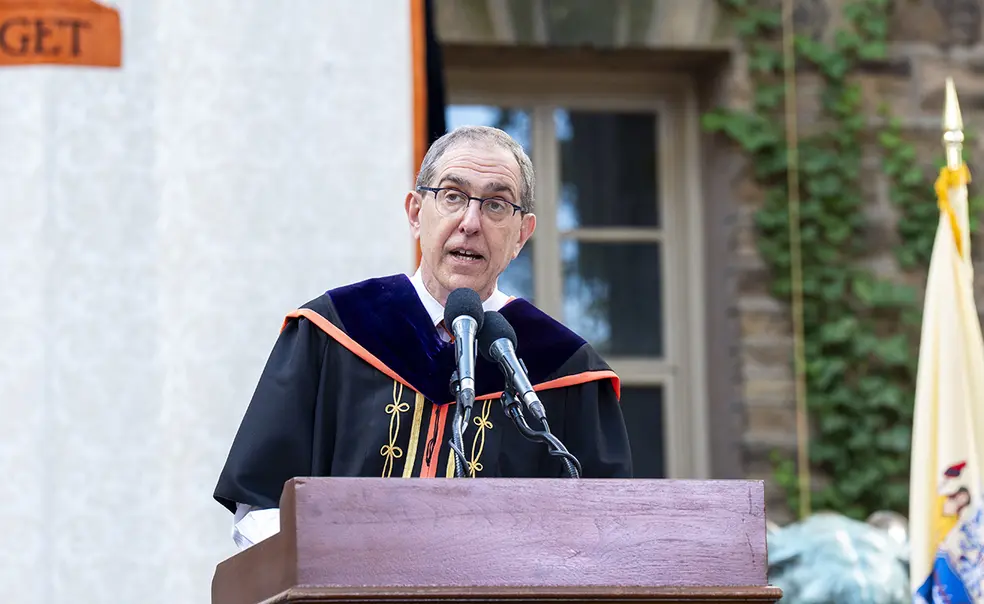

In his 2026 State of the University letter, President Christopher Eisgruber ’83 warned the community that Princeton is expecting to make further budgetary and operational changes over the coming months and for the next few years in anticipation of a decline in long-term endowment returns. University departments have already cut 5% to 7% of their budgets since last spring, according to the letter.
Two days later, an email to University employees announced that the usual merit raises of varying amounts based on performance will be replaced next year with across-the-board raises of 1%. Some employees, including the cabinet, those new to Princeton, and those on performance plans, won’t receive raises at all.
Eisgruber wrote in his letter that the recent completion of new or renovated buildings such as the Princeton University Art Museum, Briger Hall, the Frist Health Center, and the Class of 1986 Fitness and Wellness Center have capped a period of “historic growth” for Princeton that was laid out in a 2016 strategic framework document by the Board of Trustees. Construction and expansion of the undergraduate class was buoyed by the Venture Forward campaign, which raised “fundraising totals … higher than any previous Princeton campaign.”
Despite this, Eisgruber noted that “long-term rates of return are steadily declining across university endowments,” including at Princeton over the last three fiscal years, which has led the administration to assume an 8% return going forward, rather than a 10.2% return as was anticipated three years ago. That 2.2 percentage point difference “would amount to a cut of more than $11 billion — a reduction that exceeds the University’s last two capital campaigns combined” in 10 years.
In October, the University’s endowment reported an 11% return on investments for the 2025 fiscal year, its best performance in four years. That put the endowment at $36.4 billion.
Eisgruber said he expects the downward trend in endowment returns to continue as it “reflect[s] changing market fundamentals, not specific investment choices.”
Related coverage
This Is How Princeton’s Endowment Works
Endowments are back in the news, and PAW is here with a Q&A to clear up any confusion
This means the University will be more reliant than ever upon philanthropy and is likely to require “more targeted, and in some cases deeper, reductions over a multiyear period,” according to the letter. This may mean eliminating or reducing programs, as the University has to “make some hard budgetary choices in the months and years to come.” Provost Jennifer Rexford ’91 and Executive Vice President Katie Callow-Wright will lead this effort.
Hobson College, which is scheduled to be completed by 2027, and Eric and Wendy Schmidt Hall, which will become the new home to the Department of Computer Science and other programs, are two of the remaining construction projects still in the works.
Political threats on higher education, such as to research funding, immigration, diversity and inclusion, and academic freedom, led Eisgruber to declare that “we are in a crisis.” He believes “universities have an obligation to speak up” to protect the core of higher education “even when doing so may anger officials, disrupt industries, upset orthodoxies, or inflame controversies.”
The Latest
See all


Related News
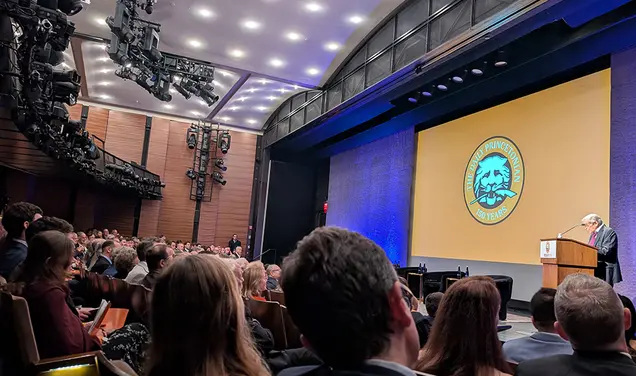
With Prominent Journalists and Hoagies, the ‘Prince’ Celebrates 150 Years
A gala at the New York Historical raised roughly $400,000 for the independent student newspaper



1 Response
Roderick McNealy ’72
7 Months AgoApplauding the Review, But Questioning the Forecast
President Eisgruber has been a steady hand at the wheel during turbulent times for other highly competitive universities. Further, applaud his serious budget reviews. However, two points. First, those whose performance exceeds expectations should be rewarded. Second, it’s unclear why there is such a conservative forecast on investment returns. The U.S. stock market is at record levels currently. Certainly a drop is possible, but the current administration — with which Princeton may not agree — is taking every possible action to increase stock market performance.