
External Pressures Play Growing Role in Campus Views of Speech

On a rainy March afternoon, a half-filled lecture hall in the basement of East Pyne became an unlikely forum for questions about teaching and something much larger: fear, not just about what can be said in the classroom and on campus, but how it can be perceived in the public eye.
At an American Association of University Professors (AAUP) event on political pressure and faculty governance led by Joan W. Scott, a professor emerita of the School of Social Science at the Institute for Advanced Study, and Keeanga-Yamahtta Taylor, a Princeton professor of African American studies, the two situated the campus climate as increasingly shaped not only by internal debates over speech, but by growing federal government scrutiny and political intervention.
“The atmosphere of fear and intimidation is very effective,” Taylor said. “How do we organize in such a way to overcome that?”
At Princeton and across the country, what once felt like campus-specific debates over free speech have been cast against national politics, with many students and faculty fearing repercussions or unwanted attention from the Trump administration. Many of the 17 students, faculty, and outside experts interviewed by PAW described a shift from internal policy to external pressure as their primary concern, reshaping how universities think about speech.
Taylor explained that her concerns about speech began during the Biden administration’s response to pro-Palestinian protests, which led to a more blunt attack by the Trump administration to “destroy campus life as we know it” by stifling speech and activism at colleges; ending all forms of diversity, equity, and inclusion programming; and a host of other actions.
“What does any faculty do in this political environment where college administrations are kind of hiding behind the Trump administration to carry through a series of draconian attacks on multiple levels of the university?” she asked.
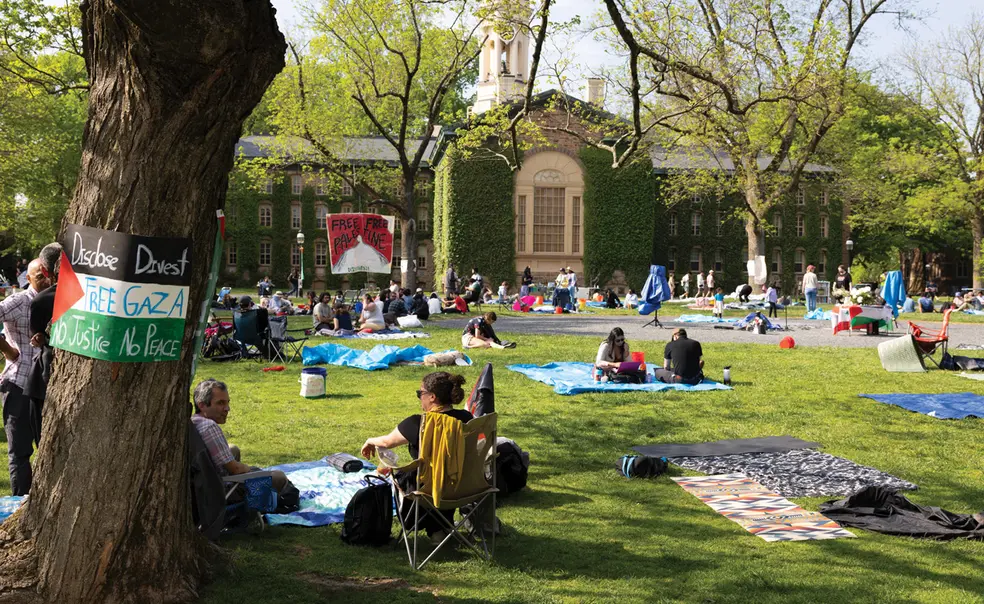
Princeton, sometimes viewed as an apathetic campus, has seen political engagement ebb and flow. A few recent moments jump out: the 2024 Gaza Solidarity Encampment, the 2019 Princeton Students for Title IX Reform (PIXR) protests, and the 2015 Black Justice League sit-in at President Christopher Eisgruber 83’s Nassau Hall office.
In April 2024, protesters briefly occupied Clio Hall, and five undergraduates and six graduate students, as well as a postdoctoral researcher and a local seminarian, were arrested and charged with criminal trespassing. This set off months of accusations and debates, a disciplinary investigation by the University, and a case in Princeton Municipal Court that was not resolved until July 2025, when all charges were dismissed after students performed volunteer service.
More recent protests and actions have been tied to national movements, including the national No Kings Day of Action and the ICE Out movement. Compared to its peer institutions, Princeton has been relatively quiet and has managed to avoid much federal scrutiny.
While some students and faculty largely on the political left point to disciplinary action following the Clio Hall protests and generally on campus as their main concern, others, largely on the right, describe a quieter anxiety: self-censorship in the classroom.
Joseph Gonzalez ’28 said that he has felt the need to censor himself in class.
“When topics are brought up, and people raise their hands, and you hear how the class is going … I don’t want to say lockstep with the group — but if your view of it is completely in the other direction of everybody else, then I tend to avoid it,” he said.
In an article for the alumni group Princetonians for Free Speech, he wrote that he specifically felt uncomfortable speaking his mind in class after Donald Trump, his preferred candidate, won the presidency, as he explained that many of his classmates were visibly distressed.
At the same time, he acknowledged that everyone has a form of self-censorship. He said that while in most classes he’s felt free to speak his mind, he still feels like a vocal minority as a center-right conservative on campus.
Politics professor Robert P. George, director of the James Madison Program in American Ideals and Institutions, sees a more positive outlook for free speech at the moment. “I think the atmosphere is freer,” he said in an interview with PAW, pointing to his conversations with students and faculty.
George said that while he feels that students are willing to speak up, whether they agree with him or not, polling data shows that students do engage in self-censorship. Princeton’s “campus climate” surveys of undergraduates in 2023 and 2024 found that those who self-identified as conservative or extremely conservative were far more likely to disagree with the statement “I feel that I can voice my true opinions on controversial topics without fear of being unfairly judged.”
At a talk at the Princeton University Art Museum in November, Eisgruber emphasized the importance of civil discourse in classrooms. “One of the things that we want our discussions to do in every class is to model and create an environment where students are able to speak up, and small signals from faculty members or other discussion leaders can be very important to creating the right kind of environment,” he said.
Spaces for debate extend beyond the classroom. Samuel Kligman ’26, the former president of the Whig-Cliosophic Society, explained that he hopes Whig-Clio is a facilitator of free expression and civil discourse on campus. In its senate debates, students on both sides of an issue discuss controversial topics ranging from assisted suicide to the role of artificial intelligence.
Kligman said that the rules put in place by the Office of the Dean of Undergraduate Students sometimes complicate speech on campus. Student groups cannot co-sponsor events with outside groups and must navigate approval processes that can hold up events.
Campus publications are also feeling the impact of current attitudes toward speech. At The Daily Princetonian, former editor-in-chief Miriam Waldvogel ’26 described “a two-fold impact.” The Prince received requests from international students and alumni to take down articles in which they were quoted. Also, international staff members have been hesitant to attach their bylines to certain contentious coverage.
In October, the Prince signed onto an amicus brief in support of The Stanford Daily in Stanford Daily Publishing Corporation et al. v. Rubio, a lawsuit in federal court that challenges the Trump administration’s revocation of international student visas for constitutionally protected speech, filed by the Student Press Law Center. The brief, signed by an additional 54 newspapers, including most of the Ivy League student papers, would benefit from a diverse set of media organizations behind it, Waldvogel explained.
“It is [an] exceedingly rare step. But we looked at that, and we said, ‘OK, it’s an extraordinary moment,’” Waldvogel said.
The concerns of international students are not unwarranted. At Tufts University, Rümeysa Öztürk, a Turkish Ph.D. student, was detained by Immigration and Customs Enforcement (ICE) in March 2025 following her op-ed criticizing university leadership regarding the Israel-Hamas war. She was released after more than a month in detention, and her legal case in federal court is ongoing.
Ila Prabhuram ’27, chair of the Undergraduate Student Government Civil Liberties Working Group, said her group also has prioritized the safety of international students, especially those considering protesting on campus. “I think in a sense that people are a bit upset and a bit afraid … and that’s something that extends beyond the University purview to an extent,” she said, adding that she believes Princeton has stood its ground against the Trump administration well.
Eisgruber has been outspoken as a defender of free speech and academic freedom. In his recent book, Terms of Respect, Eisgruber argues that colleges like Princeton are largely getting free speech on campuses right, while acknowledging room for improvement to better nurture civil discourse and foster mutual respect.
Outside of the University, advocacy and nonprofit groups continue to scrutinize Princeton’s policies on free speech. Organizations such as Princetonians for Free Speech and the national Foundation for Individual Rights and Expression (FIRE) have criticized the University at specific times for its speech issues.
In the art museum talk following his book’s release, Eisgruber criticized how FIRE ranks speech and said that it “too often code[s] controversy as though it were equivalent to censorship.”
Sean Stevens, FIRE’s chief research adviser, acknowledged that controversies at high-profile schools such as Princeton naturally draw more attention, and pointed to Princeton’s actions, not its policies, as defining the climate.
Stevens said one of the most significant things pulling Princeton down is the May 2022 firing of tenured professor Joshua Katz. While the University cited his inappropriate conduct with a female student, FIRE has argued that his criticism of a campus protest group, the Black Justice League, factored into the decision. The penalty will be removed from Princeton’s FIRE score in 2027, five years after Katz’s dismissal.
Stevens also pointed to more recent incidents, including a spring 2025 speaker event with former Israeli prime minister Naftali Bennett which was interrupted at various points by protesters walking out, a disruption by an individual with no University affiliation, a fire alarm, and yelling between protesters and attendees in the courtyard afterward. At the same time, he said Princeton is taking positive steps, such as adopting the Principles of Free Expression. In FIRE’s rankings, Princeton performs relatively well compared to its peer institutions in the Ivy League.
To Prabhuram, Princeton’s free speech policies are “not perfect, but they are exceptional.” As tension builds beyond campus, the challenge may be less about defining free speech and more about sustaining it under pressure.
The Latest
See all


Related News
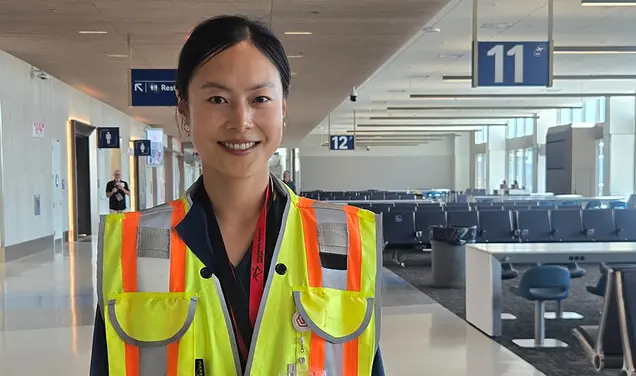
Janice Lee ’09 Worked to Renovate One of Hollywood’s Best-Kept Secrets
An engineer by training, Lee has been deputy project manager on the renovation of Hollywood Burbank Airport

No responses yet