

To Face Political Headwinds, Grad School Leaders Say Innovate and Change
Speakers at the Graduate School symposium suggested turning time of ‘crisis’ into opportunity
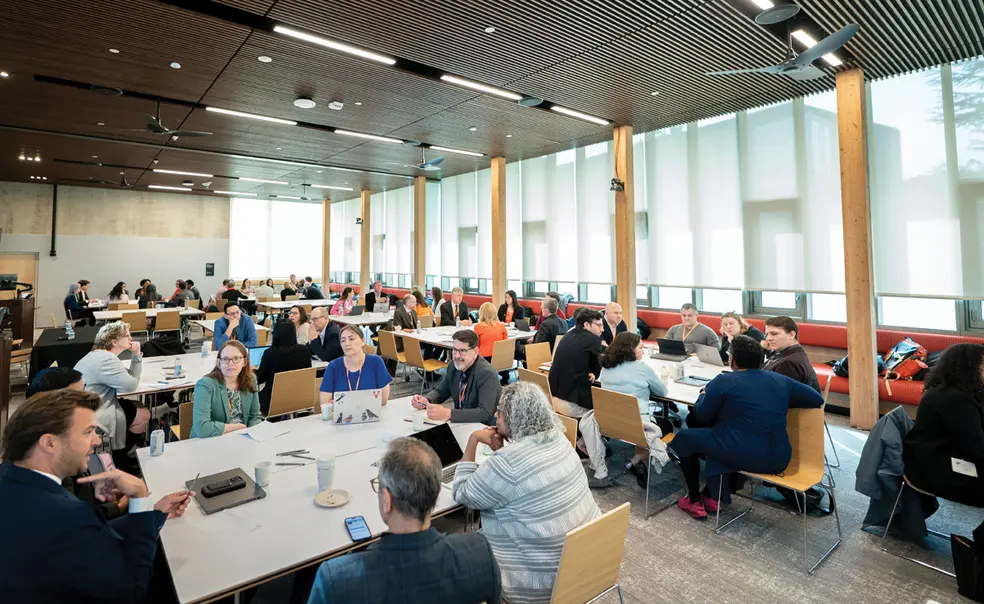

As the first panelists at an April symposium on graduate education held by the Graduate School spoke in the newly opened Briger Hall, attendees could hear the unmistakable sounds of construction — presumably buzzsaws — nearby. In a moment of unexpected harmony, both the speakers and the setting spoke to signs of transformation.
“We’re facing serious challenges coming from Washington that also affect how we think about the investments we make in graduate education,” said Provost Jennifer Rexford ’91 to an audience of about 160, including administrators from Princeton and other higher education institutions as well as professional societies.
The April 28 and 29 conference was part of the Graduate School’s 125th anniversary celebrations and took place entirely in brand new buildings on campus; in addition to Briger Hall, events were held in the Frist Health Center and the Princeton University Art Museum.
Through sessions on alternative graduate education funding models, labor market changes, and civic-minded scholarship, one theme continued to reemerge: the need for innovation and change given uncertainty at the federal level and increased skepticism by the public about higher education.
A few speakers encouraged turning this time of “crisis” — a nod to actions taken by the Trump administration, such as pausing or canceling research funding and international student visas — into an opportunity.
“I think we’re at a time when things are changing so quickly that the tendency can be to put a Band-Aid over a gaping wound that’s only going to spurt out blood on the other side,” said Suzanne Barbour, dean of the graduate school and vice provost of graduate education at Duke University.
Hendrik Lorenz, vice dean for strategic initiatives at Princeton’s Graduate School, advocated for using “the current moment of crisis to examine our practices” and to “recommit ourselves to our core values.”
Several speakers raised for discussion the amount of time it takes graduate students to earn a degree and if it can be shortened. Conference attendees also brainstormed how the capstone — traditionally a dissertation and oral exam — might change to better suit both students’ and their future employers’ needs given that many graduates now enter industry as opposed to remaining in higher education. Panelists debated the importance of internships and other work experiences outside of academia and whether industry should be more involved in education, for example by allowing students to work on real-world projects for their capstones.
Panelists also covered topics such as the importance of storytelling, networks of mentors, professional development opportunities, and partnerships with other institutions, the government, and industry.
Regarding how AI may factor into graduate education, Lisa García Bedolla, vice provost for graduate studies and dean of the graduate division at the University of California, Berkeley, said, “Doctoral education is about teaching people to be knowledge producers” and in this moment, “that is actually the skill we need,” because while AI has answers, society needs to know how to ask important questions.
Amid the debates, everyone seemingly agreed on one thing: the transformational impact of graduate education itself, including to the benefit of society. However, how to best get that information out to the public was less clear.
“How do we ensure that people understand that pure and basic research actually matters, and it can then be applied to come up with vaccines, to create better water systems, create better health care systems?” asked Chevelle Newsome, president of the Council of Graduate Schools. “All of those things that support the prosperity of our lives come through graduate education.”
As for how the symposia will impact Princeton going forward, Dean of the Graduate School Rodney Priestley said he “walked away with a tremendous amount of ideas that will give me things to think about throughout the summer as we think about how to innovate.”
The Latest
See all


Related News
With Prominent Journalists and Hoagies, the ‘Prince’ Celebrates 150 Years
A gala at the New York Historical raised roughly $400,000 for the independent student newspaper


No responses yet