
Flexing Multiple Skills, Anthony Costanzo ’04 Is Out to Save Opera Philadelphia
The famed countertenor continues to perform as he leads the opera company out of a financial crisis
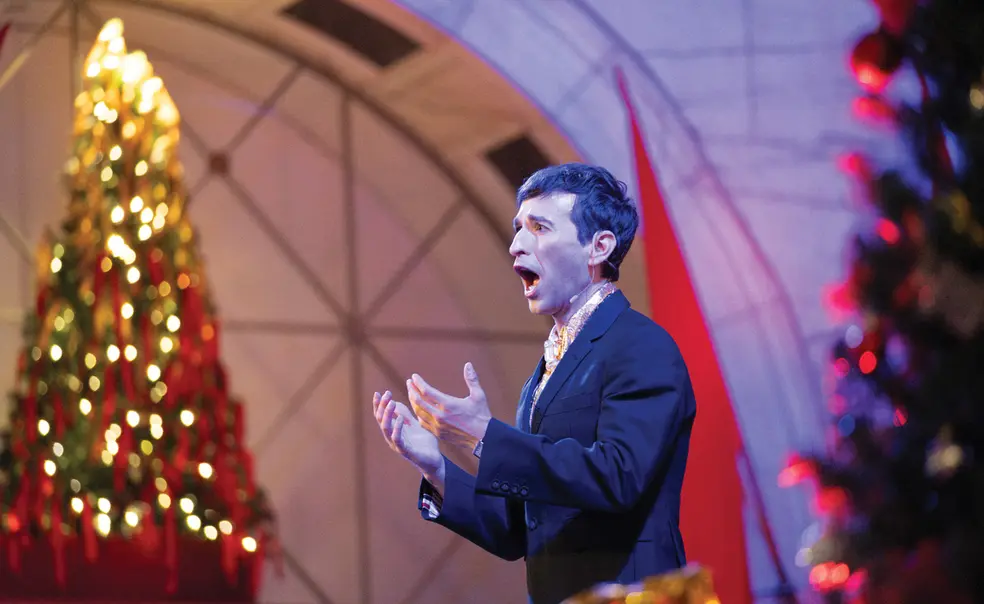

Philadelphia’s iconic Wanamaker Building has been unoccupied since March 2025, but the grand court was full again for a few hours on Sept. 8. Patrons, who snapped up several hundred free tickets in less than an hour, were treated to a show of music, dance, and a recital on the Wanamaker pipe organ, the largest in the world. They also heard Grammy-winning countertenor Anthony Roth Costanzo ’04, who sang an aria from the Handel opera Rinaldo.
These days, Costanzo wears several hats. Since 2024, he has been the general director and president of Opera Philadelphia, which also organized the event. He has been fighting to bring the organization back from the financial brink, the consequence of the pandemic and a more or less perpetual struggle to make the art form relevant to modern listeners. Getting people to turn out for opera is challenging at any time, but especially since the Trump administration has cut funding for the National Endowment for the Arts while attaching new conditions to the grants it does make.
Meanwhile, Costanzo has been keeping up his own singing career, performing on stages around the world. While it is not unheard of for opera singers to work simultaneously as arts administrators — Beverly Sills ran the New York City Opera while continuing to sing occasionally — Costanzo is still in the prime of his performing career, and still determined to do things his way. The Wall Street Journal summed it up best last September when it wrote that Costanzo “has a seemingly endless appetite for work and risk.”
Costanzo’s decision to apply for the job at Opera Philadelphia was unusual, although he was certainly familiar with the company. He had sung with them several times since his first appearance in 1996, at the age of 14, when he appeared alongside Luciano Pavarotti with a small part in Puccini’s Tosca. But Costanzo knew that a countertenor’s career doesn’t last forever. He was convinced that he had the skills to succeed in an administrative role as well.
“I’ve been producing shows for 15 years or more, so I had a sense of how to make a budget and how to make some of the changes I wanted to make,” he says.
Changes were necessary immediately. COVID had toppled Opera Philadelphia’s precarious business model, forcing it to lay off staff and slash its schedule from 10 productions and 30 performances in 2018-19 to just three productions and nine performances in 2023-24. The company, which was running a $4 million operating deficit, had only sold 30% of its tickets for the upcoming 2024-25 season. Costanzo says he had just weeks to address that or Opera Philadelphia would have faced bankruptcy.
Although Costanzo has long wanted to broaden opera’s appeal to a younger, more diverse, and less wealthy audience, Opera Philadelphia’s financial crisis made that imperative. His most aggressive innovation, and so far his most successful, has been to introduce a “pick your price” option for all seats. All tickets to all Opera Philadelphia performances are now just $11, with patrons asked to pay more if they are able. Costanzo says that Opera Philadelphia sold out its entire 2024-25 season in just three weeks after the change was announced, and with a much more diverse audience. Two-thirds of new subscribers are under age 45. They have also come from 34 states.
In the fall, Opera Philadelphia embarked on a three-year, $33 million fundraising campaign, intending to use the money to support its flexible pricing plan, commission new projects, and create a reserve to help it weather downturns. Although the company has received funding from the National Endowment for the Arts in the past — Costanzo won’t say exactly how much, only that it was “never a huge part of our budget” — it has decided not to apply for new grants going forward, even if they are available. Opera Philadelphia declined to accept the conditions the Trump administration placed on NEA funding, requiring the agency to prioritize programs that, among other things, “foster AI competency, empower houses of worship to serve communities, assist with disaster recovery, foster skilled trade jobs, [and] make America healthy again ... .”
“I want to respect our audience and staff and not have anyone feel like we’re selling our values for funding,” Costanzo says.
Instead, Costanzo has turned to private organizations. The September show at the Wanamaker Building and several others were funded by the Wyncote Foundation; TF Cornerstone, which owns and is renovating the Wanamaker building; and the Pew Center for Arts & Heritage. To appeal to a broader audience, Costanzo has also collaborated with other arts groups across Philadelphia. The Wanamaker show included performances by the Philadelphia Ballet, the Bearded Ladies Cabaret (a “queer, experimental cabaret company,” according to its website), and FringeArts.
Just days after the Wanamaker show, Costanzo was back on stage at New York’s Little Island theater for a performance of Galas, a musical play about an opera singer loosely based on the late soprano Maria Callas. “The part,” a New Yorker reviewer predicted, “should fit the extravagantly gifted Costanzo like a long buttoned glove.” Just a year earlier, Costanzo staged an adaptation of The Marriage of Figaro in which he sang all the parts. During the current season, he also is scheduled to sing in Paris, Barcelona, and Amsterdam.
“Who knows how long it will last,” Costanzo says of his dual roles as artist and administrator, “but as things are still going well, I wanted to take on this challenge to see how I could have more impact, and how I could connect in a deeper way with the art form and connect it to more people.”
As Opera Philadelphia celebrates its 50th season, Costanzo says that a thriving opera company is not only a civic asset but a civic necessity.
“Lots of people talk about the arts as an escape, but I don’t think about it that way,” he observes. “It’s not about ignoring what’s happening in the world. It’s about giving us the capacity to survive it.”
The Latest
See all


Related News
With Prominent Journalists and Hoagies, the ‘Prince’ Celebrates 150 Years
A gala at the New York Historical raised roughly $400,000 for the independent student newspaper


No responses yet