

Groundbreaking Poet Nazik Sadek al-Malaika *51’s Year as a Grad Fellow
The promising Iraqi writer, among the first women at the Graduate School, was a “not ‘an easy girl’” according to records from the Rockefeller Foundation
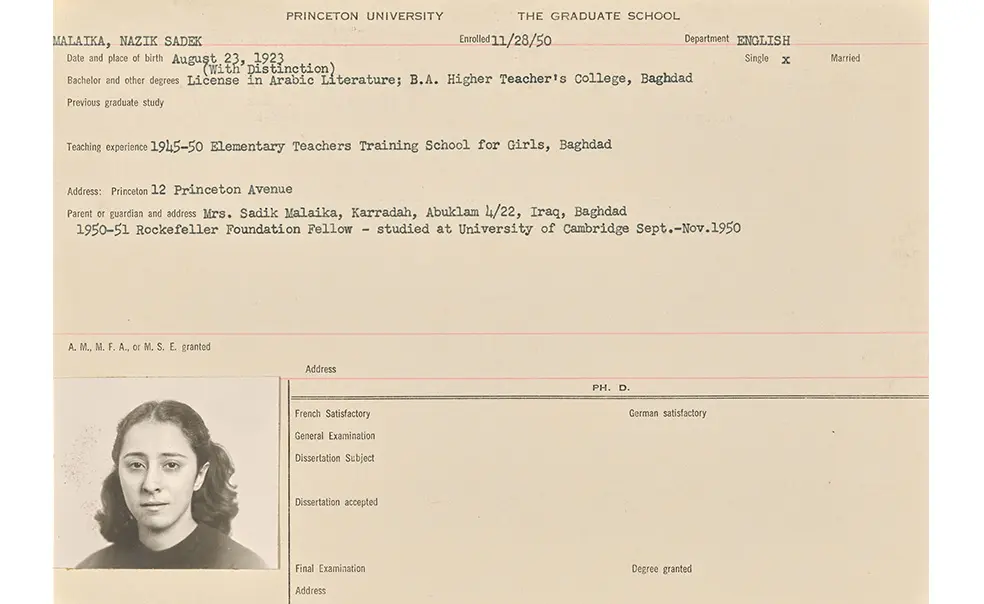

Nazik Sadek al-Malaika *51 had already made a name for herself before coming to Princeton University from Baghdad at 27. In the late 1940s, she became the first poet to use free verse in Arabic with “Cholera.” She was also building her legacy as a feminist voice with “To Wash Disgrace,” decrying honor killings. In recognition of her potential, the Rockefeller Foundation awarded her a fellowship that funded a seven-month stay in Princeton. History tends to remember Sabra Tobak *66, who matriculated in 1961, as Princeton’s “first” female graduate student. Al-Malaika was not pursuing a degree, so it seems that when she enrolled in the Graduate School in 1950, this was not newsworthy.
Starting out at Princeton was rough. Five days after arriving, al-Malaika needed an emergency appendectomy. There were signs of emotional strain, too. Concerned about her “shattered” mental state, the Rockefeller Foundation arranged for her to see a psychologist over the winter holidays. Other medical issues arose after she returned to campus. Still, the Foundation saw her as a good investment. A terse comment in their archived records describes her as “not ‘an easy girl’” but “one of the distinctly most promising poets of the present day Arab world.”
Princeton nurtured many influential writers in the 1940s and ’50s. They often came to spend time with Richard Blackmur, the legendary professor who may have been al-Malaika’s reason for being there, too. Her independent studies in creative writing at the graduate level were supervised by Blackmur, who was also a close friend of John Marshall, associate director of the Rockefeller Foundation. Perhaps Blackmur and Marshall worked together to find a home for her in this masculine fortress, both figuratively and literally. Her address was 12 Princeton Ave. Blackmur and his wife, Helen, rented an apartment in that same house, and it seems al-Malaika was a neighbor while she was Blackmur’s student. Undergraduate courses in poetry and dramatic arts rounded out al-Malaika’s Princeton education.
Al-Malaika went on to earn an M.A. in comparative literature from the University of Wisconsin-Madison before her return to Iraq. She continued to challenge patriarchy in Arabic society. Upon her death at 83 in 2007, newspapers around the world memorialized al-Malaika as one of the 20th century’s most influential Arabic poets.
The Latest
See all


Related News


Janice Lee ’09 Worked to Renovate One of Hollywood’s Best-Kept Secrets
An engineer by training, Lee has been deputy project manager on the renovation of Hollywood Burbank Airport


1 Response
Patrick H. Ryan ’68
2 Weeks AgoA Brave Woman Indeed
Thank you for your piece on Nazik Sadek Al-Malaika *51. She was a very brave woman, indeed.
Hats off. Three cheers.