

Inaugural Museum Exhibit Honors Toshiko Takaezu’s Princeton Legacy
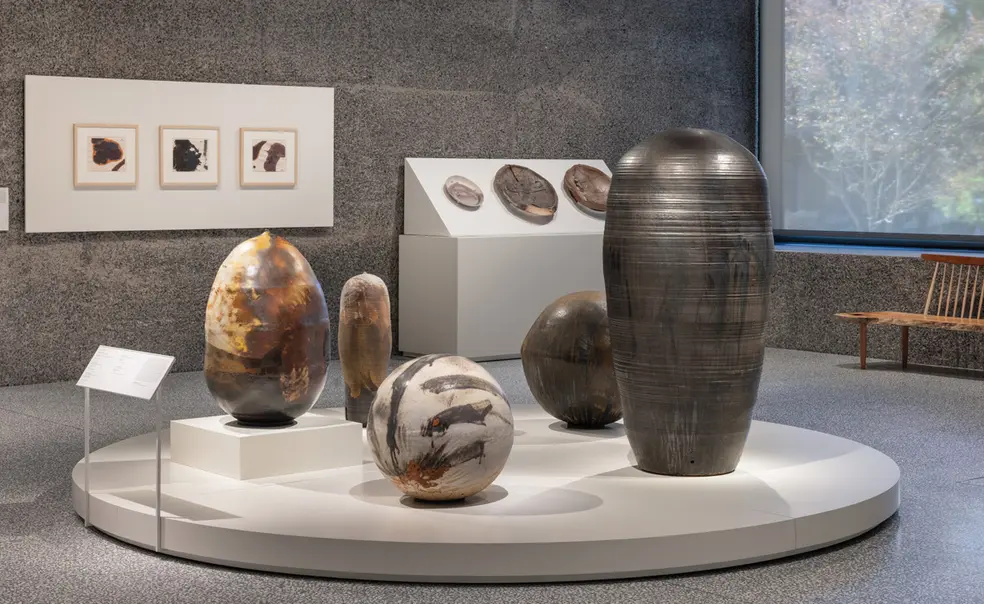

The inaugural exhibition in the new Princeton University Art Museum’s Welcome Gallery centers on a longtime faculty member in Princeton’s Program in Visual Arts whose work pushed the boundaries of 20th-century American art and helped shape the next generation of artists. Toshiko Takaezu: Dialogues in Clay features Takaezu’s ceramics in conversation with works by her contemporaries, and many of the pieces featured were made while she taught at the University.
“Takaezu taught at Princeton for nearly three decades [from 1967 to 1992], shaping generations of alumni makers and thinkers through a pedagogy grounded in discipline, honesty, and respect for one’s materials,” curators Juliana Ochs Dweck and Samuel Shapiro wrote in an email to PAW. Princeton awarded Takaezu an honorary doctorate in 1996, four years after she retired from teaching. She died in 2011 at age 88.
At the University, Takaezu often brought students to her home and studio in Quakertown, New Jersey, where a select few worked as apprentices. Former students contributed labels in the exhibition that reflect her impact as a teacher. “The show situates her practice both in mid-century artistic experimentation and in the intellectual life of the University, foregrounding her studio — through voices from past students — as a site of exchange and community,” Dweck and Shapiro wrote.
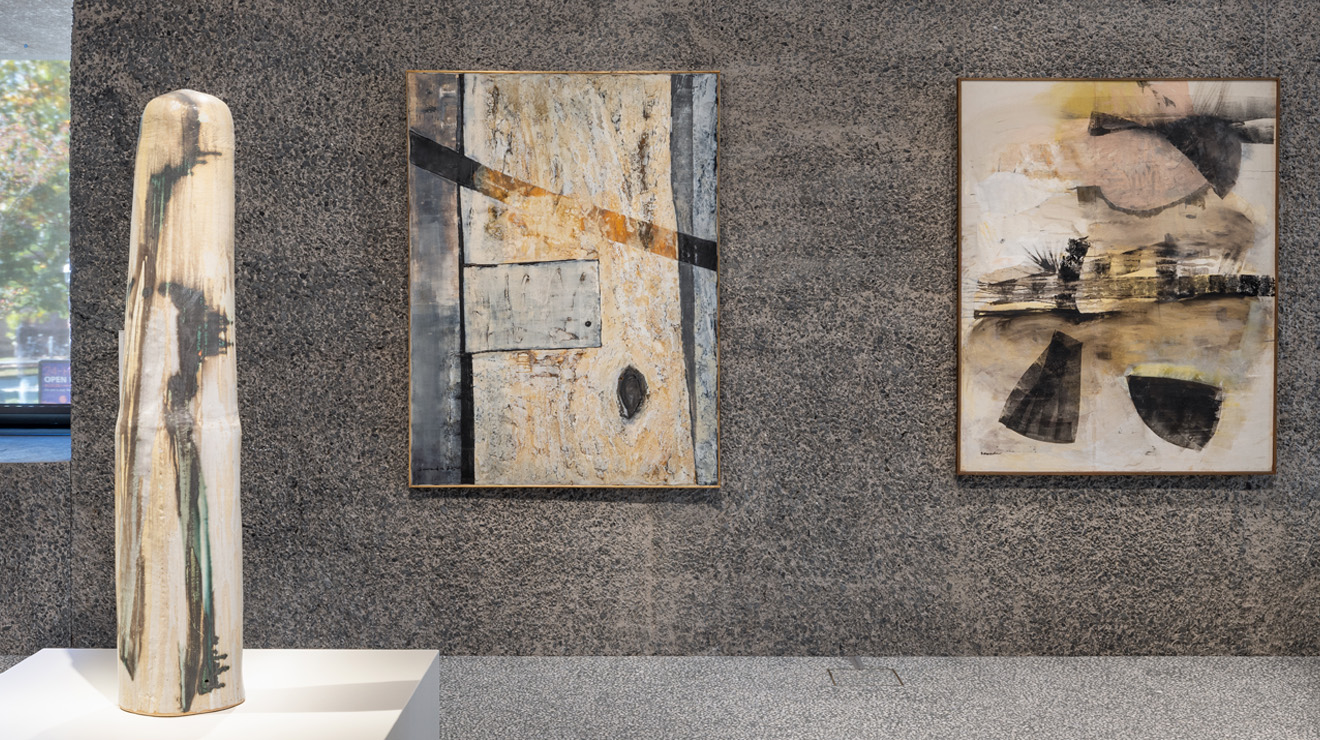
The exhibition follows Takaezu’s experiments across half a century with what she called “closed forms,” ceramic bowls that are enclosed and create nonfunctional spheres or cylinders. Through incorporating the work of other artists at the time, the exhibition traces experimental ceramics and explores parallels throughout their practices, centering on Takaezu.
A short walk away from the museum, Takaezu’s bronze bell Remembrance sits in a garden between Nassau Hall and East Pyne, and honors Princeton alumni who died in the terrorist attacks of Sept. 11, 2001. Takaezu’s work has also been displayed at the Philadelphia Art Museum, the Metropolitan Museum of Art, and the Smithsonian American Art Museum, among other places.
To Dweck and Shapiro, the exhibition was chosen as the first in the new museum “because Takaezu’s work (both her practice and her objects) so powerfully embody the values that underlie the building and the institution, with its commitments to encounter with original objects, close looking, and wide-ranging dialogue.” According to them, the exhibition signals that it is a teaching museum, where one can learn artistic legacy not just through Takaezu’s objects, but through their transmission and influence.
Museum director James Steward expressed a similar sentiment: “Our inaugural exhibitions demonstrate how our new building gives us space and architecture that is worthy of and amplifies the brilliance of the collections,” he wrote.
Seen through the Welcome Gallery’s expansive ground-floor windows, Takaezu’s ceramics catch the natural light and invite visitors inside.
“We hope visitors come away with a sense of the radical quiet of her work, its insistence on slowness and presence, and an appreciation for how profoundly an artist–teacher can shape an institution’s culture and collections,” Dweck and Shapiro wrote. The exhibition is on view through July 5.






No responses yet