

Independent Majors Say This Is the End of an Era
As Princeton pauses its independent major program, graduates recall their unconventional paths
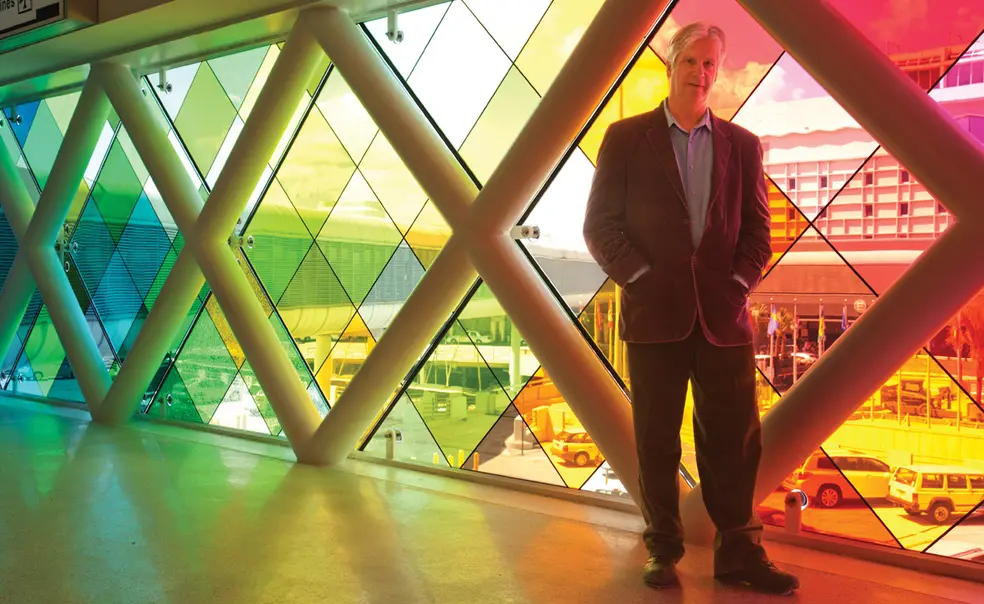

Since 1980, Christopher Janney ’72 has directed his own multimedia studio, where projects bridge architecture and performance. But his work really began at Princeton, where he was among the first of a small group of students who have pursued an independent course of study.
“I care deeply about the independent major program, even after 50 years,” Janney said, adding that he cannot imagine what his life would be like if he hadn’t created his own major in architecture and visual arts. For the last few decades, Janney’s artistic creations, which are often musical, have been installed throughout the U.S. and Europe in spots ranging from a private residence to popular music festivals.
Students from the Class of 2029 may be the last to have the chance to choose an independent major, according to the Office of the Dean of the College, which reported online that the option “will be paused for subsequent classes until further notice, pending a review of the program.”
Rebekah Peeples *09, deputy dean of the college, told PAW via email that the review will be presented to the faculty Committee on the Course of Study and that a decision is expected by the end of the academic year.
Peeples pointed to an increase in departments’ “structured, credit-bearing pathways” that lead up to junior and senior independent work and new available minors as reasons behind the pause. Also, an independent major “may represent a student’s interest in a particular moment in time, which can then be difficult to translate in the future,” such as for further education. “The College has a responsibility to ensure that students’ studies are legible externally for an extended period of time,” Peeples said.
In addition, should a faculty adviser become unable to fulfill their responsibilities, the student would face a lack of fallback options, according to Peeples.
A database of Princeton senior theses lists 205 students who have successfully completed an independent major since 1972, when the first program participants graduated. Students who wanted to major in linguistics previously had to become independent majors, but after a unanimous vote at the faculty meeting this February, the Program in Linguistics, then housed within the Council of Humanities, became an independent academic unit and now offers its own major.
This year, a single student graduated with an independent major that was not in linguistics; most recently before that was a member of the Class of 2023. According to data from the University, excluding linguistics, only eight students have graduated with an independent major since 2019.
For this year’s sophomore class, interested students must meet with their residential dean and submit a proposal outlining their intended course of study and why it cannot be achieved within an existing department. They must have at least a 3.0 GPA and the support of two or more faculty members. Proposals are reviewed by the deputy dean of the college and a faculty committee.
Alumni who graduated with independent majors mourned the program’s pause, saying that while it can be challenging to chart your own path as a young adult, the results are often rewarding.
Austin Mejia ’21, who earned a degree in computer science and public policy, said he “became convinced that this was the best path for me because it didn’t force me to compromise or choose one being more important than the other. I wanted to approach and study both equally.”
“The thing that was so special to me was that I got to really look at what I wanted to do and not be forced to take various fairly difficult classes that I had literally no interest in whatsoever,” said Gab Duguay ’22, an Indigenous studies major. “And that would’ve probably had a negative impact on my mental health and my Princeton experience.”
On the other hand, Duguay said, the lack of community and structure of an established department made him feel left out on graduation day. “I was lucky enough to get a certificate in humanities, and my family and I just treated that like it was my little reception, because otherwise I would’ve been a bit out of luck,” he said.
Dan Morris ’72, an independent major in education, said that charting his own path made him more productive. “I wasn’t [just] getting by, I was driven to do the things that I was doing,” he said.
Glenn Shepard ’87, an independent concentrator in ethnobiology who was recently a visiting professor of anthropology at Princeton, said he understands why the University wants students to follow established tracks, but those tracks may not be for everyone.
“There’s always going to be students who don’t fit into the standard boxes,” Shepard said. “To take that opportunity away forever seems very sad.”
The Latest
See all


Related News
Dung Beetles Do ‘the Job That Is Necessary’
Princeton researcher Finote Gijsman *25 studies crucial links between the insects and elephants in a new paper
No responses yet