

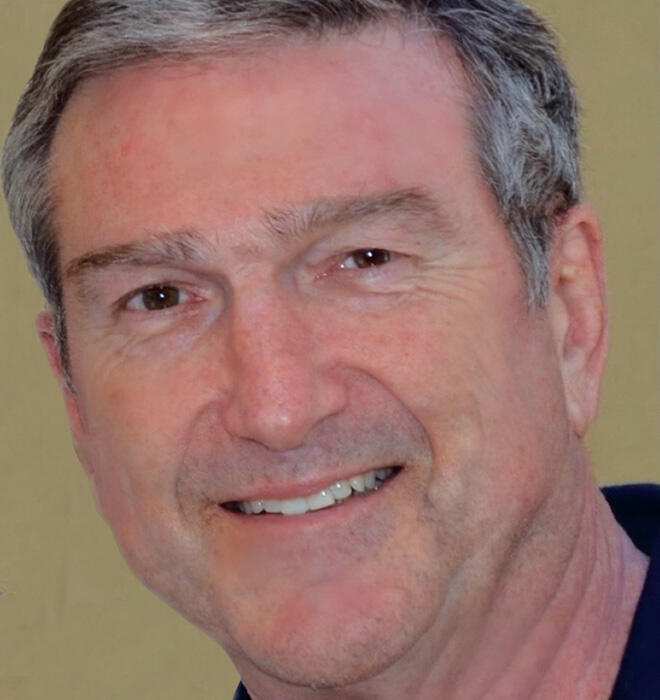
L.A. Prosecutor Robert Schirn ’63 Met Historic Moments in Criminal Justice
May 29, 1941 — April 12, 2025

In 1988, when Jim Falco ’77 interviewed for a law clerk position at the Los Angeles County District Attorney’s Office, Robert Schirn ’63, the longtime head deputy in the Major Narcotics Department, asked him two questions: Where did he go to school, and did he play softball?
“As soon as he found out I played sports at Princeton, he said, ‘OK, you’re hired,’” Falco says, explaining that Schirn, the pitcher on the L.A. D.A. office’s softball team, was looking for another outfielder.
“He didn’t care about anything other than those three things: family, sports, and the D.A.’s office,” says Brian Schirn, who followed in his father’s footsteps as an L.A. prosecutor.
The longest-serving head deputy in the L.A. D.A.’s office, Robert Schirn, nicknamed “Big Guy” thanks to his imposing height, had an outsize influence in the department as a brilliant prosecutor and policymaker in constitutional policing in Southern California. “No one, at least in my lifetime and involvement with the justice system, which is 50 years, has contributed more to public safety and criminal justice than Bob Schirn,” says Steve Cooley, a former L.A. County district attorney.
In addition to his work as a prosecutor, Barbara Turner, a former deputy district attorney for L.A. County, says Schirn was known as the search warrant “guru,” having co-authored the search warrant and wiretapping manuals for Los Angeles, texts used as law enforcement bibles across the rest of the state. “The L.A. County D.A.’s office became essentially the ‘wiretap college’ for all law enforcement and other prosecutors in California,” Cooley says. “Bob was the seed of that.”
Though he was known for many contributions to the D.A. office — from serving as the office historian to the avid creator of the department newsletter’s crossword — Schirn’s career often intersected with historic moments in criminal justice.
Schirn described Charles Manson as possessing “a tattoo of a woman’s head on each arm, and a one-inch scar over his left eye” when drafting the August 1969 search warrant for Spahn Ranch, the Manson family’s home base. Shortly after it was issued, police conducted a 100-person raid that author Tom O’Neill called “the biggest in the history of Los Angeles law enforcement at that time.”
The year prior, Schirn had contributed to the prosecution of Sirhan Sirhan, Robert Kennedy’s assassin, and later wrote the search warrant for the O.J. Simpson case.
Schirn’s life began at sea in 1941 on the Spanish passenger ship the Ciudad de Sevilla, where he was born to Jewish parents fleeing the Holocaust. In Schirn’s eventual U.S. passport, his birthplace was listed as “High Seas.” “No one [at customs] had ever seen that before,” says his youngest son, Jason Schirn.
The family settled in Los Angeles, where Schirn attended Beverly Hills High School and earned varsity letters in three sports.
At Princeton, he wanted to study engineering and play football; unfortunately, he found the major too difficult and injured his knee as a freshman. Instead, he chose political science and still managed an unusual athletic accomplishment. According to Falco, one of Schirn’s proudest moments was scoring a bucket off Princeton basketball legend Bill Bradley ’65 in a one-on-one game at Dillon Gym.
Over his summer breaks, Schirn funded his Princeton education by driving a produce truck at 4 a.m. to supply markets and restaurants in Los Angeles.
And though the image of a hardworking attorney is one of long hours at the expense of family, Schirn was completely dedicated to his wife, children, and grandchildren, making a point to attend every sporting event or recital on their calendar. “He would play basketball in the backyard with my brother, myself, and all our friends,” Brian Schirn says. “He was like the dad [for] everybody [who] came to our house.”
Schirn was also something of a true crime communicator, and TV producers frequently picked his brain on historic local cases such as the Black Dahlia murder. He loved giving popular lectures about notorious criminal cases on cruises across the globe. He further explored his passion as the co-author, with Steve Cooley, of two books on police shootouts, Blue Lives Matter (2017) and Blue Lives in Jeopardy (2019), titled before the “Blue Lives Matter” phrase had taken on a political valence. “I would read them, and I’m like, ‘Oh my God, Dad, you’ve taken this incredibly fascinating stuff here and somehow you’ve found a way to make it boring,’” Brian Schirn says, attributing his father’s dry writing style to his devotion to “integrity and honesty.”
Harrison Blackman ’17 is a freelance journalist and writer based in Los Angeles.



1 Response
Rocky Semmes ’79
8 Months AgoFilling the Position
The story of softball-playing Jim Falco ’77 interviewing for a law clerk position and getting hired on the spot (because the D.A.’s team, of which Robert Schirn ’63 was the pitcher, needed an outfielder), brings to mind a former roommate.
That roommate was interviewing for medical school at Dartmouth, and the interviewer casually questioned the assembled candidates.
As the story was related to me, the various candidates responded with alternating tales of (in exaggeration) either being Nobel Prize winners or having discovered cancer cures. The interviewer then addressed said roommate, and asked, “Tell me something about you that I don’t know.”
That roommate replied, “I play rugby.” The eyes of the interviewer went full dilation, and he immediately leaned in, with “What position?!” “Loosehead prop” was the reply and the rest is history.
Apparently the interviewer was the faculty mentor of the school’s rugby team, and they needed a player for that pivotal position.
That roommate was former flight surgeon Capt. Jeff Georgia ’78, USN (Ret.), M.D. (I gapped a year.) Last we spoke, his intention is a circumnavigation of the globe by sail on his custom-outfitted Pacific Seacraft 34. Fair seas and smooth sailing, brother!