

Lauren Hale *03 Is Studying the Impacts of Screens on Teens and Sleep
‘It’s not the devices. It’s what’s on the devices [and] how you’re engaging with them,’ Hale says

Lauren Hale *03 didn’t plan to build her career around sleep, but a single lecture rerouted her path. Near the end of her Ph.D. program in the School of Public and International Affairs, she attended a talk by neuroscientist Robert Stickgold, who described the importance of sleep in learning and memory consolidation. He showed the audience photos of low-income children sleeping on couches and on the floor, and said that we really don’t know much about how sleep affects education, nor the demography of sleep.
This struck Hale, who was training as a demographer, an expert studying human populations by analyzing data and demographic characteristics. “I basically chased him down at the airport in Madison, Wisconsin, where his talk was, and told him that I was going to study the demography of sleep,” she says.

After completing her Ph.D., Hale pursued a postdoc in sleep research and joined Stony Brook University as an assistant professor in 2005. She has been a core faculty member in public health and family, population, and preventive medicine ever since. She has chaired the board of directors for the National Sleep Foundation, a nonprofit dedicated to improving health and well-being by advancing sleep health. She also is the founding editor-in-chief of the journal Sleep Health. Stickgold’s lecture “changed my whole trajectory,” she says.
Hale has long worked with the Future of Families and Child Wellbeing Study, a longitudinal birth cohort study of American families run by Princeton, Columbia, and Notre Dame. She began studying adolescent sleep in 15-year-olds using actigraphs, devices similar to Fitbits worn on the wrist to measure movement and estimate sleep-wake patterns, but realized she couldn’t fully study sleep without understanding how teens are using their phones. That brought her into the field of screens and sleep.
In 2015, she published a paper that studied the limited literature on screens and sleep at the time. The paper has been cited more than 1,000 times. In the decade since, hundreds of studies have shown a consistent association between screen time, especially interactive nighttime screen use, and later bedtimes, shorter sleep duration, and worse sleep quality. Meanwhile, screens have also evolved, and the digital environment has become more difficult for younger people to disengage from.
Around the same time, Hale joined the scientific advisory panel of Children and Screens: Institute of Digital Media and Child Development. The nonprofit was founded by Dr. Pamela Hurst-Della Pietra, who was motivated as both a parent and a physician. “I saw that there was this growing gap between the pace of children’s digital media use and its development and our understanding of its impacts,” she says. The organization was designed to bring researchers together and provide information on the short- and long-term impacts of digital media on children, and what to do about it. The group convenes to build a collaborative and diverse research ecosystem, translates evidence for parents and educators, and works to ensure that legislation related to youth safety, privacy, and education, reflects the best available science.
Hale and Dr. Dimitri Christakis, a pediatrician, co-edited a widely downloaded handbook on children and screens that brings together psychologists, psychiatrists, communication specialists, neuroscientists, and public health experts to convey the latest research from their areas of expertise. Their goal was to give parents and caregivers an accessible, research-grounded guide.
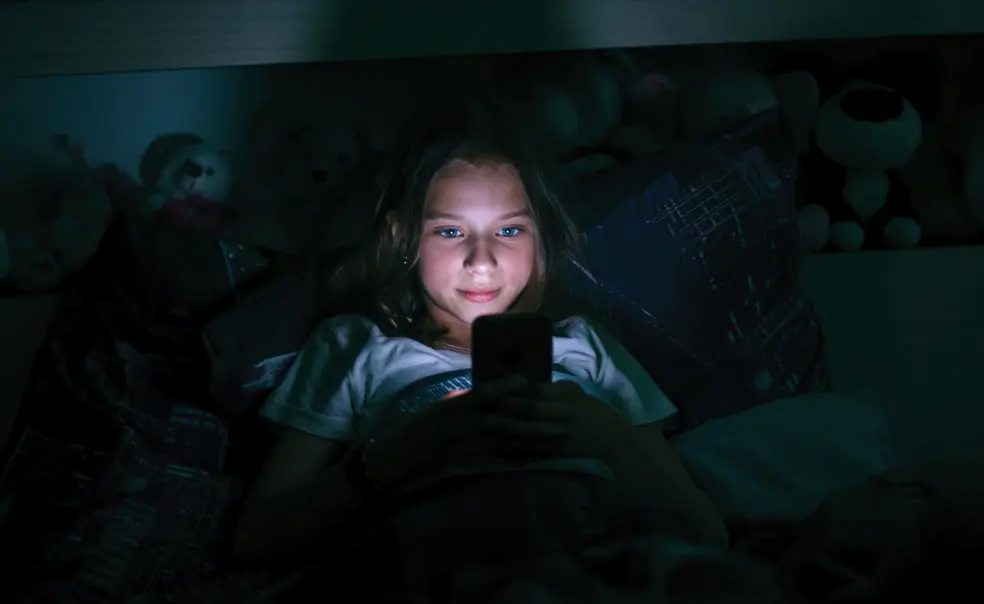
According to Christakis, 15% of adolescents are on their phones nine hours a day, and 5% are on them 12 hours a day. Hale noted that 25% of tweens sleep with their phone in hand or in bed. “No 11-year-old should have a device in their bed with them,” she says. “They should be sleeping.”
Hale’s research has shown that not all screen time carries the same weight. Interactive media, especially video games, can be particularly disruptive to sleep. “Everybody’s at risk of losing sleep because these devices capture your attention,” Hale says. “It’s not the devices. It’s what’s on the devices [and] how you’re engaging with them.”
While hypotheses about light exposure, including research that blue light suppresses melatonin, has long dominated the conversation, there are many other factors at play. Psychological and emotional arousal, how children are engaging with people on the other end of the phone, feelings of FOMO, and being woken up by your phone, either directly or indirectly, play a larger role.
Her studies also show meaningful disparities: Children of color are more likely to spend more time on their phone at night, and they are three times more likely to get a phone by age 10.
To Hale, the question is no longer about whether screens affect sleep, but what families, schools, and policymakers should do about it. She mentions school-wide phone bans, later school start times, and the elimination of daylight saving time as possible solutions.
Still, she believes powerful interventions happen right at home. “It you set rules about when and where screens can be used, you can just mitigate the potential risks associated with screen use,” she says. Her handbook encourages parents to promote no screens in the bedroom, create positive physical activities for children, and educate them on digital privacy risks. Outside of the science, as a researcher and parent herself, she returns to a simple principle.
“Try to live as much of your life as possible not through a screen,” Hale says. “That means make time and space for real interactions.”
The Latest
See all


Related News

With Prominent Journalists and Hoagies, the ‘Prince’ Celebrates 150 Years
A gala at the New York Historical raised roughly $400,000 for the independent student newspaper



1 Response
Nancy R. Browne
10 Months AgoOn Focus, Health, and Screens
The photo at the head of your article reminds me of the nights when I would read a book hiding under the covers, by the light of a flashlight. I was so engaged by the story, I couldn’t put the book down when it was time to sleep. I still do that at times now, but fortunately for me, I don’t have to get up early for work anymore. I’m still learning to regulate my sleep schedule, but school and college demands never considered my sleep a health priority; on the contrary, they tried to force me into a routine that suited others better than it suited me. Getting focused, and staying focused, is a key skill, as is determining timeliness and deadlines. Consistency and routines are best friends of physical health, but creativity and the imagination are often at odds with both of those qualities. It’s all about finding a balance, isn’t it?