

Michael Blumenthal *53 *56 Recreates Wartime Shanghai in Novel
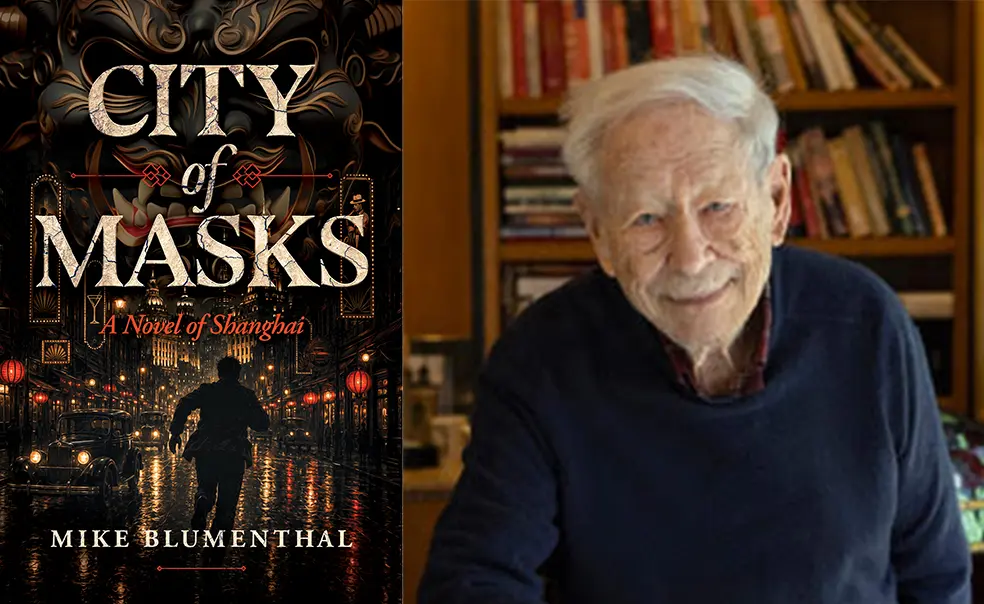

The Book: A haven for refugees and a playground for the rich, Shanghai in the 1930s and 40s was a city of extraordinary contradictions: its glittering nightlife flourished alongside poverty, corruption, and political intrigue, while foreign powers and criminal syndicates carved out their own spheres of influence. In City of Masks (Post Hill Press), Michael Blumenthal *53 *56 tells a tale of grifters, gangsters, and spies against this volatile backdrop, as the Japanese occupation and World War II upend the city’s fragile order. Though this is a work of fiction, the novel draws on Blumenthal’s firsthand experience of Shanghai, where he sought refuge from Nazi Europe in 1939 and remained for eight years.
The Author: Michael Blumenthal *53 *56 is a German-born American economist, former U.S. Secretary of the Treasury under President Jimmy Carter, and an author. After fleeing Nazi Germany with his family in 1939, he spent eight years in Shanghai before emigrating to the United States in 1947. He later held leadership positions in business and government, including directing the Jewish Museum Berlin. His memoir, From Exile to Washington (ABRAMS Press), recounts his journey from wartime refugee to public servant. His most recent book City of Masks draws on his firsthand experience of being a refugee in Shanghai during World War II. He recently celebrated his 100th birthday.
Excerpt:
Foreword
Well before the Second World War, Shanghai had grown into one of the most populous cities in the world, but one unlike any other.
Divided into three parts, each under a different jurisdiction with its own lightly enforced, opaque laws, it was the most open and pleasure-ridden city in the world, but also the most decadent, corrupt, and squalid. Foreign tycoons and a few rich Chinese lived in large mansions, waited on by hordes of servants, while legions of poor Chinese huddled in the streets and died there from hunger and disease.
There were no visa requirements or extradition laws. Anyone could come and no questions were asked. Tourists came to play, to sample the wide-open nightlife, and for the gambling, the drugs, and the women; missionaries to proselyte and to run hospitals, orphanages, and schools. Adventurers came in search of quick riches and others to hide from the law, their creditors, or their wives. Thousands of destitute political refugees sheltered in Shanghai because it was the only place in the world that would let them in.
Shanghai was China’s largest city, 97% of her people were Chinese, but in most of the town, their government had nothing to say. Political power was in the hands of foreigners backed by their government’s token military contingents — the so-called treaty powers, principally British, French, American, Italian, and a sprinkling of others. Immune to Chinese laws, the foreigners made their own rules, controlled the courts and police, owned the utilities, and ran the customs and ports. Under an unspoken arrangement, they allowed powerful criminal societies to own the local business of vice — drugs, gambling, and prostitution — and to run protection rackets while helping to keep the peace in the street so the tourists could feel safe and the tycoons could enjoy the good life.
It was a system of governance known as extraterritoriality or extrality, in effect since the Opium Wars of the 19th century when China had been forced to open herself to world trade. In the 1930s, it had become an anachronistic relic of another age, though the locals who were its beneficiaries refused to recognize that they were living on borrowed time. They hoped that it would go on indefinitely and, like an aging patient ignoring increasingly severe shocks to his system, life in their Sin City staggered along unchanged in certain critical respects until 1949, when the Communist takeover finally ended it forever.
The war between China and Japan in ’37 was the first shock. Japanese military surrounded the city and occupied the Chinese parts of town. International Shanghai became an island city and some feared it could not long survive. Political kidnapping and assassination pitting the Japanese and their Chinese puppets under Wang Ching-wei against Chiang Kai-shek’s Nationalists made life more dangerous, a million refugees from the countryside sought international protection and added to the hard-
ship in the streets. The gangs split their allegiance among the warring underground factions and crime increased. Yet tourists and other foreigners still kept coming, including 18,000 Jewish refugees from the Nazis who took advantage of the traditional no-visa policy, and after some weeks, life returned to pretty much as before.
Two years later, the outbreak of war in Europe delivered the second shock. World trade plummeted and Shanghai’s economy suffered. Unemployment rose and so did inflation. Some of the treaty powers now were enemies and had to adjust to an uncomfortable local coexistence while their intelligence services — along with those of Japan and the three separate Chinas of Chiang, Wang, and Mao — moved in to operate under the surface. Daily life became even harder and more complex, but the traditional unfettered hedonistic and morally flexible ways of old Shanghai still did not disappear.
December 1941, Pearl Harbor and war in the Pacific was the third and most severe shock of all. Japan occupied all of international Shanghai and took effective control of Frenchtown, now nominally answering to Axis-dependent Vichy France.
Extraterritoriality was dead (the Allies renounced it officially in 1943). Treaty power nationals left or were interned, and only Axis, neutral, or stranded, stateless, refugee foreigners were left behind. Wartime shortages of essential commodities caused rice riots. Black markets flourished and galloping inflation added to people’s hardship.
Shanghai now was the center of espionage in the Far East and more than a dozen Japanese, Allied, Axis, and Chinese intelligence services occasionally collaborated but mostly intrigued against each other.
Yet even under these much-altered wartime conditions, Sin City continued to operate alongside what was now also Spy City. The pace and extent of corruption accelerated, the main difference being that it was the Japanese occupiers and their Chinese collaborators who now profited from it and kept it going. In wartime Shanghai, an entire section of town — the badlands — was devoted to nightclubs, gambling casinos, opium parlors, and related rackets. There was an official eleven o’clock curfew in the badlands, but the police were on the take, and the lights rarely dimmed.
間
City of Masks is a historical fiction. The plot is invented — nothing like it actually happened, and all the main characters existed only in the author’s imagination.
It is the environment into which the story of grifters, gangsters, and spies is placed which is a historically accurate description of international Shanghai in its final years. The places where the action takes place, some of the key events, and the mov-
ers and shakers who dominated Shanghai during this period are all real.
It is also an unforgettable part of the author’s own life. He arrived there in ’39, one of the refugees from Nazi Europe, and stayed for eight years.
The idea of a novel about this period of Shanghai history had long been on his mind, and City of Masks is the result.
A Note on Language
Until the 1970s, the spelling of Chinese names most in use was the anglicized Wade-Giles method of transliterating Chinese characters. In more recent times, the alternative pinyin method officially adopted by the Chinese government in 1979 has largely replaced it.
I have arbitrarily chosen to stick to Wade-Giles for the sake of the historical context, except for a few instances where certain names and places now are universally known only in pinyin.
Prologue
Yik pushes him into the garishly furnished room and he recognizes the pungent odor of opium.
Deep carpets and subdued lighting. On one side, a large table with an open flame lamp, needles, and long-stemmed pipes. More hanging on the wall. In the center, two silk-covered divans.
He hears the door close behind him and stops to orient himself. It’s one of Tso’s private rooms that has been off-limits to him, and he’s surprised to have been called in. He looks around, but neither Tso, Yik, nor the sing-song girls are there. Only three
thugs in black pajamas. No one speaks, and he waits. Then one of them, a broad-shouldered, pockmarked gorilla, cigarette dangling from his lips, moves toward the divans. He follows him with his eyes and sees burgundy, patent leather shoes protruding from under one of the divan’s covers. He feels a stab in his gut and a lump settle in his throat.
Earlier that afternoon, he’d watched a Chinese man in an elegant black gown and matching skull cap descend from a large Nash sedan and hurry up the side alley toward what Yik calls Tso’s “swallows’ nests,” a Korean bodyguard clambering after him. With only a wispy beard and protruding ears visible, the rest of his face was hidden behind Ray-Bans and a scarf pulled high from the neck. Except for the strange burgundy shoes, there is nothing extraordinary about this scene. He’d seen it all before and gave it no further thought.
間
The pockmarked gangster pulls back the covers, exposing two bodies, very dead. The Korean’s head is tilted to one side. With open, lifeless eyes, he looks almost peaceful in his mortal repose. On the other divan, not so his master. They’ve cut off his head and have put it in his lap.
The gangster laughs and motions him forward, but he just stands, frozen in place. Unable to move or speak, his mind is blank but curiously detached, noting that there is only a little blood and wonders why.
“Gan kuai,” Hurry, the killer commands, gesturing toward the headless man’s feet, but the order hardly registers. The gangster pulls a long-barreled gun from his belt and shoves it in his face. “Xian zai,” Now! he growls.
He doesn’t understand Chinese, but the gesture is unmistakable. He realizes that he has no choice and that this has been Tso’s plan all along. So, he does as he’s told and forces himself forward. He takes the corpse by the ankles, helps to lift it, and
begins his sleepwalk into a nightmare.
Later, Obermann will remember that this was the moment when it first passed through his mind that his escape to Shanghai had been a ghastly mistake.
Excerpted from City of Masks: A Novel of Shanghai. Copyright (c) 2026 by Mike Blumenthal. Used with permission of the publisher, Post Hill Press. All rights reserved.






No responses yet