
Podcasters Lester Nare ’14 and Krishna Choudhary ’14 Created an ‘ESPN for Science’
WIRED magazine named ‘From First Principles’ one of its top science podcasts
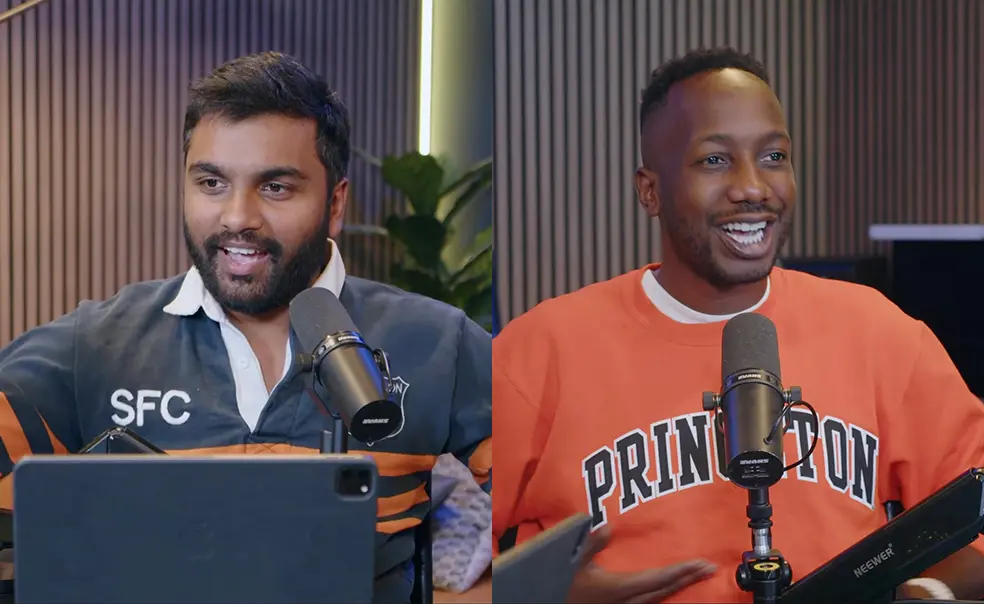

When Lester Nare ’14 and Krishna Choudhary ’14 set out to create a science podcast, they realized there was a huge gap in the market. Most of the top shows labeled “science” were about “Bigfoot, UFOs, and ghost stories,” Nare says. Others were highly general, featuring big-name science communicators like Neil DeGrasse Tyson talking about more broad concepts in layman’s terms, like relativity and black holes.
Few programs actually gave airtime to major scientific developments published in specialist journals, explaining concepts for listeners who had at least an undergraduate STEM major’s grasp of scientific knowledge — a format Nare and Choudhary dubbed “ESPN for science.”
In July 2025 they launched “From First Principles” (aka “FFP Pod”), naming it after Aristotle’s concept of breaking down ideas to their simplest components. It made science fun with episodes that predicted Nobel Prizes like they’re Oscars and counted down the top 250 American scientific discoveries for the United States’ 250th anniversary.
After just over a year, the podcast boasts, per Nare, about 500,000 followers on social media and 20,000 Spotify subscribers. In July, WIRED magazine named FFP a top science podcast, and recently Nare and Chouhary were invited to cover the 2027 Nobel Prize ceremony in Stockholm, Sweden. “It’s a love letter to the research community,” Nare says of the podcast. “It’s also a way to help people connect with science again and feel that joy of curiosity.”
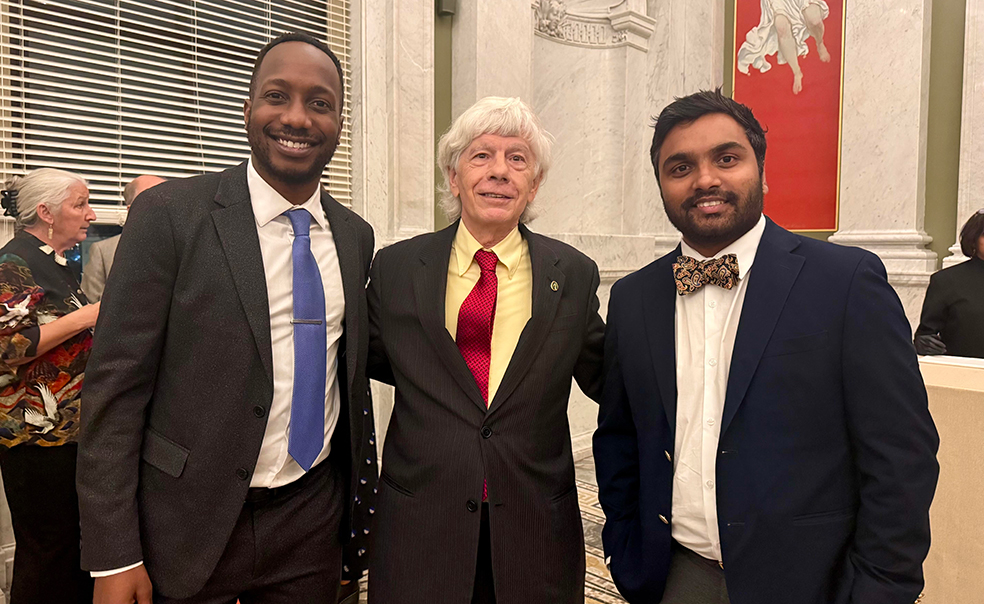
While undergraduates at Princeton, the two bonded over being the children of scientist immigrants. Nare’s parents were from Zimbabwe by way of Montreal, and Choudhary’s family hailed from Udaipur, India. “We are the beneficiaries of the U.S.’s investment in fundamental and basic sciences,” Nare says.
Nare went to Princeton to play soccer, but in his sophomore year he suffered a concussion during the first game of the NCAA Tournament, which set him in a different direction. He ended up taking a gap year before returning to major in art and archaeology, where he started experimenting with film and photography.
Meanwhile, Choudhary discovered a love of public engagement while singing with the Nassoons, and he honed his ability to break down complex topics in a seminar with physics professor Ned Wingreen, who had the class read and discuss published papers. Choudhary, a physics major, recalls that Wingreen would ask questions to check if the students really understood the topic, a formative experience in his own approach to scientific communication. Choudhary might not have been an expert in the subjects, “but I could figure out what questions to ask to become good enough to explain it to someone.”
Choudhary had grown up in Los Angeles, and when he went back to pursue his Ph.D. in physics at UCLA, he encouraged Nare to join him in the city, where Nare would be able to pursue his creative interests in entertainment. There Nare took jobs in production and started accumulating audio and video equipment, even building a podcast studio in his Van Nuys garage.
Nare and Choudhary tried several narrative formats before landing on the current structure of the podcast, in which Choudhary explains a recent scientific development to Nare, who serves as the audience stand-in. “The popular wisdom was dumb it down, make it short,” Nare says. “When everyone zigs, we zag. We’re like, let’s make it long, let’s make it technical.”
Nare says people with technical backgrounds are trying to keep up with the accelerating pace of developments in fast-moving technologies like AI. They want a science podcast that articulates developments in a sophisticated way. “If you don’t have ‘on-ramps’ helping people stay connected to what’s happening at the frontier, the information gap only widens,” he says. “That’s where you get conspiracies and all of this other kind of nonsense that gets weaponized within the culture war.”
Not everyone finds the “on-ramp,” but many, they’ve found, are happy to come along for the ride. Choudhary says his favorite comments on the podcast come from listeners who claim they didn’t really understand the scientific content but enjoy listening anyway. “We’re so excited about it, that they feel like they’re part of the conversation,” Choudhary says. “Getting any eyes on scientific literacy is always a good thing.”
The Latest
See all


Related News
Overhaul Will Shorten Orientation by Four Days, Move Outdoor Action to Fall Break
Starting next year, freshman orientation will be eight days instead of 12 and no longer include Outdoor Action and other small-group experiences
With Prominent Journalists and Hoagies, the ‘Prince’ Celebrates 150 Years
A gala at the New York Historical raised roughly $400,000 for the independent student newspaper

No responses yet