

In This Princeton Dance Course, Students Rave for Credit
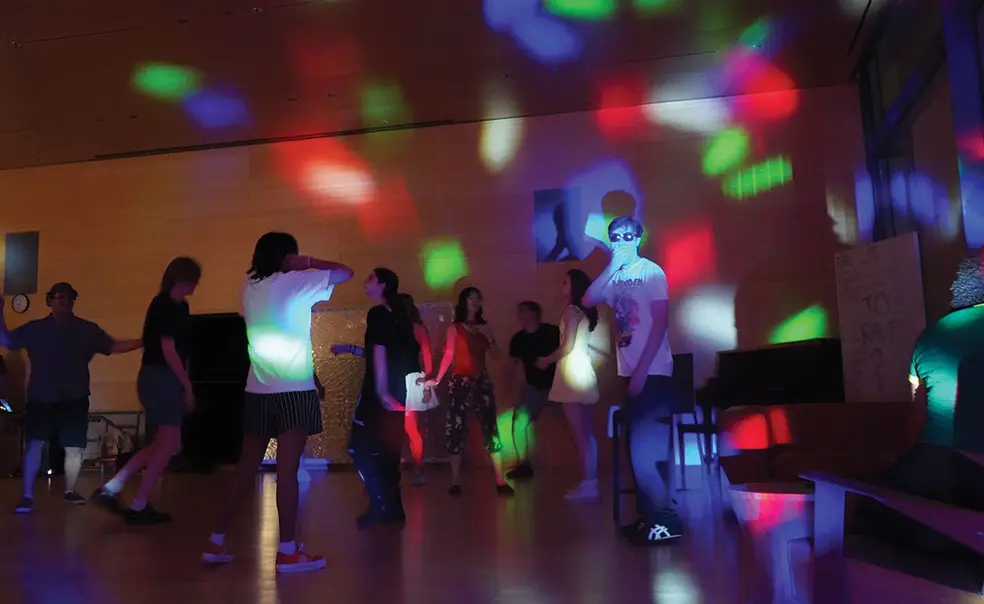

There’s probably only one place in Princeton, New Jersey, where students can rave on a Tuesday night, and it’s in the most unlikely of places: the classroom.
This spring, students in Raving: Encounters & Collisions in Night/Life, a course taught by Princeton arts fellow Niall Jones, spent their evenings exploring rave culture not simply as nightlife, but as an aesthetic, political, and social network in which they acted as cultural consumers, producers, and participants.
During the course’s final class in late April, students gathered in a studio in the Lewis Center for the Arts and were asked to set up the room together. While New York-based DJ Nia West arranged her equipment, students assembled lighting rigs, brought in couches and chairs, and prepared the space for dancing. One student contributed a lighting setup initially used for his senior thesis, which included different coloring and strobe light settings.
Before the music intensified, students and invited friends and guests were instructed to walk around the room, acknowledge one another, stretch, and situate themselves in the space. Then, slowly, the atmosphere shifted. The DJ’s mellow tracks ramped up into heavier beats, and the students were encouraged to dance. For another hour and a half, they let the rhythms move them.
Jones said the course emerged from his own love of nightlife and dancing.
“I thought it could be an interesting experiment to think about how people allow themselves to enter the idea of becoming a dancer,” he said.
Originally capped at 15 seats, the course had 70 people on the waitlist, and enrollment ultimately expanded to 35. Most students entered with little to no dance experience, according to Jones, but wanted to learn how to move more freely.
In raving, Jones said, the “objective is not to teach people a way to dance, but to invite people to kind of meet dancing on their terms, and to find their bodies, and I would come and sort of instigate with prompts, readings, DJs, sound, space, kind of ways to sort of physicalize ourselves.”
Jones emphasized that the class itself was not a rave, but rather a dance class that incorporated concepts, theories, ideas, and sounds associated with nightlife. Throughout the semester, students alternated between seminar-style discussions and studio sessions focused on movement and embodiment while also engaging with questions of race, sexuality, gender, and class disorder.
Many students entered the course carrying the pressures of Princeton, Jones said, particularly seniors balancing thesis work and plans for life after graduation.
“They would come into the class with so much weight. I would feel them so unavailable to movement,” he said. “So I’m like, ‘If you come in and you move, you did something.’”
The Latest
See all


Related News


Janice Lee ’09 Worked to Renovate One of Hollywood’s Best-Kept Secrets
An engineer by training, Lee has been deputy project manager on the renovation of Hollywood Burbank Airport

No responses yet