

Princeton Landscaping Goes Back to the Wild With Native Plants
The grounds of recent construction projects have a distinctly different look
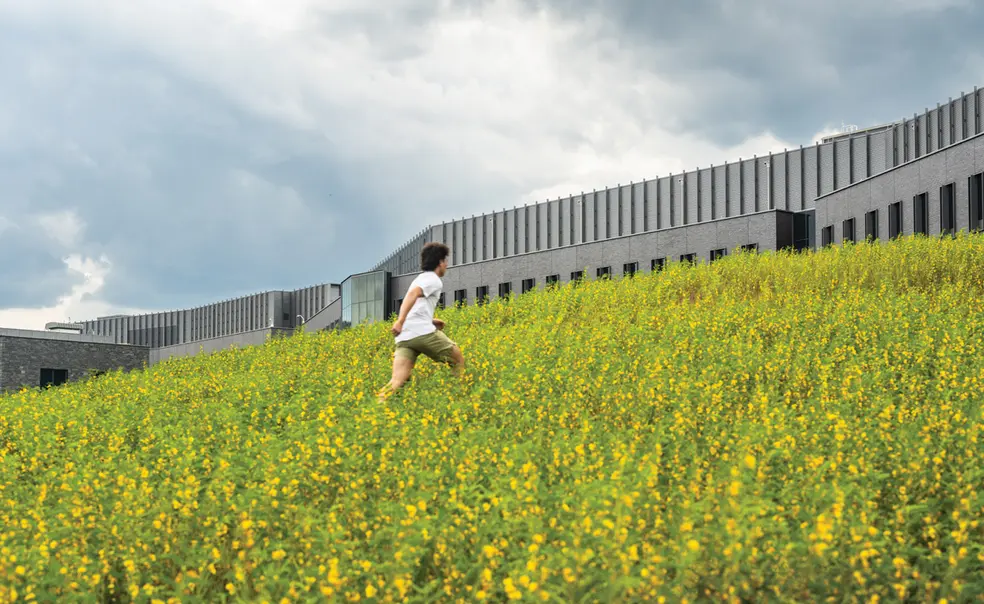

For decades, Princeton was defined by Collegiate Gothic architecture, manicured lawns, clean sightlines, and English ivy. With the raft of new buildings and the expansion of the campus across Lake Carnegie, however, the University has taken a different approach.
Gone are seasonal plantings and ornamental exotics. In their place are native perennials — grasses, shrubs, and trees — with a focus on stormwater management, biodiversity, and even reforestation that will take years (or decades) to prove out.
What started with localized experiments has morphed into large-scale projects accompanying major campus changes, including the opening of the Environmental Studies and School of Engineering and Applied Science complex, the Princeton University Art Museum, Yeh and Huo colleges, and the Meadows Neighborhood.
Landscapes designed by Field Operations of New York City and installed by Sean’s Landscaping of Hamilton, New Jersey, are vastly different than those established by landscape architect Beatrix Farrand more than a century ago.
Coneflowers and maple trees are nestled around Yeh College. Native grasses, coral bells, and hollies surround Briger Hall. Butterfly milkweed, black-eyed Susans, and honey locust trees dot the Meadows Neighborhood. But invasive plants — both nonnative species and noxious weeds — are already creeping in.
Giving land back to nature takes patience and the willingness to cooperate with an unruly environment.
“There’s an assumption that a sustainable landscape is less work, that it’s easier, but that’s not the case,” said Devin Livi, director of campus grounds. “One of our biggest challenges is educating people on the amount of work to keep the invasives out and weeding. It’s a lot, but we have an amazing group of people in campus grounds.”
While aesthetically interesting, the school’s fresh landscapes are designed to be more functional. For instance, native plants are highly skilled at absorbing stormwater. A composite metric known as the Princeton Index for Land-Use and Ecological Assessment (PILEA), built in 2015 to evaluate the wooded areas around Lake Carnegie, has been extended to measure impact for any natural area on campus. PILEA is overseen by the Office of Capital Projects, with campus departments and consultants collecting data on factors such as tree density, animal species, invasive plants, soundscape, and disturbance.
Princeton doesn’t disclose land management costs, but it has said that the increased expenditures were funded by the capital plan and restricted gifts exclusive to landscaping needs.
Working as researchers in the Office of Sustainability’s Campus as Lab program, civil and environmental engineering majors Elise Taylor ’27 and Wunnyuriti Ziblim ’28 have participated in the largest outstanding environmental project in the 2026 Campus Plan: the revitalization of the Elm Drive Woods.
Located south of Yeh and Huo, the parcel of land contains 300-year-old oaks that “haven’t had a chance to reproduce in decades,” according to Mike Van Clef, the project ecologist and stewardship director of Friends of Hopewell Valley Open Space. “It will be a small example of what central New Jersey forests used to be.”
The area was devoid of native shrubs and forbs — nonwoody, nongrassy flowering plants — due to the combination of deer and invasive plants that suffocated oak and other seedlings. Taylor and Ziblim recommended native plants for three different zones in the woods based on local availability and likelihood of success.
“I didn’t realize how much work goes into actually completely clearing an area of invasives, replanting it, and protecting it from deer,” said Taylor. “There is so much planning and thought that has to go into it … and it’s been nice to have been along for the whole process.”
In another Campus as Lab project, Ziblim got a chance to understand the challenges that the grounds team faces in coaxing life from neglected dirt. He collected soil samples from eight campus locations and sent them to a lab at Rutgers to understand nutrient levels, compaction, and toxins, helping to determine what plants could be supported and where soil amendments might be needed.
The flurry of forward-thinking landscaping at Princeton has a hint of playing catch-up. The National Wildlife Federation published Ecodemia in 1995 to focus on campus environmental stewardship as well as a 2015 progress report, “The Campus Wild.”
“Campuses have a diversity of green space,” said Kristy Jones, wildlife and nature director in the National Wildlife Federation’s Education and Engagement Department, and “maintenance is the biggest challenge,” including proper care when native plants are introduced, consistency in removing invasive species, and education for the staff and community. Success can also be measured by changes in biodiversity on campus.
“Just dropping in native plants is not a panacea unless connected to a commitment to nature — it is a whole different way of thinking and caring,” said Edwina von Gal, founder and president of the Perfect Earth Project and an early adherent for more ecologically friendly landscape design. “Meadows need help getting established ... what is wanted and what needs to be weeded out,” she said.
According to Princeton’s facilities and grounds team, a new sustainability plan is forthcoming. The campus jewel that is Prospect Garden is shifting to a four-season approach, but it won’t take on a full meadowed landscape like the vast expanse across Lake Carnegie, Livi said. As for that invasive (but managed) English ivy that scales Nassau Hall and other parts of the traditional campus, there are no plans to change.
The Latest
See all


Related News


Janice Lee ’09 Worked to Renovate One of Hollywood’s Best-Kept Secrets
An engineer by training, Lee has been deputy project manager on the renovation of Hollywood Burbank Airport


3 Responses
Steve Hiltner
3 Weeks AgoCollaborating With Nature
I particularly appreciate the quote from the campus grounds director about the amount of work needed to prevent native plantings from being overwhelmed by invasive species. On my PrincetonNatureNotes blog, I have written about the University’s past attempts to plant complex native plantings. A prairie planting around the neuroscience building lost out to mugwort, but the Betsey Stockton meadow next to the Firestone Library is hanging in there. Some of the new plantings near the soccer field have been weeded, others not.
Maintenance determines a planting’s fate. Maintenance crews need to know not only the intended plants but the many species of weeds as well. In that respect they must be even more knowledgeable than the designers, who are given higher status, recognition, and pay.
Having installed and tended native plantings at Herrontown Woods nature preserve in Princeton, I’ve found the key to success is timing the weeding before the weeds go to seed. The goal is to steadily shift the seedbank (the unsprouted seeds in the ground) from nonnative to native. Only then will native plantings become lower maintenance. In talking to one of the supervisors, I was concerned that the mulch being used might include weed seeds, which would make it impossible to progress towards lower maintenance. Perhaps the University could tap into the town’s copious quantities of woodchips. If there’s adequate budget, the University has great potential to eliminate the many invasive plants that afflict landscapes elsewhere, and demonstrate a successful collaboration with nature.
Mark Krosse ’72
1 Month AgoFarrand’s Lasting Design Influence
On the idea that these plantings “are vastly different than those established by landscape architect Beatrix Farrand more than a century ago”:
I think Beatrix Farrand was an innovator and pioneered many of the design elements now being implemented at scale at Princeton, the Lurie Garden, the High Line, and other venues more accessible to the public.
Jon Schwartz ’99
1 Month AgoKudos for Sustainability Work on Campus
Great article! I would love to see more articles on the University’s sustainability efforts. Sarah Boll and her team are doing awesome work in this area.