

Princeton Pre-read, 2026: ‘Reader, Come Home’
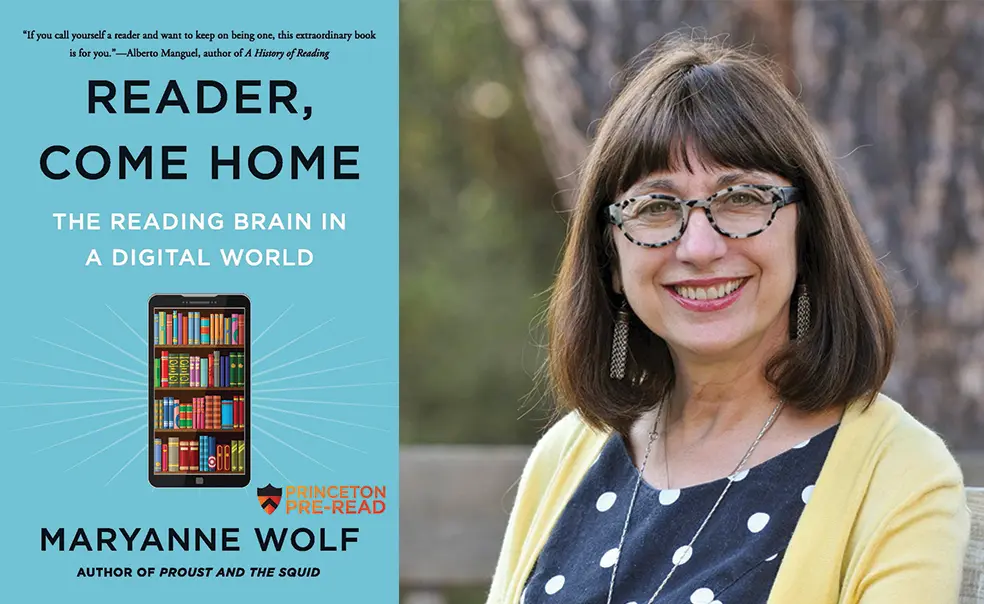

With every year’s Princeton Pre-read, I introduce incoming first-year students to the intellectual life of the University through the experience of reading and discussing a book together. The Class of 2030’s book is Maryanne Wolf’s Reader, Come Home: The Reading Brain in a Digital World. This is my foreword to the Pre-read edition, which the incoming class will receive this summer. I encourage all alumni to read along with us!
Dear Members of the GREAT Class of 2030,
Warm greetings from Princeton! My colleagues and I look forward to welcoming you to campus in August. Your talents, interests, and perspectives will add tremendously to this community, and I am confident that you in turn will develop and grow through the experiences, interactions, challenges, and opportunities that await you here.
I am delighted to share with you this copy of the Princeton Pre-read selection for 2026, Maryanne Wolf’s Reader, Come Home: The Reading Brain in a Digital World. The Pre-read is one of many traditions you will encounter at Princeton and is part of a series of activities that will introduce you to the scholarly and communal life of the university. I like to think of it as a scholarly counterpart to the Pre-rade, a joyous ceremony in which incoming undergraduates mark their arrival at Princeton by parading out from Opening Exercises.
I chose Reader, Come Home as this year’s Pre-read because it addresses a question of vital importance to every entering student: Why should we continue to read long, challenging books when artificial intelligence agents can quickly summarize them for us? Or, to take it down a notch, when we can plug into an audiobook at the gym?
Deep, immersive reading is at the heart of a Princeton education, but today, more than ever, that activity depends upon conscious and energetic commitment.
We are most likely to read books fully and well only if we understand why they offer us something distinctive, valuable, and irreplaceable.
Professor Wolf approaches this topic with perspectives drawn from literary studies, cognitive neuroscience, and developmental psycholinguistics. She is a leading expert on dyslexia, and her work on that subject has earned her awards and fellowships around the world. Professor Wolf thus exemplifies what scholars call “interdisciplinarity”: the capacity to combine insights from multiple academic fields to produce new understanding and knowledge. Interdisciplinarity is an important feature of academic research today and the Princeton curriculum that awaits you.
I like Reader, Come Home for another, very straightforward reason: The book is a pleasure to read. It is an epistolary book, organized as nine letters. Professor Wolf’s writing is clear, imaginative, humane, and occasionally whimsical. I first encountered her book several years ago, when it enthralled me over the course of a transatlantic flight. Reader, Come Home made a long journey seem short! I hope that you enjoy the book as much as I have—both on my first, midair reading and when I reread it this year.
Professor Wolf will take the stage during Orientation Week to talk with us about Reader, Come Home. Over the course of the fall semester, I will host Pre-read discussions in the residential colleges that will provide us with opportunities to talk about the book and the broader issues it raises. I anticipate that these conversations will range over many topics, but here are four you might consider as you read the book this summer:
1. Professor Wolf devotes Letter Three to “deep reading.” What does she mean by that concept? Is the experience of “deep reading” familiar to you? Do you agree with Professor Wolf’s account of its character and value?
2. In Letters Five through Eight, Professor Wolf examines how children learn to read in a digital world. What do you remember about how you developed into a skilled reader? What roles did print and digital sources play in that evolution? Did Reader, Come Home change how you thought about your education before Princeton and your development as a reader?
3. In Letter Nine, Professor Wolf talks about the three lives of a “good reader” (pp. 188-190). What does she mean by this idea? How does she describe the connections between reading, reflection, and contemplation? What kind of reading life do you want for yourself, at Princeton and afterward?
4. When describing the aims of a college education, Judith Shapiro, a former president of Barnard College, once said, “You want the inside of your head to be an interesting place to spend the rest of your life.” Does Professor Wolf’s book help you understand the meaning of President Shapiro’s statement? How does reading matter to well-being?
I look forward to examining these topics and others with you, and to welcoming you when you arrive on campus later this year. In the meantime, I hope that you enjoy Reader, Come Home, and I hope, too, that you have a wonderful and refreshing summer.
With very best wishes,
Christopher L. Eisgruber
Princeton, New Jersey
March 2026






No responses yet