

Prison Teaching Initiative Marks 20 Years Amid Funding Hurdles
As federal funding changes, PTI lost support from the National Science Foundation’s INCLUDES initiative


Nationwide, only a small fraction of incarcerated individuals have access to college-level education — in some estimates, as few as 6%. For the past 20 years, the Prison Teaching Initiative (PTI) has sought to expand that access, offering higher education courses and mentorship to incarcerated and formerly incarcerated students across New Jersey.
The anniversary comes as PTI navigates a changing federal funding landscape, including the loss of support tied to the National Science Foundation’s INCLUDES initiative, which aimed to increase participation and accessibility in STEM fields and was eliminated following federal actions cutting diversity, equity, and inclusion programs. INCLUDES funded STEM internship opportunities for students at PTI for nearly a decade.
The group initially hoped to expand and build new programs across the country; however, funding scarcities have brought that to a pause. “I think our approach right now is to do the things that are within our control,” said Brandon Kronstat, PTI’s associate director.
Chris Etienne, PTI’s student engagement coordinator, connected with Princeton initially through New Jersey’s prison education network. While enrolled at Rutgers through the NJ-STEP (Scholarship and Transformative Education in Prisons) program, he attended events held by Students for Prison Education, Abolition, and Reform, an advocacy group founded by Princeton undergraduates, and engaged with volunteers in the Petey Greene Program, a national tutoring network for incarcerated and formerly incarcerated people that was founded by Princeton alumnus Charlie Puttkammer ’58 and his wife, Cordie.
While working on Rikers Island, he learned that PTI was hiring someone to create the STEM internship program, a position funded by INCLUDES. He said that he initially didn’t think that he was ready to take on the role, but in the position, Etienne created a toolkit of what such internships should look like in post-secondary education. He’s worked with schools including Howard, Stanford, and Rutgers universities.
Despite current uncertainties, Etienne said the blueprint he created remains available. “I’m just hoping that we’ll be able to start allocating research funds to minoritized communities and to nontraditional students, so we could once again pick this initiative up, and continue to carry this work forward,” he said.
To co-founder Jenny Greene, a professor of astrophysics, it is uncertain what other sources of funding will look like in the future or if INCLUDES funding is gone forever. “It’s not completely clear how our funding profile will change from a Princeton perspective. I think that’s all, at least from our perspective, still in flux,” she said. She explained that the initiative has been trying to pivot to private sources of funding, but nothing’s come through yet. “We’re just doing everything we can think of,” she said.
Founded in 2005, PTI is now in five state prisons and has partnered with local colleges as part of NJ-STEP, a statewide collaboration launched in 2013. The association works with New Jersey’s Department of Corrections and the State Parole Board to provide courses to incarcerated students. Princeton, through PTI, provides faculty instructors.
“When we think about what our work is, it is expanding access to education … to students who have been historically left out of that conversation in many, many ways,” Kronstat said.
In addition to in-prison coursework, PTI has also brought formerly incarcerated students to Princeton’s campus for summer internships in the sciences and humanities. The initiative has partnered with the Federal Bureau of Prisons at Fort Dix and Mercer County Community College. Princeton’s Class of 1994, since its 25th reunion, has established a mentorship program with PTI, pairing incarcerated students with professionals in relevant fields and offering professional development workshops. In 2025, the University donated 52 laptops and other technology for use by PTI students in two New Jersey prisons.
Much of PTI’s early expansion was driven by astrophysics professor Jill Knapp, who was largely responsible for coordinating volunteers, schedules, grades, and university partnerships during the program’s formative years. Graduate students were also critical to building PTI, serving as volunteer instructors for courses in math, science, social sciences, and the humanities.
“I don’t think I anticipated how satisfying … or how kind of addictive a teaching experience it would be,” Greene said. She received the Presidential Award for Excellence in Science, Mathematics, and Engineering Mentoring from President Joe Biden in January 2025 for her work with PTI.
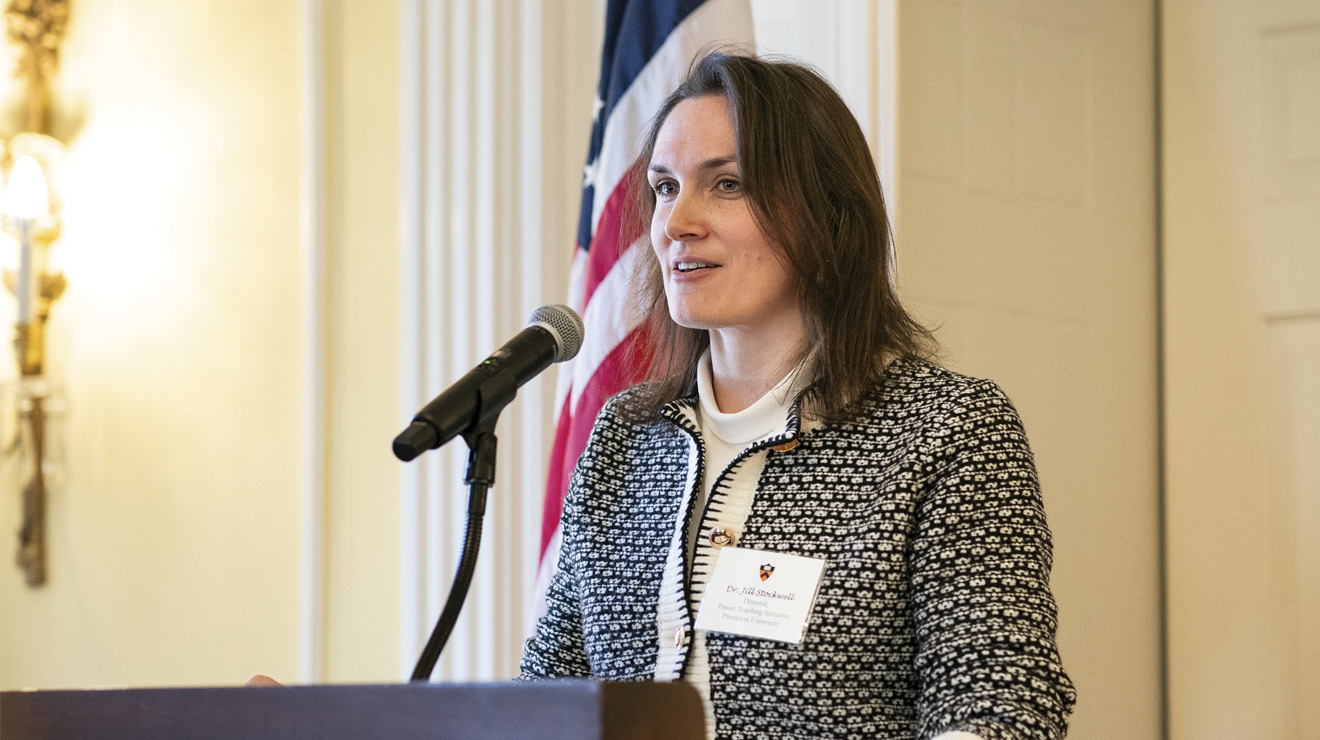
One early volunteer was Jill Stockwell *17, who began teaching with PTI while completing her Ph.D. in comparative literature. She later became a PTI postdoctoral fellow through the INCLUDES grant and served as PTI’s director from 2018 to 2025 after the program’s first director unexpectedly passed away.
During Stockwell’s tenure, PTI expanded its summer internship programs and mentorship initiatives. Some formerly incarcerated students who began in the NJ-STEP program and participated in PTI courses and internships have returned as mentors to support the next generation of students. Stockwell described this model as “recognizing the potential and incredible skills of students and empowering them to use them.”
To Greene and Stockwell, these programs transform both students and instructors. “I do think it’s changed people’s trajectories,” Greene said.
Marion Alberty is one of those people. She began volunteering with PTI in 2019 while a postdoctoral researcher in the atmospheric and oceanic sciences program. She realized PTI was an organization that she “would love to put myself into more and more” and joined the staff as the STEM instructional specialist when the position was instituted in 2023.
Dena Lane-Bonds, who joined PTI last year as an instructional specialist, said the program is “a huge testament to what’s possible in higher-education prison programming.”
Looking ahead, Greene said her long-term goal is for a Princeton degree to be offered through PTI. “Step zero is being able to offer Princeton credit,” she said.
The Latest
See all


Related News

With Prominent Journalists and Hoagies, the ‘Prince’ Celebrates 150 Years
A gala at the New York Historical raised roughly $400,000 for the independent student newspaper



1 Response
Lawrence Cheetham ’67
8 Months AgoFunding for Prison Teaching
Hoping the substantial Princeton endowment can supplant the loss of tax-payer funding via NSF. And why not use our own funds?