


My religion encompasses all religions. I believe in God, I believe in the universe. I believe you are god, I believe I am god; I believe the earth is god and the universe is god. We’re all god. — Ray Bradbury
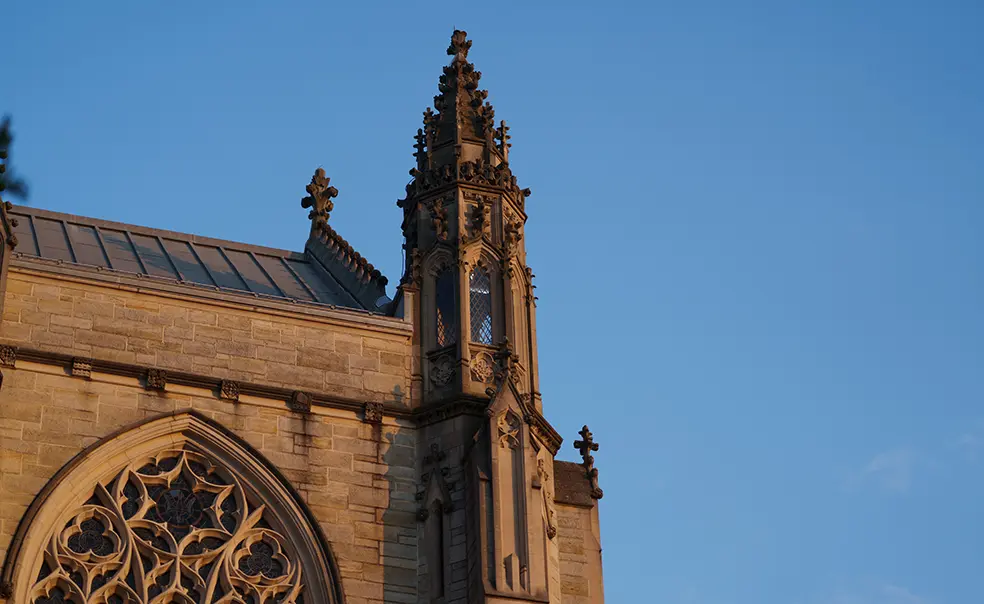
If there’s an image that comes to the mind of the Princetonian in February (despite some serious recollection of Mitch Henderson ’98’s and Steve Goodrich ’98’s spectacular men’s basketball team of 1998), it’s likely to be that of the Chapel on Alumni Day. There are two levels on which this image works; the first is the Service of Remembrance as explicit symbol of the unity and beauty of the University populace, with various professors, maintenance workers, and assistant coaches being recalled by returning family members and alumni with equal fervor. But the second is the Chapel itself, an immensely concrete combination of historic allusion and future aspiration, each a demonstration of the University as an aspirational whole far larger than the sum of its parts. Its original driving force, president John Grier Hibben 1882 *1893, wished it to be (paradoxically) “a house of ancient mystery” standing against the materialistic philosophy and drift of our age.
The soul searching behind this dream of the good Rev. Hibben certainly reflected the dogmatic ideas of both himself and his professor and inspiration, president James McCosh — whose bas-relief statue rules the Marquand transept of the Chapel. The design parallel to the windows of the creation and science, high above the west end of the nave, are enough on their own to eliminate all doubt. But they also reflect the accidental timing of the era in which this massive “anti-materialistic” project was undertaken: the Roaring Twenties.
The burning of the Marquand Chapel in 1920, following the cataclysm of World War I, coincided with a set of religious and behavioral questions entirely different from those which faced the community when it was built in 1882. We saw one aspect of this last time in the huge surge of individual creativity among those on campus, trying through personal expression to come to terms with the almost limitless evil exposed during the war. The aftermath also included the establishment of the annual Service of Remembrance itself, which precedes the Chapel by nine years; if the edifice seems as if it were constructed for the exercise, in many senses it was. There was great, if unfocused, restlessness among the students, who were seeking existential answers from elders who had botched the war so terribly, and who even then were in the midst of botching the ensuing peace.
As Alexander Hall stepped in to do emergency duty for Sunday services and many other gatherings, Hibben after 1920 took steps that only he could, to try an institutional approach to the perceived malaise. The president historically had run most of the Marquand Chapel services, with periodic special help from guests who varied little from the standard Presbyterian practices of the Chapel. The move to Alexander turned this approach on its head, with various guest preachers arriving in waves. This was not always successful — since students were required to attend chapel services, a boring guest could be quickly greeted by various crude indicators of displeasure/derision. As the underclassmen were banished to the huge balcony, their antics were hard to pinpoint, so various public apologies would appear regularly regarding this misbehavior. Whether these guest slots were unannounced tryouts for some new religious minister concept was anyone’s guess (except perhaps Hibben).
But of course inevitably there were successes, if only by chance. And with The Daily Princetonian keeping score and issuing periodic opinions on the imports, guest preacher analysis became something of a competitive sport. Quickly, one imported reverend seemed to strike a chord with the preponderance of students, and most critically the sophomores in the cheap seats. His name was Karl Reiland, and since 1915 he had been the Episcopal minister at St. George’s Church on Stuyvesant Square in New York City, a heartily liberal congregation. One of his earliest sermons there was based on John 8:32 — “You shall know the truth, and the truth shall make you free” — and was pointedly titled “An Invitation for the Thinking Man.”
“Unorthodox” was so commonly applied to Reiland it seemed part of his name, and his lively sermons were perfect for a captive college audience. Oh yes, he also opposed Prohibition, favoring beer and light wine, “as long as it’s not too light.” In 1926, as the huge new Chapel arose behind Pyne Library, Reiland decided to hang out on campus for a few days following one of his crowd-pleasing messages to the balcony, chatting with the young scholars and trying to come to grips with the same questions of malaise from a religious viewpoint that professor Alfred Noyes and others did from a poetic perspective. The Prince caught wind of this and felt it unusual enough — if not unprecedented — to devote some space to his findings. Clearly he felt college men were increasingly interested in “religion, but they are interested in its restatement in terms of modernism rather than in its repetition in terms of medievalism.” They also saw advances in the sciences as a clear indication that taking the Bible — or any fixed religious revelation — as literal gospel was ridiculous. So real religion and science could easily be compatible, in line with Hibben’s — and McCosh’s — stance. They saw unaddressed social ills — poverty, housing, unrest, bigotry — and asked why the church would not step in to alleviate them. They wanted to know why Christian sects engaged in petty competition instead of joining to advance the country. Why, they asked, did the church sanction war, instead of the World Court or the League of Nations? Why did the church have no grand strategy to achieve a moral world? They “did not ask the church to turn stones into bread,” said Reiland, “but they seem to suspect that the old orthodox bread has become as hard as rock, and when they ask for reality — for real bread — they do not want a stone offered to them as food for faith."
If this range of student sentiment sounds strikingly familiar to you, the Nimble Historian, and its denominational concerns not necessarily even limited to organized Christianity, you have certainly been paying attention over the last century. And the resulting logic of Hibben was — given the opportunity that had fallen in his lap — to create an edifice to begin addressing those concerns, not only in stone, but also in ministry. The new Chapel would come with its own resident shepherd, first titled the dean of religion, then — at the last minute, in a blaze of insight — the dean of the Chapel, to support the University in facing all the complex conundrums captured in the iconography of the Chapel itself.
So why not just appoint Reiland and be done with it? Certainly there were two major impediments. It was 1928, and his “Episcopal” label was a bit much for the Presbyterian hegemony to deal with, it having been only 150 years since the Revolution, when “we” won. The second, ironically, was Reiland’s own activism within his denomination: He felt, as an example, the Episcopal bishopric was “an interesting decoration — we must have someone around to say grace at banquets.” So the “plays nicely with superiors” question seemed valid.
In any case, there was a strong Presbyterian-friendly candidate willing to give the new position a shot, even in full view of Hibben — whose continued presence was not necessarily a plus. This was the Rev. Robert Russell Wicks, minister at a large Congregationalist church in Holyoke, Massachusetts, and tellingly, long the chaplain at Mount Holyoke College down the road in South Hadley. His abilities were organizational as well as philosophical, coming in with a definite plan of action ministry beyond his own services and sermons. He wanted a strong artistic involvement beyond the building itself, and so the Chapel Choir was born. He wanted to support the community activities the students found important, so the Student-Faculty Association (now the Student Volunteers Council) was formed in Murray-Dodge. He wanted a sort of loose board of visiting ministers who would return repeatedly and so become personally comfortable with the student body and the congregation. Needless to say, Reiland made the cut, to the delight of The Prince and his many fans. In 1934, he was back dumping on student apathy and calling for service to others, pointedly noting that good can fight evil, but not indifference. And in his last visit in 1937 — the year following his parish retirement — he praised the idealism of youth and excoriated those who cynically took advantage of it to lead young people into danger. Two years later, most of the world would again be at war.
By the time Wicks retired in 1947, this new version of the Chapel and religious ministry seemed to somehow have been in place forever; today, with the enhancement of many new chaplaincies and community service ideas, it essentially has been. The beliefs and philosophy of McCosh and Hibben remain, a continuing force on a nondenominational campus which still preaches humanism.
The Latest
See all


Related News
With Prominent Journalists and Hoagies, the ‘Prince’ Celebrates 150 Years
A gala at the New York Historical raised roughly $400,000 for the independent student newspaper


No responses yet