

On Catharsis: Do We Long for Art or Escape?

I took the road less traveled by, and that has made all the difference. — Robert Frost, The Road Not Taken, 1915
There are episodes that crop up in historical research — some quite important — that in retrospect seem to defy the logic structure that we bring to reexamining them today. Watch a few Dodgers’ series with Shohei Ohtani; now imagine a universe in which the Red Sox would sell Babe Ruth to the Yankees. Imagine Neville Chamberlain freely handing over many thousands of innocent people to their doom under a creature like Hitler, simultaneously declaring “peace for our time.” (Perhaps something to be recalled in Washington in our own day.) Imagine being able to forcefully espouse equality like Thomas Jefferson, while enslaving hundreds of fellow people. If you, the Savvy Historian, are beginning to feel we’re back in the land of situational ethics, you would be correct. And as you see from the above examples, many results of highly peculiar circumstances may have long-lasting impact on unlikely descendent players whose knowledge or understanding of the genesis may be little to none.
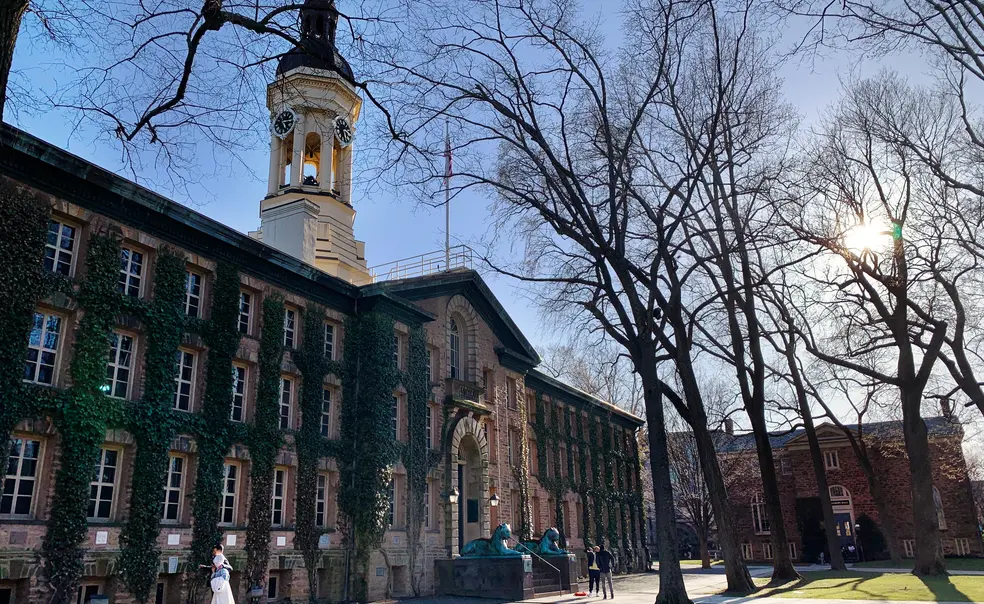
Until the institutional formalization in 2005 of the arts at Princeton via President Shirley Tilghman’s call for green-haired undergrads and the ensuing $101 million home for them thanks to Peter Lewis ’55, virtually every aspect of fine arts study and/or activities on campus could be categorized as happenstantial or (most charitably) by the label popularized by Professor Hubert Alyea 1928 which applies equally to scientific inquiry: “happy accidents.” The Nassau Lit in 1847, the Glee Club in 1874, the Princetonian in 1876, Tiger Magazine in 1890, and Triangle in 1891 were extracurricular outlets for student creativity that appeared primarily because of (widely separated, obviously) fixation by a very few students each, then somehow successfully handed to successive generations of fixees. The administration and faculty were mainly prominent by virtue of not closing down the various groups over obvious slights from the youthful writers; financial shoals were a constant threat to each, and indeed were the ruination of many short-lived creative groups whose names are now lost to history.
Almost from the day alumnus Woodrow Wilson 1879 took over the presidency of the newly dubbed University in 1902, this began to change. The 50 Preceptor Guys he hired to revolutionize the faculty landscape in 1905 included seven in the English department. Notably, that included 27-year-old Christian Gauss, who became godfather to the fine arts for decades, and 31-year-old Francis MacDonald 1896, who spent his 31-year career creating new ways for writing to be infused into the curriculum. The following year, 25-year-old Donald Clive Stuart was hired from the University of Paris. A playwright, in 1919 he became Princeton’s first formal dramatic arts teacher, and Triangle’s adviser. All these published authors were then joined serendipitously in 1914 by the popular British poet Alfred Noyes, whose American wife caused him to spend one semester a year in Princeton. It was into this artistic environment that such undergrads as Edmund Wilson 1916 and Scott Fitzgerald 1917 were plunged when they arrived on campus, but in the end that was only half the story.
Fitzgerald had been on campus one year when World War I broke out. This event had been regarded by a great many in Europe as almost inevitable, to the degree that a portion of Noyes’ reputation was based on a lengthy anti-war poem, The Wine Press. The war necessarily became top-of-mind for college students, far more so when the United States joined in 1917. Four percent of Fitzgerald’s “War Baby” class died in the conflict, other alums and families were ravaged by the Spanish flu, and by the time the campus came back to some semblance of normal order in the fall of 1919, a generation of Princetonians had been deeply scarred. Throw into this atmosphere the wild card of the publication of Fitzgerald’s This Side of Paradise in 1920, and the happenstantial environment for creative expression was about as forceful as it ever could be, even had it been on purpose.
Noyes was the first to document this beyond the classroom, taking advantage of the convenience of the University Press to publish A Book of Princeton Verse in 1916, with poems by 25 undergrads and recent alums, including MacDonald and Edmund Wilson. In the introduction, he consciously tied it to recent books of Oxford poetry, and so to the war generation then under siege across the globe. The following year, the students created the Freneau Club, named for Phillip Freneau 1771, the poet of the Revolution, and thus America’s founding poet, as it were. They met monthly, inviting established poets to read their works and stand for questions from the members. They began with Robert Frost, then 42 years old, already established as the voice of New England, and continued on with such writers as Maxwell Struthers Burt 1904, who served a similar function in Wyoming. They get points for inviting Amy Lowell in an age when women were still treated shabbily in academia, socialist Louis Untermeyer, and M’Cready Sykes 1894 (who doubled as a New York lawyer). Nicholas Vachel Lindsey and Siegfried Sassoon found their way to Princeton, with Sassoon reading selections from Thomas Hardy as well, his choice for greatest living English language poet. On his visit, Sinclair Lewis opined that the best preparation for a fiction writer was to work as a newspaper reporter.
In the fall of 1921, students (including a number from the Freneau Club) formed the Tuesday Evening Club: Once a week, the members would gather for a private reading of poetry, essays, and short stories, then retreat to polish their work and often return to try again. There were briefly even copycat groups with slightly different foci, going under names such as the Coffee Club and the Fromage Club. This highly popular approach resulted in two published Tuesday Evening Club volumes of student literary work, beyond the pages of The Nassau Lit, which was in one of its golden ages, publishing student compositions eight times a year.
Meanwhile, the undergrads who were theater fixated burst the bounds of Triangle and in 1919 founded Theater Intime, whose primary purpose was to give performing opportunities for student writing and theatrical production, beyond the musical bounds of Triangle. Begun in a dorm room, it took over the Murray Theater in 1921 and never looked back.
In 1922, a new broad extracurricular approach to the arts was spearheaded by Gauss and classics professor Duane Reed Stuart, yet another of the Preceptor Guys. They formed the Fine Arts Club, intending to construct gatherings covering all forms of the fine arts, and in a stroke of true creativity to join with a parallel group at Harvard to effectively split the effort required to run the groups. This approach offered to attract the members of the Freneau and Tuesday Evening Clubs without the bother of external logistics. So essentially, they were subsumed into the new departmental-advised group for joint activities and programs.
With the trauma of the war receding into the background of history and the inevitable displacement of one college generation (i.e. four years) by another, the forces compelling interest from the students were dispersed elsewhere — these were also the days of the 1922 football Team of Destiny and the enactment of the Four-Course Plan and the advent of the senior thesis in 1924, for example — and the compulsion to spill one’s soul on paper clearly receded. After multiple reoutfittings, the Fine Arts Club narrowed by 1926 into an annual get-together of Harvard and Princeton fine arts faculty and graduate students, plus summer activities for a very few members, without undergraduate involvement.
By 1929, increasing complaints of quality had reached The Nassau Lit. Rather than let them slide, the editorial board, headed by Intime and Triangle author Erik Barnouw 1929, in the March edition posted in response perhaps the most savvy reflection on creativity ever seen on the campus. It cited the war trauma and tumult of 10 years prior — what it termed “Philistinism” — as a virtually required ingredient for the outburst of creative output we’ve noted above. It cited the books of poetry and newly born Intime plays as cathartic personal antidotes to that ferment. But those personal outlets seemed to have subsequently faded along with the global terror that gave rise to them. For example, Intime from 1920-22 had 40 plays submitted from 15 authors; from 1925-29 it received six plays from four authors (including Barnouw, intriguingly) and was filling in with stock plays. As the behavioral desperation receded, the board felt its antidote of urgency was fading with it, and the two were fated to live or die together. The Freneaus and Tuesday Eventides and the Fromagees had vanished; Noyes’ wife had died and he was back at Oxford. Many potential submissions to the Lit had gone with them. Indeed, the magazine itself in the next five years would shrink from eight issues to six to four.
I’m still not really certain that, despite some powerful logic and various examples of this across the years, the motivation of creativity can be primarily put down to a human need to counteract or avoid misery. But I do need to look again at All the President’s Men, at Benjamin Britten’s War Requiem, at Apocalypse Now, at Noyes’ Princeton 1917, at Graham Greene’s The Third Man, and try to honestly understand how they are important, and consider how they might be driven by dire necessities. Recall what Harry Lime said about the cuckoo clock.
The Latest
See all


Related News
With Prominent Journalists and Hoagies, the ‘Prince’ Celebrates 150 Years
A gala at the New York Historical raised roughly $400,000 for the independent student newspaper


No responses yet